



DAPA to lay groundwork for nuclear submarine program in second half of year
Aug 06, 2026, 09:30 am


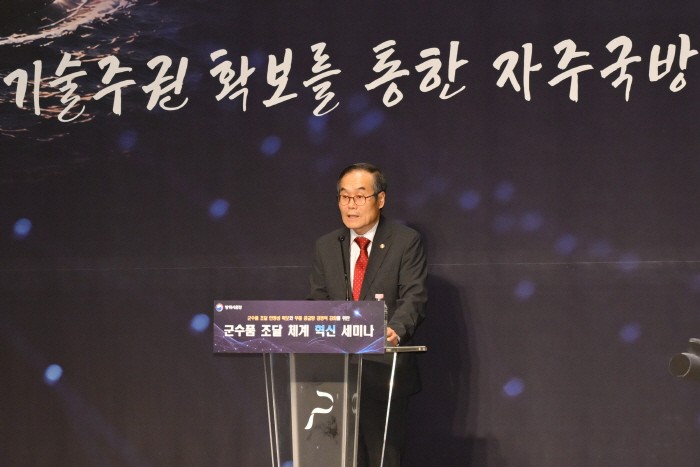 |
| Lee Yong-cheol, head of the Defense Acquisition Program Administration (DAPA), delivers opening remarks at a seminar on innovating the military procurement system at the Plaza Hotel in Seoul on the 31st. / Yonhap |
The Defense Acquisition Program Administration (DAPA) announced its core initiatives for the second half of the year on the 5th, including laying the groundwork to advance the nuclear-powered submarine program.
DAPA gave its 2026 second-half presidential policy briefing that day under the theme "Nation and Peace, an Irreplaceable Korea That Makes the Public Proud."
First, DAPA plans to secure core capabilities for national self-defense. It will secure forces, AI, and manned-unmanned systems needed for the transfer of wartime operational control (OPCON) in a timely manner, and lay the groundwork for the nuclear-powered submarine program. Drawing on the organization and expertise built through Korea's indigenous submarine development, DAPA plans to establish a project plan for the nuclear submarine program within the year and field the "three-axis" defense system on schedule.
The agency also pledged to overhaul its system for acquiring advanced weapons. It will move quickly to enact a "National Defense Advanced Capability Acquisition Act" to establish a specialized acquisition system for advanced capabilities, and activate rapid pilot projects to quickly apply new technologies highlighted in modern warfare to defense. It also plans to manage public vessel orders through a cross-government consultative body, pursue integrated procurement of naval and coast guard vessels, and expand the application of defense R&D outcomes to disaster response areas such as wildfire suppression and search and rescue.
DAPA also aims to lower barriers to entry for small and medium-sized enterprises (SMEs) and venture firms in the defense industry, encouraging participation from innovative SMEs and young talent. It will support the full lifecycle of companies through the K-Defense Startup Support Program, expand youth employment and encourage entrepreneurship through the Defense Industry Youth New Deal policy, and support entry into global defense supply chains through the K-Defense Export Fund.
The agency will implement, for the first time, a defense industry-specific "shared growth" evaluation, offering benefits related to offset trade and interest subsidies to companies that excel in collaborative partnerships, and will move forward with a shared-growth localization program for parts development, in which the government and prime contractors jointly fund development. It also plans to preemptively respond to supply chain risks by building a weapons system supply chain database and operating an early-warning system, and to develop anti-tampering technology to prevent the theft of advanced technology, which will be made mandatory for weapons systems intended for export.
DAPA will also operate a cross-government export support system under its leadership to identify export and industrial cooperation opportunities and establish country-specific export strategies. It plans to expand its integrated Korea pavilion operations at overseas defense exhibitions and modification/development projects for export-oriented weapons systems.
With the U.S., DAPA will strengthen cooperation on entering the shipbuilding market and on maintenance, repair, and overhaul (MRO), while also stepping up export efforts targeting Southeast Asia and South America.
DAPA will improve institutional systems to ensure fair and transparent bidding in defense procurement, and conduct safety inspections across all facilities handling military explosives. It will also work to strengthen defense industry safety management, including preparing measures to prevent recurrence of safety incidents.
DAPA Administrator Lee Yong-cheol said, "We will shift the paradigm for acquiring advanced capabilities and build a defense industry ecosystem centered on shared growth and safety, leaping forward as an irreplaceable K-defense industry," adding, "We will make this year the founding year in which Korea's defense industry is reshaped with a future-oriented character."
Lee Han-sol
Most Read
-
1
Celltrion’s Omlyclo gains ground in major European..

-
2
Trump demands rates fall below 1% as Fed hikes for..

-
3
Hyundai Motor Group breaks ground on integrated st..

-
4
U.S. strikes 3 Iranian oil tankers, Iran vows reta..

-
5
Trump makes $1 trillion bet ahead of midterm elect..

-
6
Iran resumes ballistic missile production, assembl..

-
7
Samsung Electronics, Mistral AI to jointly develop..

PEOPLE







-
Address : In-Young Bldg., 34, Uisadang-daero 1-gil, Yeongdeungpo-gu, Seoul
Copyright by ASIATODAY CO., LTD. All rights resereved