



Foreign, unification ministries eye UN General Assembly, APEC in China to reopen inter-Korean talks
Aug 06, 2026, 09:29 am


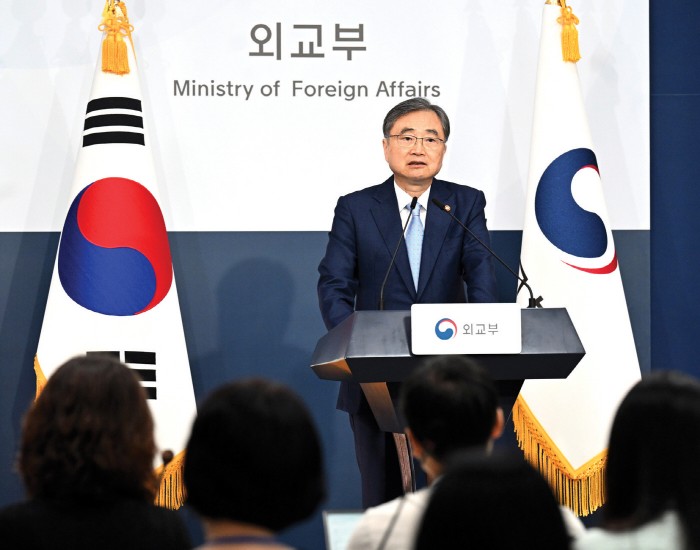 |
| Foreign Minister Cho Hyun gives a briefing on the Ministry of Foreign Affairs' policy report at the ministry's briefing room in the Government Complex Seoul on the 5th. / Park Sung-il, Staff Photographer |
The Ministry of Foreign Affairs and the Ministry of Unification have presented their agenda for the second half of the year, aiming to use the September UN General Assembly and the November Asia-Pacific Economic Cooperation (APEC) summit in Shenzhen, China as opportunities to lay the groundwork for peaceful coexistence on the Korean Peninsula.
At a briefing to President Lee Jae-myung on the 5th, Foreign Minister Cho Hyun said, "We will explore engagement with North Korea using various opportunities, including the UN General Assembly," adding, "Under close coordination with the U.S., we will continue efforts to create conditions for resuming dialogue with North Korea, and work to advance phased denuclearization discussions, starting with a 'freeze.'"
However, Minister Cho said at a briefing immediately after the report that it remains uncertain whether there will be an opportunity for direct contact with North Korea at the UN General Assembly, noting that based on North Korea's stance so far, it may avoid such an opportunity, but that the government is nonetheless trying to find some way to break the current deadlock.
Unification Minister Chung Dong-young also stressed that Korea should concentrate all its capabilities through the November APEC summit in Shenzhen to create a decisive turning point toward peaceful coexistence, adding that the government needs to present a development vision in the August 15 Liberation Day address and actively deploy peace envoys to fully activate a "peacemaker and pacemaker plus" approach.
For the second half of the year, the Ministry of Unification proposed measures to ease military tensions, including mutual use of both Koreas' official state names, beginning restoration of the September 19 military agreement, and peaceful use of the Demilitarized Zone (DMZ). It also said it would support efforts toward a U.S.-North Korea summit and pursue a four-party peace declaration involving South and North Korea, the U.S., and China.
The ministry also plans to pursue practical inter-Korean cooperation projects, including peace tourism at Wonsan-Kalma, a Seoul-Beijing high-speed rail line, and cooperation linked to the Greater Tumen Initiative. However, the Foreign Ministry reportedly assessed some of the Unification Ministry's proposals as lacking feasibility.
Minister Chung said the enforcement decree of the Inter-Korean Cooperation Fund Act needs to be revised to help resume inter-Korean relations, and asked for President Lee's attention to the matter. The aim is to expand the scope of fund support, which is currently limited to direct inter-Korean exchange and cooperation projects.
According to the Unification Ministry, the fund's execution rate has remained at just 2-3% over the past decade. The ministry envisions broadening the fund's scope to support the creation of peace economic zones in border areas, revitalizing civilian unification movements, and restoring the research ecosystem for North Korean studies.
The Foreign Ministry said it would strengthen the strategic nuclear partnership between Korea and the U.S. to help create the conditions for building nuclear-powered submarines and securing authority for uranium enrichment and spent nuclear fuel reprocessing. It also plans to strengthen cooperation with the Group of Seven (G7), NATO, and countries in Latin America and ASEAN.
On Korea-U.S. relations, the ministry said it would develop the Korea-U.S. alliance in a future-oriented direction through cooperation in strategic fields, and closely coordinate on economic and trade issues to produce mutually beneficial outcomes. Regarding supply chain risks triggered by the war in the Middle East, it said it has pursued cooperation with Japan on crude oil supply and stockpiling and cooperation with India on naphtha. It also said that through the president's recent trip to South America, Korea worked to expand supply chains for critical minerals such as rare earths, lithium, and nickel, and to diversify crude oil supply sources with Argentina.
Mok Yong-jae
Most Read
-
1
Celltrion’s Omlyclo gains ground in major European..

-
2
Trump demands rates fall below 1% as Fed hikes for..

-
3
Hyundai Motor Group breaks ground on integrated st..

-
4
U.S. strikes 3 Iranian oil tankers, Iran vows reta..

-
5
Trump makes $1 trillion bet ahead of midterm elect..

-
6
Iran resumes ballistic missile production, assembl..

-
7
Samsung Electronics, Mistral AI to jointly develop..

PEOPLE






-
Address : In-Young Bldg., 34, Uisadang-daero 1-gil, Yeongdeungpo-gu, Seoul
Copyright by ASIATODAY CO., LTD. All rights resereved