



Sergeant pay to hit W40mn — military aims for mid-sized firm level
Aug 06, 2026, 09:17 am


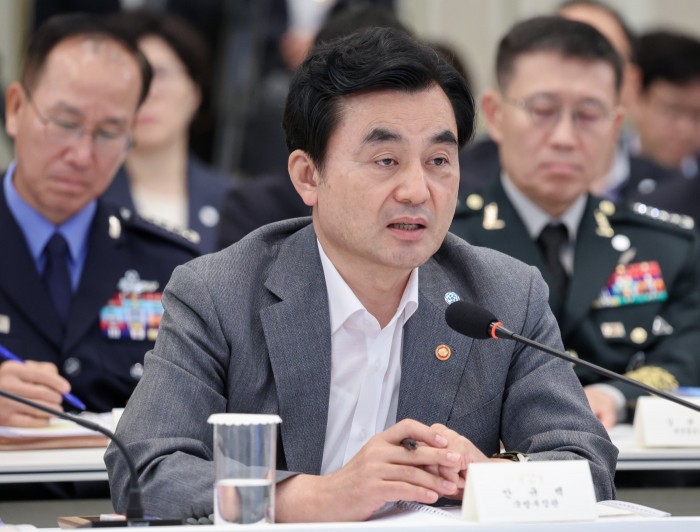 |
| Defense Minister Ahn Gyu-baek reports at a briefing session presided over by President Lee Jae-myung, held at the state guest house of the presidential office on the 5th. / Yonhap |
The Ministry of National Defense will raise the annual pay for a first-year staff sergeant to around 40 million won, and gradually increase pay for mid-level noncommissioned officers, with master sergeants reaching 72 million won.
The ministry reported these plans to improve compensation for military officers and NCOs at a briefing session presided over by President Lee Jae-myung, held at the state guest house of the presidential office on the 5th.
By 2029, annual pay will rise to 40 million won for staff sergeants and second lieutenants, 50 million won for sergeants first class, 55 million won for captains, and 72 million won for master sergeants. The goal is to provide compensation befitting service members' sacrifices, benchmarked against employees at mid-sized companies with similar roles and experience.
A Defense Ministry official explained that the pay levels were designed with reference to comparable positions and years of service at mid-sized companies. If the policy proceeds as planned, the average annual pay increase is estimated at around 6.6%. As of 2027, combined personnel costs for officers and noncommissioned officers are expected to total about 12.4 trillion won.
The ministry also plans to introduce a "leap savings" account for career service members, raise duty pay, and reduce the number of duty officer positions. Compensation for fulfilling mandatory military service will also be strengthened, including raising reservist training pay to 330,000 won.
Military housing policy will also be revised. The ministry plans to build large-scale housing complexes of 1,000 or more units in hub areas with good living conditions, while expanding customized housing support through the use of private housing. It also plans to support recruits' self-development through reading coaching programs, book support, and improvements to barracks libraries.
The ministry is also pursuing a restructuring of the military to respond to the shrinking pool of conscription-age youth. It plans to strengthen AI-based drone and counter-drone systems as well as space, cyber, and electromagnetic capabilities, and to raise reserve forces to a level closer to that of standing units. It also plans to reduce the number of active-duty soldiers while increasing the number of technically skilled noncommissioned officers, shifting toward an officer- and NCO-centered structure, and expanding the use of standing reserve forces and civilian resources. The restructuring will proceed in three phases through 2040, with the first phase — involving some adjustment to troop levels — set to begin by 2030.
Lee Han-sol
Most Read
-
1
Celltrion’s Omlyclo gains ground in major European..

-
2
Trump demands rates fall below 1% as Fed hikes for..

-
3
Hyundai Motor Group breaks ground on integrated st..

-
4
U.S. strikes 3 Iranian oil tankers, Iran vows reta..

-
5
Trump makes $1 trillion bet ahead of midterm elect..

-
6
Iran resumes ballistic missile production, assembl..

-
7
Samsung Electronics, Mistral AI to jointly develop..

PEOPLE







-
Address : In-Young Bldg., 34, Uisadang-daero 1-gil, Yeongdeungpo-gu, Seoul
Copyright by ASIATODAY CO., LTD. All rights resereved