



61% of youth with migration backgrounds want to settle in Korea, but support remains 'blind spot'
Aug 05, 2026, 09:43 am


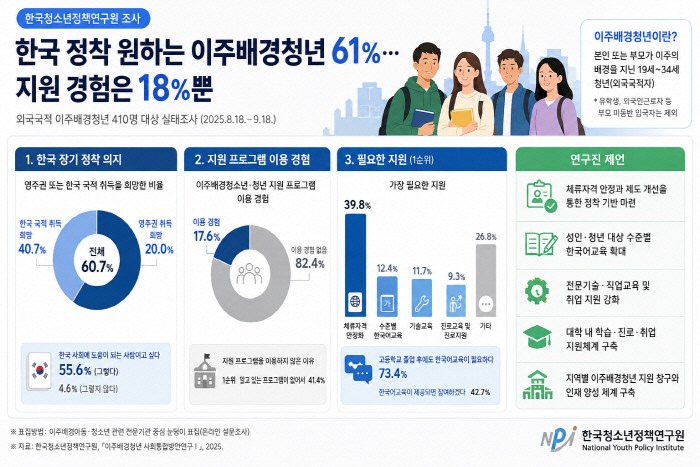 |
| Six in 10 foreign-national youth with migration backgrounds who grew up in Korea hope to settle here long-term, but fewer than 2 in 10 have used related support programs. / Image generated with ChatGPT |
A survey found that 6 in 10 foreign-national youth with migration backgrounds who grew up in Korea hope to obtain permanent residency or Korean citizenship and settle here long-term, while fewer than 2 in 10 have used related support programs, highlighting a policy gap that needs to be filled once these youth enter early adulthood.
The National Youth Policy Institute announced the results of its "Study on Social Integration Measures for Youth with Migration Backgrounds I" on the 4th. The institute surveyed 410 foreign-national youth aged 19-34 with migration backgrounds who grew up in Korea, conducting the study from August to September of last year.
The survey found that 40.7% of respondents ultimately hoped to acquire Korean citizenship, while 20.0% wanted permanent residency — bringing the total share expressing a desire for long-term settlement in Korea to 60.7%.
Willingness to contribute to Korean society was also high. Asked whether they wanted to become someone who benefits Korean society, 55.6% said yes, while only 4.6% said no.
Despite this desire to settle, few had received policy support. A total of 82.4% said they had never used a support program for youth with migration backgrounds. Among those who had not used such programs, the most commonly cited need was stabilizing their residency status, at 39.8%, followed by level-based Korean language education (12.4%), technical education (11.7%), and career education and support (9.3%).
73.4% said they still needed Korean language education even after graduating high school, and 42.7% said they would participate if such education were offered. The older respondents were when they entered Korea, the more highly they rated the importance of Korean language ability for adapting to Korean society.
The researchers recommended stabilizing residency status, expanding Korean language education for adults, and strengthening technical and vocational education as well as university-based learning, career, and job support systems. They also proposed establishing regional support windows and talent development systems for youth with migration backgrounds.
Yang Kye-min, a senior research fellow at the National Youth Policy Institute, said, "Children and adolescents with migration backgrounds are growing up and entering young adulthood, but policy support still remains focused on the childhood and adolescent stages," adding, "A youth support system spanning residency, education, and employment needs to be established so these young people can settle stably and become self-sufficient in Korean society."
Kim Nam-hyung
Most Read
-
1
Celltrion’s Omlyclo gains ground in major European..

-
2
Trump demands rates fall below 1% as Fed hikes for..

-
3
Trump makes $1 trillion bet ahead of midterm elect..

-
4
Iran resumes ballistic missile production, assembl..

-
5
Samsung Electronics, Mistral AI to jointly develop..

-
6
Trump warns countries not helping U.S. must pay re..

-
7
Seoul faces triple squeeze over troop deployment t..

PEOPLE







-
Address : In-Young Bldg., 34, Uisadang-daero 1-gil, Yeongdeungpo-gu, Seoul
Copyright by ASIATODAY CO., LTD. All rights resereved