



AI data centers emerge as war targets — 5 hit in Middle East
Aug 04, 2026, 04:41 pm


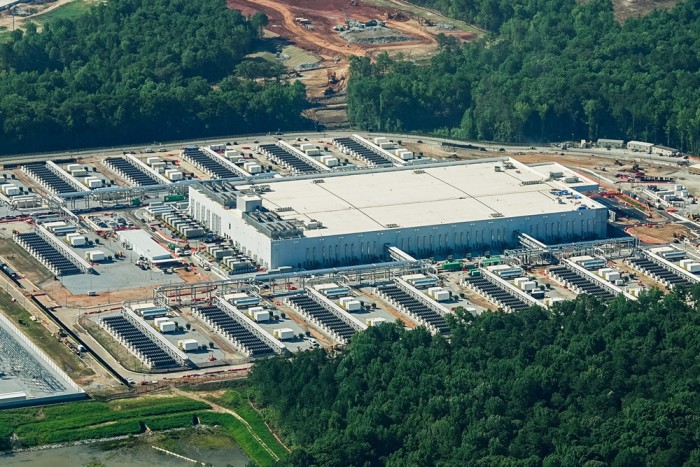 |
| An overview of a data center complex operated by developer QTS in Fayetteville, Georgia, U.S., on the 17th of last month (local time). / Reuters-Yonhap |
As Iran opts to counter its military disadvantage against the U.S. with economic strikes, data centers underpinning the global AI industry are emerging as a new target in various countries around the world.
According to CNN on the 3rd (local time), the U.S. and Iran have struck at least five data centers in the Gulf region since the war began this year.
This includes Iran's second missile attack on an Amazon data center in Bahrain on the 21st of last month.
Following that strike, the Iranian regime claimed on Telegram that it had targeted the facility again because Amazon provides cloud services to U.S. military intelligence operations.
Amazon Web Services (AWS), Amazon's cloud division, listed a service outage in the region on its status page following the first attack on April 30, and satellite imagery also showed extensive damage to AWS facilities.
Iran has stated from the early stages of the war that it considers data centers legitimate military targets.
At the time, Iran's Islamic Revolutionary Guard Corps (IRGC) released a list of 29 tech facilities owned by companies including Amazon, Google, Microsoft, Nvidia, and Palantir as targets.
Data centers in the Middle East are important assets not just for U.S. military and AI operations, but for the countries of the region themselves. Gulf states are aiming to become a "third global AI hub" after the U.S. and China.
Saudi Arabia is investing a significant portion of its $1 trillion (about 1,420 trillion won) sovereign wealth fund into AI.
The United Arab Emirates (UAE) signed a $500 billion (about 710 trillion won) agreement with the Trump administration last year to build the "Stargate" AI data center project.
This is the largest AI data center project currently underway outside the U.S., involving companies such as OpenAI, Oracle, Nvidia, and Cisco.
Six Gulf countries — Bahrain, Kuwait, Oman, Qatar, Saudi Arabia, and the UAE — have pledged more than $2 trillion (about 2,840 trillion won) in combined AI-related investment with the U.S., in exchange for moving away from Chinese AI technology.
Helima Croft, global head of strategy at investment bank RBC Capital Markets, said such attacks and threats could undermine confidence in a region that has the potential to become a key hub for AI innovation and investment, adding that they also reveal what role these companies play in war and diplomacy, and how far the U.S. might go to protect them.
Kim Hyun-min
Most Read
-
1
Celltrion’s Omlyclo gains ground in major European..

-
2
Trump demands rates fall below 1% as Fed hikes for..

-
3
Trump makes $1 trillion bet ahead of midterm elect..

-
4
Iran resumes ballistic missile production, assembl..

-
5
Samsung Electronics, Mistral AI to jointly develop..

-
6
Trump warns countries not helping U.S. must pay re..

-
7
Apple launches first foldable, 1 million won prici..

PEOPLE






HEADLINE NEWS
- Trump to roll out ‘unprecedented welcome’ for Xi with B-2 bombers, F-22 fighters
- S. Korea, U.S., and Japan form united front on Taiwan and economic coercion..
- Trump administration moves to impose sweeping sanctions on International Cr..
- Xi to make state visit to U.S. Sept. 23-25, dispelling rumors over his heal..

-
Address : In-Young Bldg., 34, Uisadang-daero 1-gil, Yeongdeungpo-gu, Seoul
Copyright by ASIATODAY CO., LTD. All rights resereved