



Navy conducts combat trial for AI-based mine warfare drones
Aug 03, 2026, 09:03 am


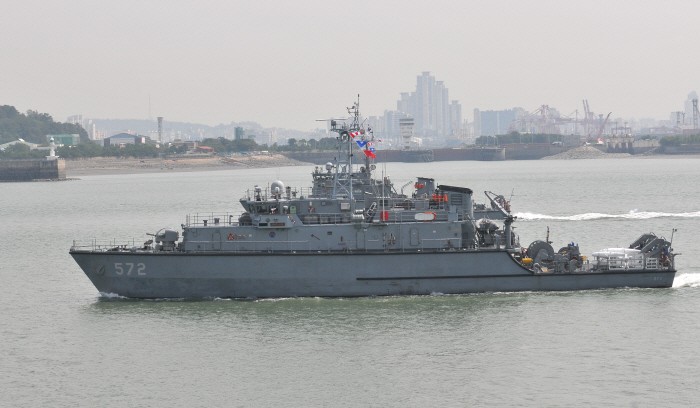 |
| ROK Navy minesweeper Ongjin (MSH-572). / ROK Navy |
The Navy conducted a combat trial of an AI-based mine warfare unmanned system on the 3rd, jointly with Hanwha Systems at Busan Naval Base.
For the trial, the Navy deployed the minesweeper Ongjin (MSH, 730-ton class), surveillance and reconnaissance drones, two Hanwha Systems unmanned surface vehicles (USVs), and one autonomous underwater vehicle (AUV) for mine detection.
Mines are underwater weapons laid to blockade harbors or cut off sea lanes. Depending on the detonation mechanism, they include contact mines, influence mines that detonate upon detecting a ship's magnetic field or acoustic signature, and combination mines that use two or more of these methods. By placement, they can be moored or bottom mines. When intelligence indicates mines have been detected or laid, navigation may be restricted, and clearing underwater mines requires significant time and resources.
The combat trial proceeded in the following order: mission planning using a large language model (LLM)-based AI-assisted mine warfare mission system; mine detection through integrated operations involving the Ongjin, USVs, and AUV; a demonstration of target analysis by the AI-based Automatic Mine Detection System (AMDS); and mine clearance through the Ongjin's autonomous control of the USVs.
The exercise began with the dissemination of a simulated scenario in which Busan Port had been blockaded by enemy mines. The LLM-based AI-assisted mine warfare mission system analyzed weather and ocean currents to draw up a mission plan for mine detection and clearance using the minesweeper and unmanned mine-clearance vessels, then reported it to the human commander aboard the Ongjin. Once the commander approved the plan, it was transmitted to the manned and unmanned mine-clearance assets.
The minesweeper Ongjin and the unmanned mine-clearance vessels divided the search area by zone to detect simulated mines, while surveillance and reconnaissance drones took off to assess the operational environment within the harbor. The unmanned mine-clearance vessels used their onboard AUVs to locate the mines. AMDS analyzed the target data gathered by the AUV and reported to the commander that the objects were enemy-laid mines.
The Ongjin moved to a safe zone in preparation for a potential mine detonation and commanded the formation of unmanned mine-clearance vessels as the control ship. The unmanned vessels then carried out a simulated procedure to remove the mines using their mine-clearance equipment, concluding the day's combat trial.
Lt. Cmdr. Lee Kwang-hoon, head of the Unmanned Systems Operations Innovation Division at Republic of Korea Fleet Command, who prepared the trial, said, "Through this trial, we confirmed that the concept of mine warfare in which AI supports mission planning and target analysis while minesweepers and unmanned systems operate together will be sufficiently effective for future maritime operations," adding, "We will further develop the Navy's manned-unmanned maritime combat system in progress, reflecting the lessons learned from this trial."
Vice Adm. Kwak Kwang-sup, commander of Republic of Korea Fleet, said, "AI technology and unmanned systems will become core capabilities on the future maritime battlefield, and we must lead the future battlefield through the rapid military application of advanced technology," adding, "We will expand civilian-government-military cooperation to rapidly adopt AI technology at the Busan AX hub and advance our maritime operational capabilities through various combat trials."
Lee Han-sol
Most Read
-
1
Celltrion’s Omlyclo gains ground in major European..

-
2
Trump demands rates fall below 1% as Fed hikes for..

-
3
Trump makes $1 trillion bet ahead of midterm elect..

-
4
Iran resumes ballistic missile production, assembl..

-
5
Samsung Electronics, Mistral AI to jointly develop..

-
6
Trump warns countries not helping U.S. must pay re..

-
7
Apple launches first foldable, 1 million won prici..

PEOPLE






HEADLINE NEWS
- Trump to roll out ‘unprecedented welcome’ for Xi with B-2 bombers, F-22 fighters
- S. Korea, U.S., and Japan form united front on Taiwan and economic coercion..
- Trump administration moves to impose sweeping sanctions on International Cr..
- Xi to make state visit to U.S. Sept. 23-25, dispelling rumors over his heal..

-
Address : In-Young Bldg., 34, Uisadang-daero 1-gil, Yeongdeungpo-gu, Seoul
Copyright by ASIATODAY CO., LTD. All rights resereved