



S. Korea not earthquake-safe zone: under 20% of private buildings quake-resistant
Jul 31, 2026, 09:42 am


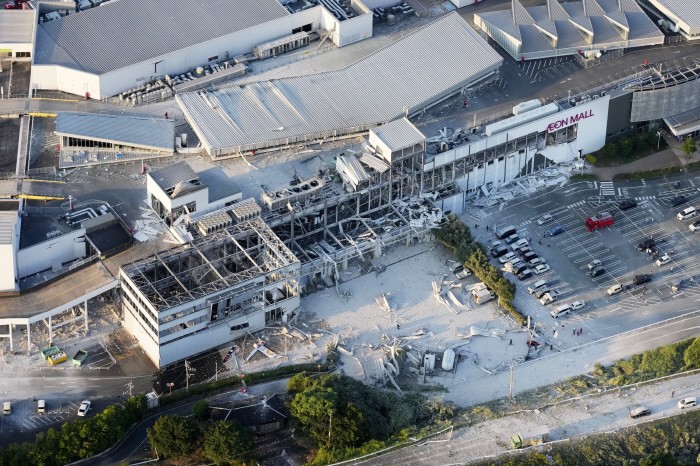 |
| Part of a large shopping mall lies collapsed after a magnitude 7.1 earthquake struck Kumamoto in western Kyushu, Japan on the 28th. / Yonhap |
As tremors from the magnitude 7.1 earthquake in Kumamoto, Japan reached Korea, concerns are growing that the Korean Peninsula is not an earthquake-safe zone either. However, the seismic design rate for private buildings in Korea still remains below 20%.
According to the Ministry of the Interior and Safety and the Ministry of Land, Infrastructure and Transport on the 30th, as of the end of last year, the seismic design rate for private buildings in Korea stood at 18.1%, a stark contrast to the 82.7% seismic performance rate for public facilities. The private-sector seismic design rate refers to the proportion of all buildings with seismic design applied, while the public-sector rate refers to the proportion of facilities subject to reinforcement that have secured seismic performance.
While the Korean Peninsula is not directly part of the Pacific Ring of Fire, it lies on its periphery and is not immune to the effects of major earthquakes in neighboring areas such as Japan. During the Kumamoto earthquake on the 28th, there were a series of reports of tremors being felt in Busan, Ulsan, and South Gyeongsang Province.
The risk of strong earthquakes in Korea has already been confirmed. In 2016, a magnitude 5.8 earthquake — the largest since instrumental observation began in Korea — struck Gyeongju, and the following year, a magnitude 5.4 earthquake in Pohang damaged urban buildings and infrastructure. These two earthquakes prompted a wider recognition that the Korean Peninsula can no longer be considered an earthquake-safe zone.
The seismic performance rate for public facilities has risen from 37.3% in 2011 to 82.7% last year through the government's annual reinforcement efforts. The government plans to secure seismic performance for all existing public facilities by 2035. In the private sector, however, strengthened seismic standards are not applied retroactively to existing buildings, and reinforcement is difficult to mandate, so improvement mainly relies on old buildings being demolished and replaced with newly built structures that meet seismic design standards.
The Ministry of the Interior and Safety provides partial national and local government funding for seismic performance assessments and reinforcement work on private buildings, and operates an "earthquake-safe facility certification system." However, participation remains low due to the burden on building owners, and there is no mid- to long-term target for raising the private-sector seismic design rate.
Han Sang-hwan, a professor in the Department of Architectural Engineering at Hanyang University, said, "The government should provide sufficient incentives for private building owners to voluntarily undertake seismic reinforcement," adding, "Public education is also needed alongside this, to establish the understanding that if a building collapses, the owner ultimately bears the loss."
Kim Nam-hyung
Most Read
-
1
Celltrion’s Omlyclo gains ground in major European..

-
2
Trump demands rates fall below 1% as Fed hikes for..

-
3
Hyundai Motor Group breaks ground on integrated st..

-
4
U.S. strikes 3 Iranian oil tankers, Iran vows reta..

-
5
Trump makes $1 trillion bet ahead of midterm elect..

-
6
Iran resumes ballistic missile production, assembl..

-
7
Samsung Electronics, Mistral AI to jointly develop..

PEOPLE







-
Address : In-Young Bldg., 34, Uisadang-daero 1-gil, Yeongdeungpo-gu, Seoul
Copyright by ASIATODAY CO., LTD. All rights resereved