



7 firms named over persistent failures in female hiring
Jul 30, 2026, 09:56 am


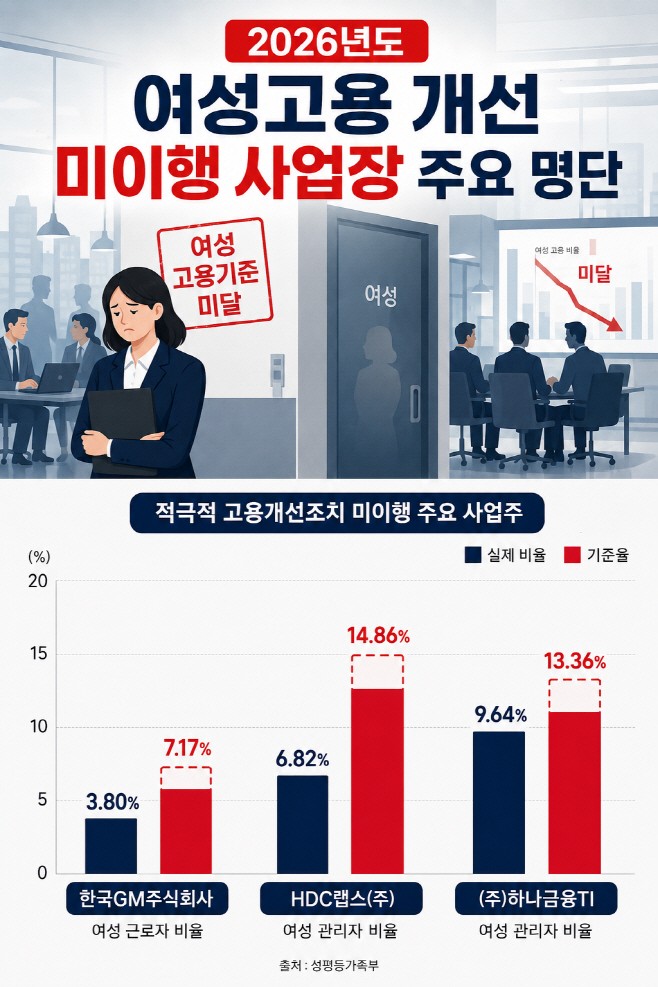 |
| The Ministry of Gender Equality and Family disclosed a list of 37 workplaces on the official gazette and its website that failed to implement affirmative action, including GM Korea, HDC Labs, GM Technical Center Korea, and Hana TI, citing low female employment ratios and insufficient improvement efforts. / Image generated with ChatGPT |
The Ministry of Gender Equality and Family disclosed a list of 37 workplaces on the official gazette and its website for failing to implement affirmative action, citing low female employment ratios and insufficient improvement efforts, including GM Korea, HDC Labs, GM Technical Center Korea, and Hana TI.
The ministry announced on July 29 that it published the list of 37 workplaces that failed to implement affirmative action on the official gazette and its homepage due to low female employment ratios and inadequate efforts toward improvement.
Affirmative action is a system designed to encourage public institutions and workplaces with 500 or more full-time employees to raise the proportion of female workers and female managers. As of this year, the program covers 346 public institutions, 166 local public corporations and agencies, and 2,283 private companies.
The number of workplaces subject to this list disclosure stands at 37, a decrease of four from last year. Entities on the list include GM Korea, HDC Labs, GM Technical Center Korea, Arem, and Hana TI.
By size, 7 companies (18.9%) had 1,000 or more full-time employees, while 30 companies (81.1%) had fewer than 1,000. By industry, administrative and support service activities accounted for the largest share with 11 workplaces (29.8%), followed by land and water transport-related industries with 5 workplaces (13.5%).
General construction, heavy industry, electronics, and facility management and rental industries (excluding real estate) each accounted for 3 workplaces (8.1%). Heavy industry includes non-metallic mineral products, fabricated metal products, machinery and equipment, and motor vehicles and trailers, while the electronics industry includes electronic components, precision instruments, and electrical equipment.
The disclosed workplace information will be published in the official gazette and posted on the ministry's website for six months. The affected workplaces will have their Family-Friendly Certificates revoked and will be restricted from applying for certification for the next two years. They will also face institutional disadvantages, such as credit rating deductions in the Public Procurement Service's Excellent Product Designation evaluation.
Meanwhile, to reduce gender gaps across occupations, job levels, and employment types, the ministry plans to require workplaces whose female employment rates or female manager ratios fall below 70% of the industry and size average to establish and execute improvement plans, while expanding consulting and implementation support. Workplaces that fail to make improvements following these measures will be publicly listed.
Won Min-kyung, Minister of Gender Equality and Family, stated, "To create a gender-equal labor market, raising the proportion of female workers and managers must go hand in hand with efforts to accurately identify and address structural gaps across occupations, job levels, and employment types," adding, "We will enhance the effectiveness of affirmative action and prepare for the seamless introduction of the Gender Pay and Employment Disclosure System to support autonomous improvements by companies and public institutions."
Kim Bo-young
Most Read
-
1
Celltrion nears additional contract with major U.S..

-
2
Putin proposes trilateral U.S.-China-Russia summit..

-
3
U.S. weighs dropping MOAB, world's most powerful n..

-
4
"Aren't those foreigners on welfare?": M..

-
5
Attention centers on APEC for possible Trump-Xi-Pu..

-
6
Saudi Arabia, Iran hold first diplomatic talks to..

-
7
China tightens grip on boosting domestic demand an..

PEOPLE






-
Address : In-Young Bldg., 34, Uisadang-daero 1-gil, Yeongdeungpo-gu, Seoul
Copyright by ASIATODAY CO., LTD. All rights resereved