



Employment centers shift to AI and counseling
Jul 30, 2026, 10:14 am


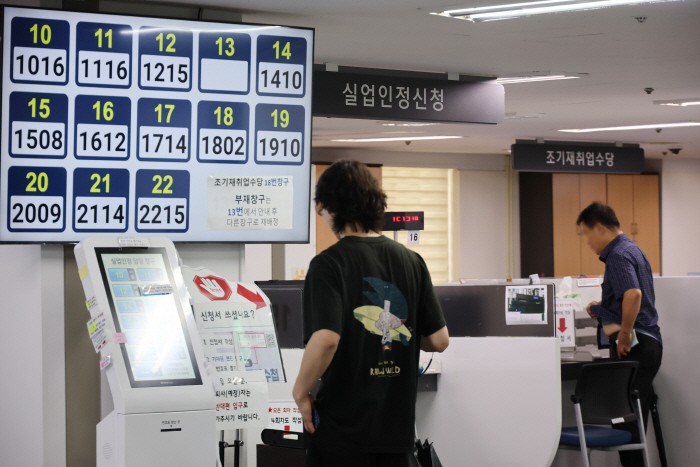 |
| Job seekers wait for counseling at an employment center in Seoul on July 15. / Yonhap News |
Plans are underway to reform employment services so that repetitive administrative tasks, such as paying unemployment benefits and calculating various allowances, are left to artificial intelligence (AI), while employment centers focus on in-depth counseling for the employment-vulnerable and job seekers in need of career transitions. To this end, plans were presented to develop the online platform Employment24 into a digital employment center and to establish regional employment centers to strengthen local employment policies and corporate support functions.
The Korea Labor Institute held the Expert Forum on Employment Service Innovation at the Korea Press Center in Jung-gu, Seoul on July 29 to discuss the direction of national employment service reform.
While more than 2 million people visit employment centers annually, a single counselor handles more than 70 cases of unemployment recognition and benefit/allowance calculations per day, leaving insufficient time for job counseling. The economically active population managed by a single employment center staff member stands at 5,612, approximately 11 times that of Germany. Critics also point out that the organizational structure has largely remained unchanged for about 20 years since the advancement of employment services in 2005.
Accordingly, the Ministry of Employment and Labor plans to transition employment services from being centered on benefit payouts to counseling-focused services that connect people with jobs, establishing a lifelong total care system that supports career development from graduation to post-retirement.
Gil Hyun-jong, a senior research fellow at the Korea Labor Institute, presented four major tasks in his keynote speech on Innovation Plans for Providing National Employment Services: strengthening customized services, separating administrative and service organizations, establishing AI-based digital employment centers, and restoring the expertise and vitality of employment center staff. The plan calls for automating standardized tasks, such as unemployment benefit payouts, using AI while having field personnel focus on face-to-face counseling for job seekers requiring high levels of support.
A proposal was made to reorganize the online platform Employment24 into a digital employment center linked with offline centers. Under this system, AI would analyze job seekers' resumes, capabilities, and job search activities to recommend jobs, vocational training, and government support programs, connecting them to self-directed or intensive support services.
An organizational reform proposal was also presented to establish regional employment centers tasked with analyzing local labor markets, responding to corporate restructuring, and supporting businesses, allowing frontline centers to concentrate on face-to-face services for job seekers and businesses.
While agreeing with the direction of the reform, experts noted that counseling personnel and data infrastructure must be established prior to introducing AI.
Kim Kyun, a senior research fellow at the Korea Employment Information Service, emphasized, "Introducing AI is not a matter of reducing staff, but of shifting the role of counseling personnel from benefit administration to counseling and case management," adding, "Administrative task automation and job training for counseling personnel must be pursued together."
Concerns were also raised that people requiring support could be excluded during the process in which AI automatically classifies job seekers. This is because job-seeking intent is difficult to accurately determine through surveys or administrative data alone, and job-seeking activities conducted on private employment platforms may not be captured in public data.
Experts suggested that because AI classification could affect service levels or benefit eligibility, the authority for final decisions and adjustments should rest with counselors, with an appeals process established. Opinions were also presented that users should be given the choice between online and face-to-face service channels.
The Ministry of Labor is currently conducting a pilot AI automation service for the National Employment Support Program in Daejeon. Having operated a pilot center for unemployment benefits in the first half of this year, the ministry plans to push forward with counseling-centered employment service reforms by next year after conducting pilot operations across individual projects.
Kim Nam-hyung
Most Read
-
1
Celltrion’s Omlyclo gains ground in major European..

-
2
Trump demands rates fall below 1% as Fed hikes for..

-
3
Trump makes $1 trillion bet ahead of midterm elect..

-
4
Iran resumes ballistic missile production, assembl..

-
5
Samsung Electronics, Mistral AI to jointly develop..

-
6
Trump warns countries not helping U.S. must pay re..

-
7
Seoul faces triple squeeze over troop deployment t..

PEOPLE







-
Address : In-Young Bldg., 34, Uisadang-daero 1-gil, Yeongdeungpo-gu, Seoul
Copyright by ASIATODAY CO., LTD. All rights resereved