



Standard median income sees record-high increase
Jul 30, 2026, 10:07 am


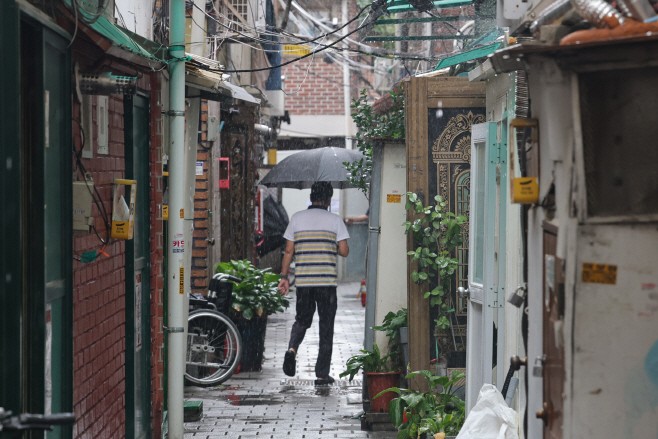 |
| A citizen walks with an umbrella in a flophouse village in Donui-dong, Jongno-gu, Seoul. / Yonhap |
Although the government emphasized the protection of vulnerable groups by raising next year's standard median income by a record-high 6.7%, critics point out that it falls short of reality. This is because despite previous sharp increases, the poverty rate and income gap have deteriorated, while structural blind spots, such as selection criteria by benefit type and support obligation rules, remain unaddressed.
According to the government and related authorities on July 29, the Ministry of Health and Welfare raised the 2027 standard median income by 6.7% for a four-person household on the previous day. This marks the highest rate of increase since 2015, as well as the third consecutive year in the 6% range, following 6.42% in 2025 and 6.51% this year. Consequently, the standard median income for a four-person household will increase by 435,147 won from 6,494,738 won per month this year to 6,929,885 won next year. For a single-person household, it will rise by 171,804 won from 2,564,238 won to 2,736,042 won.
The problem is that while the government promotes this as a record-high increase, indicators provided as grounds for the decision show that past hikes have failed to halt poverty and polarization. The relative poverty rate rose by 0.4 percentage points (p) from 14.9% in 2023 to 15.3% in 2024, and the quintile share ratio widened from 5.72 to 5.78 times. The average monthly deficit for first-quintile households—the bottom 20%—increased by 81,000 won, from 438,000 won in the fourth quarter of last year to 519,000 won in the first quarter of this year. The proportion of deficit-ridden households in the first quintile also rose by 3.8%p from 58.7% to 62.5%.
With this standard median income increase, the maximum livelihood benefit payout will rise by 54,977 won from 820,556 won to 875,533 won per month for single-person households, and by 139,247 won from 2,078,316 won to 2,217,563 won for four-person households. However, these represent the maximum amounts payable to households with no recognized income; actual benefits subtract recognized income from the baseline amount, meaning the actual increase varies by recipient.
Selection criteria by benefit type were also frozen at 32% for livelihood benefits, 40% for medical benefits, 48% for housing benefits, and 50% for education benefits. While income thresholds rise alongside the standard median income, the scope of coverage relative to the median income itself has not expanded. Structural blind spots, such as the support obligation rules for medical benefits, were likewise left unaddressed in this decision.
Civil society organizations, including the Social Welfare Committee of People's Solidarity for Participatory Democracy (PSPD), pointed out that the gap between the standard median income and the median income from the Survey of Household Finances and Living Conditions widened from 12.49% in 2018 to 29.62% in 2023. They are calling for raising the selection criteria for livelihood benefits, abolishing support obligation rules, disclosing Central Livelihood Security Committee meeting materials and minutes, and including benefit recipients in discussions. PSPD emphasized, "Rather than merely repeating the phrase 'record-high increase' every year, the government must present a proper baseline to protect the lives of low-income citizens," adding, "To achieve this, the calculation method must be overhauled to close the median income gap and bring it in line with reality as soon as possible."
Lee Se-mi
Most Read
-
1
Celltrion nears additional contract with major U.S..

-
2
Putin proposes trilateral U.S.-China-Russia summit..

-
3
U.S. weighs dropping MOAB, world's most powerful n..

-
4
"Aren't those foreigners on welfare?": M..

-
5
Attention centers on APEC for possible Trump-Xi-Pu..

-
6
Saudi Arabia, Iran hold first diplomatic talks to..

-
7
China tightens grip on boosting domestic demand an..

PEOPLE






-
Address : In-Young Bldg., 34, Uisadang-daero 1-gil, Yeongdeungpo-gu, Seoul
Copyright by ASIATODAY CO., LTD. All rights resereved