



Japanese stocks see growing volatility on AI concerns and South Korean market ties
Jul 28, 2026, 04:49 pm


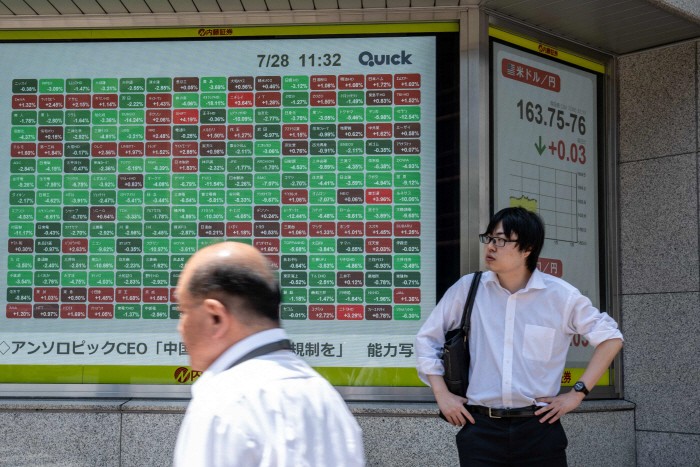 |
| The Nikkei Stock Average is visible on an electronic board at the Tokyo Stock Exchange on July 28. / AFP, Yonhap News |
As the Japanese stock market continues to experience severe fluctuations since May, concerns over the artificial intelligence (AI) and semiconductor industries along with high correlation with the South Korean stock market are pointed out as key factors.
On July 28, the Nihon Keizai Shimbun (Nikkei) reported that the intraday volatility rate of the Nikkei Stock Average in July averaged 2.5%, remaining high following June. This is the first time since the Lehman Brothers crisis in 2008-2009 that the intraday volatility rate has exceeded 2% for three consecutive months.
The newspaper cited fluctuations in foreign stock prices as the reason why high volatility persists despite no specific financial crisis, analyzing that the impact of the South Korean market, which shares the same trading hours with no time difference, played a significant role.
On the same day, the KOSPI index plummeted by as much as 10% intraday, triggering a circuit breaker, and the crash in the South Korean market intensified selling pressure in Japan.
Semiconductor stocks showed widespread weakness as concerns over overheating competition in the memory market spread due to reports on the Shanghai stock listing of ChangXin Memory Technologies (CXMT), China's largest memory chipmaker, and DUV exposure equipment production by Chinese affiliates. Kioxia Holdings, Tokyo Electron, and Advantest dropped sharply, while leveraged ETF trading involving Kioxia, Samsung Electronics, and SK Hynix was found to have driven up volatility across both countries' indexes.
Concerns over worsening finances following reports that OpenAI is reviewing data center loan guarantees also triggered selling in semiconductor-related stocks.
Amid broad weakness in tech stocks, auto stocks such as Honda and Mazda, along with defensive sectors like pharmaceuticals and railways, advanced to support the index floor.
Experts analyzed that the market reaction to negative news in AI and semiconductors was somewhat excessive, forecasting that upcoming earnings announcements from major global big tech companies will serve as a watershed for a market rebound.
Lee Jeong-eun
Most Read
-
1
Celltrion’s Omlyclo gains ground in major European..

-
2
Trump demands rates fall below 1% as Fed hikes for..

-
3
Trump makes $1 trillion bet ahead of midterm elect..

-
4
Iran resumes ballistic missile production, assembl..

-
5
Samsung Electronics, Mistral AI to jointly develop..

-
6
Trump warns countries not helping U.S. must pay re..

-
7
Apple launches first foldable, 1 million won prici..

PEOPLE






HEADLINE NEWS
- Trump to roll out ‘unprecedented welcome’ for Xi with B-2 bombers, F-22 fighters
- S. Korea, U.S., and Japan form united front on Taiwan and economic coercion..
- Trump administration moves to impose sweeping sanctions on International Cr..
- Xi to make state visit to U.S. Sept. 23-25, dispelling rumors over his heal..

-
Address : In-Young Bldg., 34, Uisadang-daero 1-gil, Yeongdeungpo-gu, Seoul
Copyright by ASIATODAY CO., LTD. All rights resereved