



38% of salaried workers go to work as usual despite natural disasters
Jul 27, 2026, 10:04 am


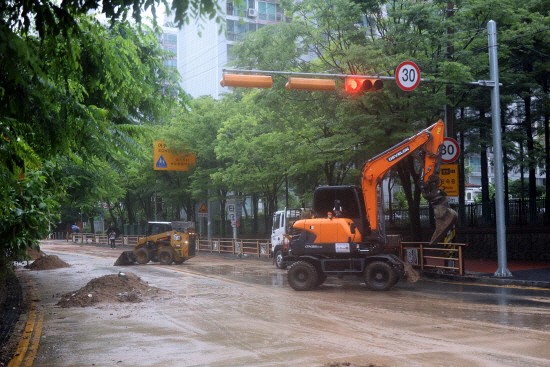 |
| Workers clear soil and debris off a road in front of an apartment complex in Songgang-dong, Yuseong District, Daejeon, after heavy rain fell on July 9. / Yonhap |
Government recommendations advise telecommuting and flexible hours during natural disasters like heavy rain and heat waves, yet many office workers still commute as usual per company instructions. Four out of ten workers reported going to work normally even during natural disasters, and one in seven experienced or witnessed disadvantages due to tardiness.
According to a survey of 1,000 office workers aged 19 and older nationwide conducted from June 1 to 9 by global research firm Global Research at the request of Gabjil 119, 38.4% of respondents said they had commuted as usual following company instructions even when the government recommended work-from-home or adjusted hours.
Additionally, 43.8% answered that their workplaces do not guarantee telecommuting or flexible hours during severe weather like typhoons, heavy rain, and heat waves. Disparities by employment type were evident, with non-regular workers reporting a higher rate at 49.8% compared to regular workers at 39.8%.
Furthermore, 15.3% of total respondents noted experiencing or witnessing unfair treatment caused by tardiness during force majeure disaster situations.
Meanwhile, 65.4% of respondents felt that employees should be allowed to independently choose their work arrangements or exercise their right to refuse work in such disaster scenarios. While over half of respondents supported flexible work policies during disasters, these measures remain unapplied in many workplaces.
Gabjil 119 pointed out that current regulations fail to protect workers adequately during natural disasters. While public servants are covered by official leave provisions when natural disasters make commuting difficult, the Labor Standards Act covering general workers lacks clear criteria for handling tardiness or absences caused by natural disasters. They also argued that the right to stop work under the Occupational Safety and Health Act suffers from vague standards regarding immediate danger and lacks sufficient protection against adverse treatment, limiting its effectiveness.
Nam Da-hyun, a labor attorney at Gabjil 119, emphasized that heat waves and heavy rains are becoming routine due to the climate crisis, yet worker safety remains left to employer discretion, adding that standards for handling tardiness and absences during natural disasters must be codified into law and the right to stop work made more effective so workers can respond safely.
Kim Tae-hoon
Most Read
-
1
Celltrion’s Omlyclo gains ground in major European..

-
2
Trump demands rates fall below 1% as Fed hikes for..

-
3
Hyundai Motor Group breaks ground on integrated st..

-
4
U.S. strikes 3 Iranian oil tankers, Iran vows reta..

-
5
Trump makes $1 trillion bet ahead of midterm elect..

-
6
Iran resumes ballistic missile production, assembl..

-
7
Samsung Electronics, Mistral AI to jointly develop..

PEOPLE






-
Address : In-Young Bldg., 34, Uisadang-daero 1-gil, Yeongdeungpo-gu, Seoul
Copyright by ASIATODAY CO., LTD. All rights resereved