



Gov't to mandate minimum pay cuts for dilatory public officials
Jul 24, 2026, 10:03 am


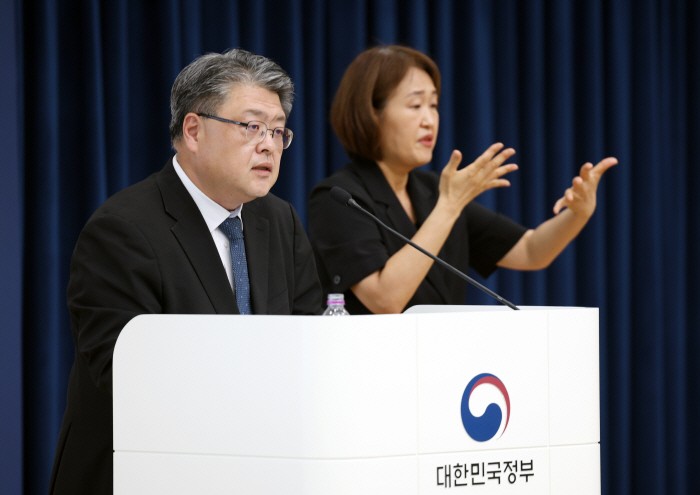 |
| Cheon Ji-yoon, Director General of the Ethics and Service Bureau at the Ministry of Personnel Management, explains key measures, including tougher disciplinary actions for passive administration, during a legislative notice briefing on the draft amendment to the Rules on Disciplinary Action Against Public Officials at the Government Complex Sejong on July 23. / Photo courtesy of Ministry of Personnel Management |
Public officials who delay or neglect their duties without a valid reason, including duty negligence or passive administration, will face a minimum disciplinary measure of a pay reduction. Those who damage their dignity by using hate speech targeting individuals or specific groups will also face severe accountability, up to dismissal.
The Ministry of Personnel Management announced on July 23 a legislative notice for the proposed amendment to the Rules on Disciplinary Action Against Public Officials centered on these measures. As part of efforts to build a trusted public service, the amendment is scheduled to take effect on October 1.
Under the revised rules, nonfeasance, duty negligence, and passive administration—failing to act despite being obligated to do so—will be dealt with strictly. Previously, nonfeasance and duty negligence were grouped under disciplinary criteria with entirely different characteristics, but they will now be categorized as a separate type of misconduct, with the minimum disciplinary threshold raised from a reprimand to a pay reduction.
Passive administration, defined as misconduct encompassing nonfeasance that infringes upon public rights and interests or incurs losses to national finances, will also carry a minimum disciplinary baseline of a pay reduction alongside nonfeasance and duty negligence. Furthermore, while no explicit provisions previously existed regarding supervisory accountability for nonfeasance and duty negligence—unlike passive administration—managers can now face disciplinary action if found negligent in their oversight responsibilities.
The amendment also establishes new disciplinary criteria for hate speech. Previously, hate speech lacked dedicated disciplinary standards, forcing authorities to apply generic provisions such as "other violations" under the duty to maintain dignity. Going forward, public officials who severely breach their duty of dignity through hate speech will be subject to distinct disciplinary standards, facing up to dismissal, while strict management will ensure that receiving official commendations will not qualify them for disciplinary leniency.
"We will ensure that strict standards apply to public officials who evade responsibility through passive administration," said Choi Dong-seok, Minister of Personnel Management. "By strengthening disciplinary standards for passive administration and hate speech, we will actively work to establish a public service culture that aligns with public expectations and the trends of the times."
Lee Han-sol
Most Read
-
1
Celltrion’s Omlyclo gains ground in major European..

-
2
Trump demands rates fall below 1% as Fed hikes for..

-
3
Hyundai Motor Group breaks ground on integrated st..

-
4
U.S. strikes 3 Iranian oil tankers, Iran vows reta..

-
5
Trump makes $1 trillion bet ahead of midterm elect..

-
6
Iran resumes ballistic missile production, assembl..

-
7
Samsung Electronics, Mistral AI to jointly develop..

PEOPLE







-
Address : In-Young Bldg., 34, Uisadang-daero 1-gil, Yeongdeungpo-gu, Seoul
Copyright by ASIATODAY CO., LTD. All rights resereved