



Tesla's Q2 earnings fall short as AI and robotics investments expand
Jul 23, 2026, 01:24 pm


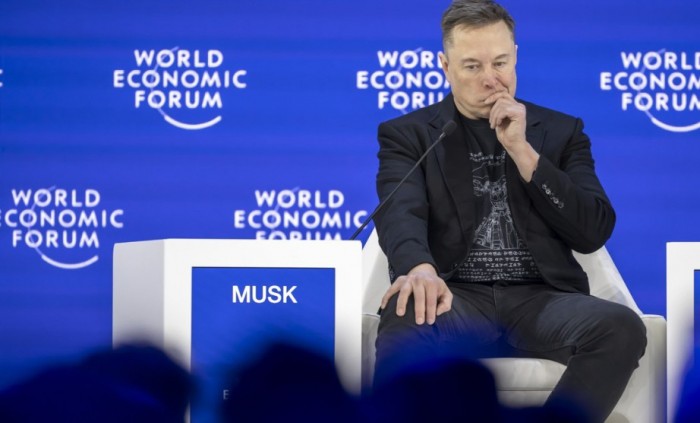 |
| Tesla Chief Executive Officer Elon Musk attends the World Economic Forum in Davos, Switzerland, on July 22 (local time). / Photo courtesy of EPA, Yonhap News Agency |
Reuters reported on July 22 (local time) that Tesla's second-quarter earnings showed a sluggish performance, with profitability and cash flow deteriorating significantly despite revenue beating market expectations.
Revenue rose 26 percent year-over-year to $28.24 billion (approx. 41.6116 trillion won), surpassing market expectations of $25.71 billion (approx. 37.8194 trillion won).
Conversely, net income fell 5 percent year-over-year to $1.11 billion (approx. 1.6417 trillion won). Adjusted earnings per share (EPS) came in at 33 cents (approx. 440 won), falling far short of the market consensus of 51 cents (approx. 680 won) compiled by market research firm LSEG.
Free cash flow (FCF) turned negative for the first time in over two years, recording a deficit of $1.09 billion (approx. 1.6025 trillion won).
Despite the revenue growth, Tesla's profits declined due to lower electric vehicle selling prices and reduced revenue from regulatory credits—environmental compliance credits granted by governments to automakers.
Vehicle deliveries increased to 480,000 units compared to the same period last year (380,000 units), but the average vehicle selling price fell to $42,730 (approx. 62.94 million won), pulling the automotive gross margin down to 16.3 percent, below the expected 18.04 percent.
As the U.S. federal government ended tax credits for EV purchases and repealed penalties for failing to meet fuel efficiency standards, Tesla's regulatory credit revenue dropped significantly. Consequently, its overall gross margin fell to 16.8 percent from 17.2 percent a year earlier, missing market expectations of 19.4 percent.
On the other hand, capital expenditure (CapEx) surged 142 percent year-over-year to $5.79 billion (approx. 8.5211 trillion won).
Tesla has discontinued production of its higher-priced sedans and SUVs, shifting its focus toward relatively lower-cost models.
It is also channeling its resources into developing Robotaxi—its driverless autonomous ride-hailing service—Cybercab, and its humanoid robot Optimus. Reuters analyzed that the heavy burden of expanding investments in AI and robotics over its core revenue generator, automobiles, compounded the profit decline.
Reuters added that Tesla plans to invest more than $25 billion (approx. 36.755 trillion won) in AI and robotics this year, roughly triple last year's amount.
Park Jin-sook
Most Read
-
1
Celltrion’s Omlyclo gains ground in major European..

-
2
Trump demands rates fall below 1% as Fed hikes for..

-
3
Trump makes $1 trillion bet ahead of midterm elect..

-
4
Iran resumes ballistic missile production, assembl..

-
5
Samsung Electronics, Mistral AI to jointly develop..

-
6
Trump warns countries not helping U.S. must pay re..

-
7
Apple launches first foldable, 1 million won prici..

PEOPLE






HEADLINE NEWS
- Trump to roll out ‘unprecedented welcome’ for Xi with B-2 bombers, F-22 fighters
- S. Korea, U.S., and Japan form united front on Taiwan and economic coercion..
- Trump administration moves to impose sweeping sanctions on International Cr..
- Xi to make state visit to U.S. Sept. 23-25, dispelling rumors over his heal..

-
Address : In-Young Bldg., 34, Uisadang-daero 1-gil, Yeongdeungpo-gu, Seoul
Copyright by ASIATODAY CO., LTD. All rights resereved