 | | 0 |
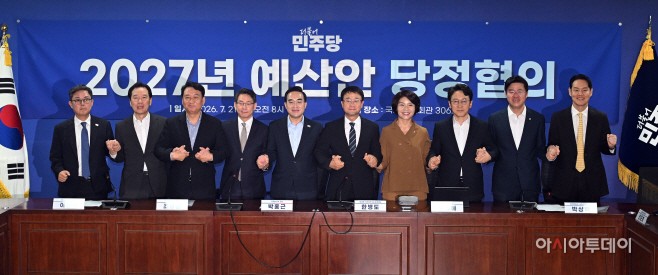
Han Byung-do, acting leader and floor leader of the Democratic Party of Korea (sixth from left), Park Hong-keun, Minister of Planning and Budget (fifth from left), Lee Kwang-jae, Chairman of the Special Committee on Budget and Accounts (third from left), and other attendees pose for a photo during a party-government consultation on the 2027 budget proposal held at the National Assembly on July 21. / Courtesy of Asia Today
|
The Democratic Party of Korea and the government held a consultation meeting at the National Assembly on July 21 and agreed to draft next year's (2027) budget at a record-high scale of "800 trillion won plus alpha." Marking the first budget fully led by the Lee Jae-myung administration from start to finish, the ruling party and the government plan to leverage increased tax revenues driven by the semiconductor boom to focus on securing future growth engines and supporting regional growth.
Han Byung-do, acting leader and floor leader of the Democratic Party, stated during the meeting, "The 2027 budget proposal is the very first budget fully led by the Lee Jae-myung administration across its entire drafting process," adding, "It must serve as the catalyst to save South Korea's critical window of opportunity for the future." Han emphasized, "Along with strategic investments to swiftly execute the 'Three Mega Projects' (semiconductors, physical AI, and data centers) that will determine our future competitiveness, safety budgets aimed at fostering local-led growth and recovering livelihoods must be meticulously allocated."
Han Jeoung-ae, Chief of the Policy Committee, stated that the party would ensure the solid execution of pledges made during the last local elections. Noting that next year marks the 30th anniversary of the Asian Financial Crisis (IMF), Han remarked, "The repayment of public funds incurred by the 1997 financial crisis is scheduled to conclude next year." She added, "Following the Kim Dae-jung and Moon Jae-in administrations' graduation from the IMF bailout, President Lee Jae-myung's popular sovereignty government will finally bring this chapter to a complete close."
Representing the government, Park Hong-keun, Minister of Planning and Budget, announced expenditure restructuring plans aimed at enhancing fiscal efficiency. Minister Park stated, "We will restructure an additional 50 trillion won in spending this year and reflect it in next year's budget proposal," explaining, "Inefficient or low-performing projects will be restructured strictly according to principle, while additional tax revenues generated by the semiconductor boom will be directed toward establishing a future response fund to reinvest in the youth and regional areas."
Lee Kwang-jae, Chairman of the National Assembly's Special Committee on Budget and Accounts, unveiled plans for budget reviews based on Key Performance Indicators (KPIs) alongside the efficient management of national assets. Chairman Lee stressed, "We must clarify what outcomes are achieved once the budget is spent," adding, "We will examine the flow of money across South Korea to ensure policy goals are met using the 800 trillion won budget, 1,700 trillion won in national pension funds, and the financial system."
Shim Jun-bo