



"200,000 jobs and public housing priority": Super budget packed with youth policies
Jul 14, 2026, 09:06 am


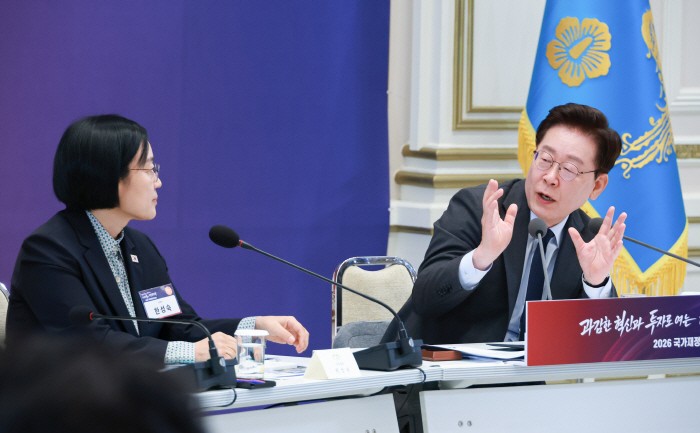 |
| President Lee Jae-myung comments during the National Fiscal Strategy Meeting held at the Blue House on July 13, in response to remarks made by Prime Minister Han Sung-sook. / Photo courtesy of Yonhap News Agency |
"200,000 jobs and public housing priority": Super budget packed with youth policies
The upcoming "super budget," projected to reach a record-breaking 800 trillion won, will feature extensive support packages for youth, regional development, and education, alongside the "Three Mega Projects" focused on semiconductors, artificial intelligence (AI) data centers, and physical AI. Specifically, the government plans to establish a customized support system encompassing the entire life cycle of young adults—including education, employment, housing, asset formation, and marriage—to intensely support the 2030 generation.
The government's enhanced support for youth stems from the recognition that structural industrial shifts driven by the AI transition and severe "K-shaped polarization" are disproportionately impacting the younger demographic. Political analysts interpret this policy push as a dual-purpose strategy aimed at both improving the livelihoods of the 2030 generation and recovering public sentiment, particularly given President Lee Jae-myung's relatively low approval ratings among young adults.
"We will build a Republic of Korea where everyone grows together and no one is left behind," President Lee emphasized during the National Fiscal Strategy Meeting held on July 13. "For young people taking their first steps into society, we will establish a comprehensive support network that spans their entire life cycle, from employment to housing and asset building."
Following the meeting, Koo Yun-cheol, Deputy Prime Minister and Minister of Economy and Finance, unveiled the tailored lifecycle support measures. Under the initiative, the government aims to create 200,000 youth jobs and nurture over 100,000 young entrepreneurs by 2030.
To generate these jobs, the government plans to link private enterprises, universities, and public training systems to cultivate 200,000 experts in AI, semiconductors, and the green transition (GX), with a heavy focus on the Three Mega Projects. The blueprint intends to simultaneously boost industrial competitiveness and employment by merging future industry investments with youth employment policies.
Housing support for the younger generation will also expand. The government will supply a new type of public rental housing that matches the quality of private residential units in highly accessible areas, such as transit-oriented zones near subway stations, and give priority allocation to young applicants.
For asset building, a youth-specific Individual Savings Account (ISA) will be launched, alongside bolstered support for young employees at small and medium-sized enterprises (SMEs) to help them accumulate seed money. Furthermore, the government will implement measures to alleviate the so-called "marriage and childbirth penalty" by easing income requirements for housing loans geared toward newlywed couples and expanding free childcare and education options.
Concrete plans were also finalized for the Three Mega Projects, the other major pillar of next year's budget. Bae Kyoung-hoon, Deputy Prime Minister and Minister of Science and ICT, announced that a pan-governmental comprehensive support task force (TF) will be operated to ensure the swift execution of private investments in AI data centers, which are projected to reach a capacity of 8.4 gigawatts (GW) by 2029. Alongside this, the government plans to secure core technologies, construct large-scale testbeds, and develop industrial clusters.
Presenting the framework for the Three Mega Projects, Minister of Trade, Industry and Energy Kim Jung-kwan outlined plans to foster the materials, components, equipment, packaging, and foundry sectors to complete an robust industrial ecosystem. This will align with the historic 957 trillion won private investment pledged for semiconductor manufacturing facilities, backed by the Mega Cluster Act and the Special Semiconductor Act to support investments in new fabrication plants.
Additionally, Minister of Climate, Energy and Environment Kim Sung-whan and Minister of Land, Infrastructure and Transport Kim Yun-deok presented an infrastructure innovation strategy to supply power and water to high-tech industries, as well as a development strategy for semiconductor high-tech industrial complexes, respectively.
Hong Sun-mi
Most Read
-
1
Trump demands rates fall below 1% as Fed hikes for..

-
2
Celltrion seeks rheumatoid arthritis indication ex..

-
3
Chinese e-commerce giants AliExpress, Temu and She..

-
4
Trump warns countries not helping U.S. must pay re..

-
5
Turkish Airlines named main club partner of Liverp..

-
6
China expels No. 2 military official Zhang Youxia..

-
7
Houthi rebels release video claiming downing of Sa..

PEOPLE







-
Address : In-Young Bldg., 34, Uisadang-daero 1-gil, Yeongdeungpo-gu, Seoul
Copyright by ASIATODAY CO., LTD. All rights resereved