



ADB lowers developing Asia growth forecast on prolonged energy shocks
Jul 09, 2026, 10:17 am


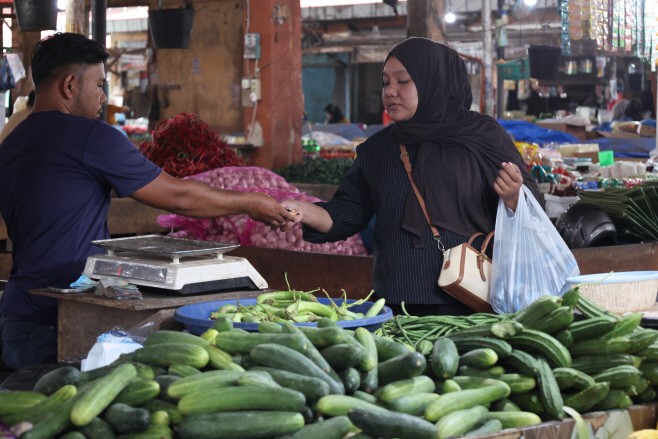 |
| Vendors and customers buy and sell goods at a traditional market in Indonesia. / Courtesy of EPA via Yonhap News |
The Asian Development Bank (ADB) has revised downward its economic growth forecast for developing economies in the Asia-Pacific region to 4.9% for this year, warning that the energy market shocks stemming from conflicts in the Middle East are becoming prolonged.
According to the July edition of the Asian Development Outlook (ADO) released in Manila on July 8 (local time), the updated projection is a 0.2 percentage point reduction from the 5.1% forecast in April, and a 0.6 percentage point drop compared to last year's 5.5% growth rate. Meanwhile, the growth forecast for 2027 was maintained at 5.1%.
In its report, the ADB diagnosed that conflicts in the Middle East have caused long-term disruptions to energy sectors and supply chains, driving up production costs and dampening economic activity. The direct trigger for the downgrade was the sharp spike in oil prices prompted by Middle East tensions this spring. Brent crude surged to around $144 per barrel in April. Consequently, the ADB raised its annual average oil price forecast for this year to $87 per barrel—a significant jump from its April estimate of $72 per barrel. Oil tanker traffic through the Strait of Hormuz has recovered slightly since a framework ceasefire agreement was announced on June 14, but data shows volumes remain well below pre-conflict levels.
Nevertheless, the outlook showed some improvement compared to an emergency revision of 4.7% made in late April, thanks to two stabilizing factors. First, after the mid-June framework agreement, oil prices dipped below $80 per barrel, mitigating worst-case scenarios. Second, first-quarter growth came in at a resilient 5.5%, buoyed by robust domestic demand and economic momentum built up prior to the conflict.
While economic growth has seen a minor cushion, the inflationary shock has deepened. The ADB raised its inflation forecast for the region this year to 4.3%, marking a 0.7 percentage point increase from the April projection (3.6%) and a 1.3 percentage point jump from last year's 3.0%. Rising energy and fertilizer costs are the core drivers. The ADB's internal analysis indicates that food security is also under threat; countries heavily reliant on fertilizer imports, such as Cambodia and the Philippines, could face a drop in rice production this year unless policy interventions are made.
The growth forecast for Southeast Asia was tweaked slightly lower to 4.6% from April's 4.7%, while the region's inflation outlook was sharply increased to 3.9% from 3.2%. By country, Vietnam maintained both its growth forecast of 7.2% and inflation forecast of 4.0%, exhibiting the most stable trajectory in the region. In contrast, the Philippines bore the direct brunt of the energy shock, with its growth forecast cut from 4.4% to 3.8% and its inflation projection soaring from 4.0% to 5.9%. Indonesia (5.2%) and Thailand (1.8%) maintained their growth forecasts, though their inflation estimates were revised upward to 3.0% and 2.9%, respectively.
The ADB pointed to a potential collapse of the Middle East peace process as the primary downside risk. If the ceasefire agreement falls through, oil prices could spike again, exacerbating already elevated inflationary pressures. Other highlighted risk factors included sharp corrections in artificial intelligence (AI)-related tech stocks, further U.S. tariff shocks, food price volatility driven by El Niño, and the prolonged slump in China’s property sector. As the aftereffects of the energy shock clear only gradually, developing Asian economies remain caught under the dual pressures of slowing growth and rising prices.
Jeong Ri-na
Most Read
-
1
Celltrion’s Omlyclo gains ground in major European..

-
2
Trump demands rates fall below 1% as Fed hikes for..

-
3
Trump makes $1 trillion bet ahead of midterm elect..

-
4
Iran resumes ballistic missile production, assembl..

-
5
Samsung Electronics, Mistral AI to jointly develop..

-
6
Trump warns countries not helping U.S. must pay re..

-
7
Apple launches first foldable, 1 million won prici..

PEOPLE






HEADLINE NEWS
- Trump to roll out ‘unprecedented welcome’ for Xi with B-2 bombers, F-22 fighters
- S. Korea, U.S., and Japan form united front on Taiwan and economic coercion..
- Trump administration moves to impose sweeping sanctions on International Cr..
- Xi to make state visit to U.S. Sept. 23-25, dispelling rumors over his heal..

-
Address : In-Young Bldg., 34, Uisadang-daero 1-gil, Yeongdeungpo-gu, Seoul
Copyright by ASIATODAY CO., LTD. All rights resereved