



N. Korea slams S. Korea-Japan defense ties as 'self-destructive'
Jul 09, 2026, 10:10 am


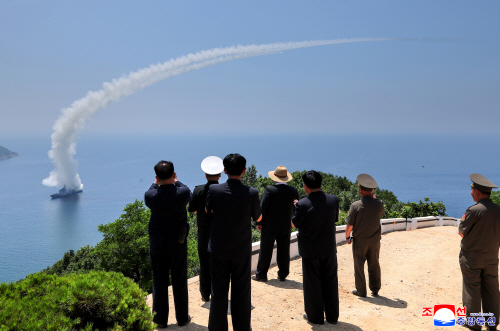 |
| North Korean leader Kim Jong-un inspected weapon system tests, including missiles and naval guns, aboard the new 5,000-ton class destroyer 'Kang Kon' on July 3, the Korean Central News Agency reported on July 5. The warship had previously run aground during its launching ceremony. / Courtesy of Yonhap News |
North Korea has strongly criticized the recent strengthening of defense cooperation between South Korea and Japan, labeling it a "foolish and reckless act that will bring about their own destruction." Experts analyze that Pyongyang views this bilateral military aligning as piggybacking on "U.S. hegemony strategies" and is aiming to push back against tighter trilateral coordination among Seoul, Washington, and Tokyo.
Kang Chul-su, a senior official at Pyongyang's Enemy Study Institute, published an article on July 9 titled "A Highly Dangerous Military Collusion Inviting Destruction." In the piece, Kang claimed that "military collusion between South Korea and Japan—a war-criminal state currently racing toward becoming a military power—has become blatant, placing the security environment of the Korean Peninsula in even greater jeopardy." The Enemy Study Institute is believed to be the renamed successor of the Secretariat of the Committee for the Peaceful Reunification of the Country, which previously operated under the United Front Department and has likely been integrated into the Ministry of Foreign Affairs.
Kang pointed to several recent examples, including South Korea's "Black Eagles" air force aerobatic team receiving aerial refueling support from Japan in January, the resumption of bilateral search-and-rescue drills last month for the first time in nine years, and the recent South Korea-Japan defense ministerial talks. He claimed that these moves are stepping stones toward signing a bilateral Acquisition and Cross-Servicing Agreement (ACSA).
Last month in Seoul, the defense ministers of South Korea and Japan held their first bilateral talks in 11 years and agreed to advance exchanges between their respective aerobatic teams. However, Seoul drew a line, clarifying that this does not mean Japan's Air Self-Defense Force will provide routine refueling support. The issue of an ACSA was also excluded from the official agenda. The South Korean government currently acknowledges the need to review a potential ACSA with Japan, but maintains that public sentiment must be taken into consideration.
The North Korean official linked this security cooperation directly to U.S. geopolitical strategy, claiming that "the security cooperation between Japan and South Korea is a confrontational collusion targeting our Republic and part of an effort to build a 'triangular nuclear cooperation system' to militarily check neighboring countries by piggybacking on American hegemony." Observers note that this rhetoric appears aimed at justifying and calling for a tighter alignment among North Korea, China, and Russia.
Kang went on to justify the North's nuclear weapons program. "The current reality proves that consistently expanding and strengthening our Republic's nuclear forces, and fully exercising our status as a nuclear-armed state, is the one and only way to proactively respond to an unpredictable international situation and defend our peace and safety," he argued. He added that "the absolute, unyielding balance of power on the Korean Peninsula established by our supreme nuclear state will never change," reaffirming Pyongyang's stance that it will not pursue denuclearization.
Previously on July 7, North Korea had reacted sharply to Japan's development of uncrewed underwater vehicles (UUVs), labeling it an "aggressive military buildup aimed at overseas invasion."
"North Korea views the military expansion of South Korea and Japan as a direct threat to the polycentric regional order centered around North Korea, China, and Russia in Northeast Asia," said Oh Kyeong-seob, a senior research fellow at the Korea Institute for National Unification. "Pyongyang views Seoul-Tokyo cooperation as a major hurdle to its strategy of undermining the U.S.-led global order, and it leverages this bilateral partnership as a key talking point to justify its own nuclear weapons development."
Mok Yong-jae
Most Read
-
1
Trump shares map on social media labeling Strait o..

-
2
Kia Sportage outperforms Mazda CX-5 in German auto..

-
3
Houthis launch successive attacks on Saudi airport..

-
4
U.S. deploys carrier, 10,000 more troops to Middle..

-
5
Trump rejects Iran's offer to open Strait of Hormu..

-
6
N. Korea conducts first swarm attack drill with dr..

-
7
U.S.-China summit falls short on substance as Trum..

PEOPLE






HEADLINE NEWS
- Seoul dismisses Ukraine's claim of 'S. Korean support for Russia' as "inaccurate and inappropriate"
- S. Korea, Japan race to develop nuclear-powered submarines
- Henri Kagan, Kenso Soai win Nobel Prize in Chemistry for uncovering how mol..
- Vance says Alaska LNG cooperation will move forward with Seoul's current or..

-
Address : In-Young Bldg., 34, Uisadang-daero 1-gil, Yeongdeungpo-gu, Seoul
Copyright by ASIATODAY CO., LTD. All rights resereved