



K-Defense joins hands with NATO, aiming to penetrate 15-trillion-won annual market
Jul 09, 2026, 09:26 am


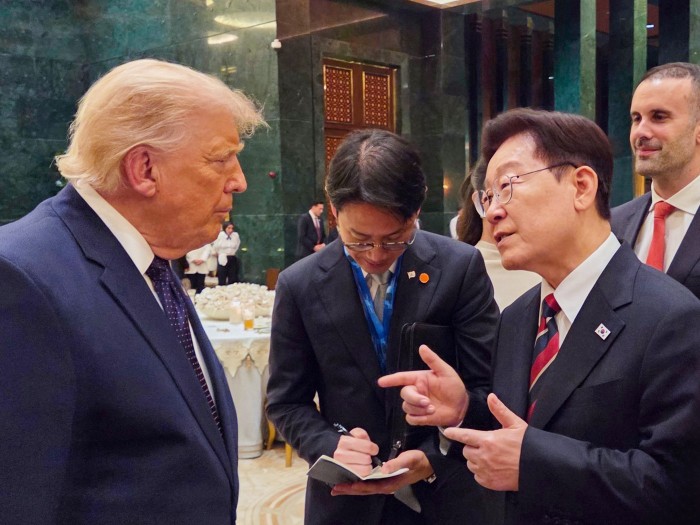 |
| South Korean President Lee Jae-myung and U.S. President Donald Trump speak during an official welcoming gala dinner hosted by Turkish President Recep Tayyip Erdoğan and his first lady at the Presidential Complex in Ankara, Turkey, on July 7 (local time). / Courtesy of Yonhap News |
K-Defense joins hands with NATO, aiming to penetrate 15-trillion-won annual market
Attending his first NATO summit since taking office, President Lee Jae-myung moved to establish the institutional framework necessary for K-Defense to enter NATO’s joint procurement market. As NATO allies agree to scale up their defense spending to 5% of their gross domestic product (GDP) by 2035, the Blue House envisions turning the NATO procurement market—estimated at 15 trillion won annually—into a new arena for South Korean defense firms.
According to the Blue House on July 8, National Security Advisor Wi Sung-lac announced during a briefing at the press center in Ankara, Turkey, on July 7 (local time) that South Korea and NATO have officially launched negotiations to conclude a procurement agreement, a move catalyzed by President Lee's meeting with NATO Secretary General Mark Rutte. "We have secured a foothold to enter the NATO defense market and build a resilient defense supply chain," Wi said. "Once the agreement is finalized, it will provide the institutional groundwork for our companies to participate in the NATO joint procurement market, which is projected to reach 15 trillion won per year."
The Procurement Framework Agreement defines the legal and administrative protocols essential for defense logistics cooperation and procurement contracts between NATO and its partner nations. Until now, domestic defense contractors have expanded their exports primarily through bilateral arrangements with individual NATO member states, such as Poland. However, establishing an institutional foundation for South Korea-NATO procurement cooperation will lower entry barriers and allow South Korean firms to participate in NATO-wide joint procurements and multinational defense initiatives.
In his keynote address at the NATO Defense Industry Forum, President Lee also emphasized the need to upgrade bilateral defense ties. "We must advance beyond the current defense cooperation focused on arms transactions and transition into a 'Defense Industry Partnership 2.0' where we research, produce, and operate systems together," President Lee stressed. "Joint research and development is the most reliable way to align technical standards and share the direction of innovation."
The remarks reflect a strategic vision to elevate K-Defense from a simple export industry into a long-term cooperative partner within the NATO defense supply chain. It also serves as sales diplomacy designed to back the government's stated goal of becoming one of the world's top four defense exporters.
NATO's broader trend of expanding defense investments presents a major opportunity for K-Defense. As the NATO market, which accounts for more than half of global defense spending, accelerates its rearmament efforts, South Korean enterprises are expected to find greater openings in sectors ranging from ammunition, self-propelled howitzers, and armored vehicles to naval vessels and space- and AI-based battlefield technologies.
The scope of cooperation is already widening into supply chains and future warfare technologies. In addition to ammunition and space projects where South Korea previously participated as an observer, the government has newly joined defense raw materials initiatives. The expansion aims to simultaneously secure defense supply chains and strengthen cooperation in next-generation combat tech.
"NATO is accumulating lessons from the war in Ukraine, where cutting-edge technologies like drones and AI are proving decisive," National Security Advisor Wi noted. "We are pushing for South Korean companies to participate in NATO innovation testbeds, which evaluate and verify civilian innovative technologies for battlefield deployment."
Meanwhile, on the same day, President Lee shared a warm conversation with U.S. President Donald Trump at a reception and welcoming gala dinner hosted by Turkish President Recep Tayyip Erdoğan and his first lady. The two leaders agreed to continue follow-up working-level discussions regarding military shipbuilding, a sector President Trump had previously requested cooperation in. They also agreed to schedule their golf outing, which was promised during President Lee's visit to the U.S. and the Group of Seven (G7) summit, at a mutually convenient time.
Park Young-hoon
Most Read
-
1
Trump shares map on social media labeling Strait o..

-
2
Kia Sportage outperforms Mazda CX-5 in German auto..

-
3
Houthis launch successive attacks on Saudi airport..

-
4
U.S. deploys carrier, 10,000 more troops to Middle..

-
5
Trump rejects Iran's offer to open Strait of Hormu..

-
6
N. Korea conducts first swarm attack drill with dr..

-
7
U.S.-China summit falls short on substance as Trum..

PEOPLE





HEADLINE NEWS
- Seoul dismisses Ukraine's claim of 'S. Korean support for Russia' as "inaccurate and inappropriate"
- S. Korea, Japan race to develop nuclear-powered submarines
- Henri Kagan, Kenso Soai win Nobel Prize in Chemistry for uncovering how mol..
- Vance says Alaska LNG cooperation will move forward with Seoul's current or..

-
Address : In-Young Bldg., 34, Uisadang-daero 1-gil, Yeongdeungpo-gu, Seoul
Copyright by ASIATODAY CO., LTD. All rights resereved