



China launches SLBM into Pacific, urges against overinterpretation
Jul 08, 2026, 10:31 am


China has reiterated its stance that there is "no need to overinterpret" its recent test launch of a nuclear-capable submarine-launched ballistic missile (SLBM) into the high seas of the Pacific Ocean, brushing off widespread international criticism.
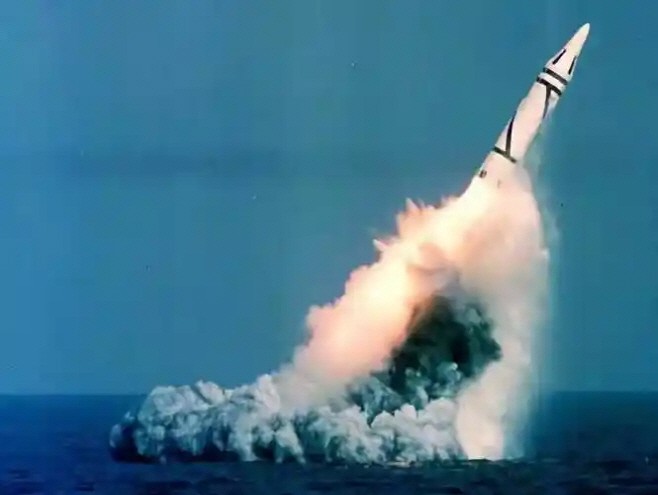 |
| The "JL-3" submarine-launched ballistic missile (SLBM) launched by China on July 6 drew immediate protests from neighboring countries. / Courtesy of Global Times |
Mao Ning, spokesperson for China’s Ministry of Foreign Affairs, stated during a regular press briefing on July 7 that the recent test launch was a "routine military training activity and is not directed at any specific country or target." She added, "We notified relevant nations, including the Solomon Islands and others in the South Pacific, in advance. This is in accordance with international law and practice."
She further emphasized, "China adheres to a path of peaceful development and a self-defensive nuclear strategy, always maintaining its nuclear capabilities at the minimum level required for national security. There is no need for related countries to overinterpret this."
The state-run Global Times also defended the action in a commentary, stating that it "demonstrates China's determination and capability to firmly safeguard its national sovereignty, security, and territorial integrity." It asserted that the launch marks a "milestone moment" for China's nuclear development, adding that by continuously strengthening its strategic deterrence system—including its "nuclear triad"—China aims to "fundamentally break the dangerous situation where one side holds absolute military superiority and can exert pressure at will."
According to Beijing diplomatic sources, China announced the previous day that a strategic nuclear submarine had successfully launched a single SLBM equipped with a dummy warhead into the high seas of the Pacific. The "nuclear triad" referred to by the Global Times signifies a state possessing all three major nuclear delivery vehicles: Intercontinental Ballistic Missiles (ICBMs), SLBMs, and strategic bombers. This capability ensures the power to retaliate even in the event of a preemptive nuclear strike.
Although China did not officially disclose the specifications of the missile, experts estimate it to be the "JL-3," which was unveiled at the military parade marking the 80th anniversary of the victory in the War of Resistance Against Japan last year. The JL-3 is reported to have a maximum range of up to 12,000 km, placing most of the Pacific, including the U.S. mainland, within its target range.
The launch has drawn sharp criticism from the international community. Japanese Chief Cabinet Secretary Minoru Kihara noted, "China’s military trends, combined with a lack of transparency, are a matter of serious concern for Japan and the international community."
Australian Foreign Minister Penny Wong criticized the launch as "destabilizing" for the region, and New Zealand Foreign Minister Winston Peters stated that it was "inconsistent with regional stability." NATO Secretary General Mark Rutte also expressed vigilance, remarking, "We cannot be naive."
Notably, Solomon Islands Prime Minister Jeremiah Manele, currently serving as the chair of the Pacific Islands Forum, stated, "In my capacity as Forum chair, I have conveyed a strong protest to the Chinese ambassador," adding that his government has also officially submitted a protest letter to Beijing. Given that even the Solomon Islands, which maintains close ties with China, has expressed strong opposition, the launch of the JL-3 is being viewed as a major incident that has sent shockwaves through the international community.
Hong Soon-do
Most Read
-
1
Celltrion nears additional contract with major U.S..

-
2
Putin proposes trilateral U.S.-China-Russia summit..

-
3
U.S. weighs dropping MOAB, world's most powerful n..

-
4
"Aren't those foreigners on welfare?": M..

-
5
Attention centers on APEC for possible Trump-Xi-Pu..

-
6
Saudi Arabia, Iran hold first diplomatic talks to..

-
7
China tightens grip on boosting domestic demand an..

PEOPLE







-
Address : In-Young Bldg., 34, Uisadang-daero 1-gil, Yeongdeungpo-gu, Seoul
Copyright by ASIATODAY CO., LTD. All rights resereved