



Lee proposes ROK-NATO defense upgrade for joint weapons production
Jul 08, 2026, 09:03 am


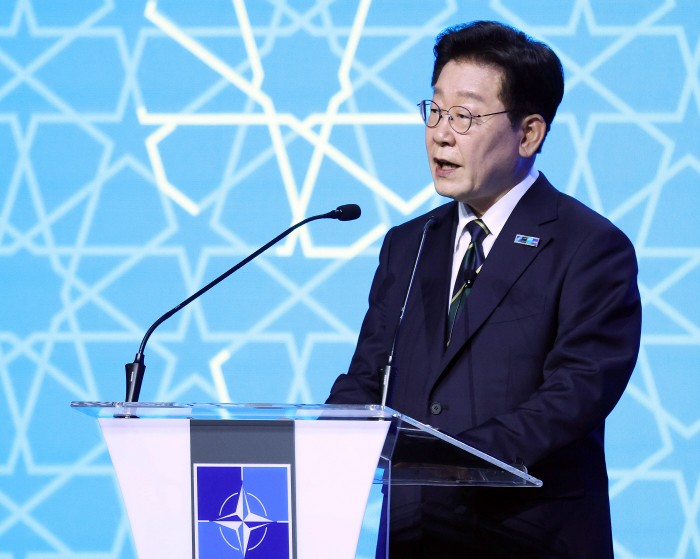 |
| South Korean President Lee Jae-myung delivers a keynote speech at the NATO Defense Industry Forum held at the Ankara Convention Center in Turkey on July 7 (local time). / Courtesy of Yonhap News |
South Korean President Lee Jae-myung proposed upgrading defense cooperation between South Korea and NATO beyond mere arms trading into a new phase of joint research, co-production, and joint operations during his address at the NATO Defense Industry Forum on July 7 (local time). The proposal leverages South Korea's defense manufacturing capacity and reliability amid a push among NATO members to expand defense spending and restructure defense supply chains.
"I propose that we elevate our defense industry cooperation, which currently centers on buying and selling weapon systems, into a 'ROK-NATO Defense Partnership 2.0' where we research, produce, and operate weapon systems together," President Lee stated during his keynote speech. The speech was delivered during the forum's fourth session, titled "Defense Industry Solidarity between the Republic of Korea and NATO," held in Ankara, Turkey.
President Lee pinned trust as the fundamental condition for this defense cooperation. "For cooperation to exert true power, there is something that must be secured alongside technology and production capacity," Lee said. "That is trust."
"NATO and the Republic of Korea share tragic memories of war and have stood as partners protecting the values of democracy, freedom, and peace amid rigorous security environments," he noted.
"On the back of this trust, South Korea's defense industry grew with the cooperation of NATO allies, enabling us to secure a high level of technological compatibility," Lee added.
The President emphasized that combining South Korea's reliable production capabilities and proven technological prowess with NATO's long-standing institutional expertise would bolster security on both sides.
"If the stable production capacity and proven technology of South Korea, a reliable partner, are combined with NATO's long-standing know-how, the security capabilities of both sides will be significantly enhanced," Lee said. "In an era of uncertainty, actions must be bolder and cooperation must happen faster."
President Lee also suggested expanding joint research in cutting-edge technologies, an effort closely linked to interoperability—a key focus for NATO. Member states prioritize standards and compatibility across weapon systems, ammunition, communications, and maintenance to ensure effective joint operations.
Collaborating with NATO from the research and development phase could pave the way for South Korean weapon systems to better align with NATO operational standards and increase opportunities for co-production. President Lee's "Partnership 2.0" proposal falls in line with NATO's internal push to strengthen its defense industrial base.
"First, we must boldly expand joint research into advanced technologies," Lee said. "Developing and researching together is the most definitive way to align technological standards and share the direction of innovation."
"I hope we can plan and push forward more joint research programs, similar to NATO's ammunition and space cooperation initiatives in which South Korea currently participates," he noted.
Drawing a parallel to energy security, President Lee suggested implementing a collective management approach within the defense sector.
"Just as member nations of the International Energy Agency jointly manage strategic petroleum reserves to respond to energy crises, I look forward to creating mechanisms that apply similar wisdom to the defense industry," Lee said.
"In a rapidly changing security environment, I believe the world becomes safer only when nations with a strong will to defend themselves forge a tighter solidarity," he said. "South Korea will be your most reliable partner."
Prior to attending the forum, President Lee held a bilateral meeting with NATO Secretary General Mark Rutte to reaffirm their commitment to deepening ties.
"We have spoken on the phone a couple of times, but it is a pleasure to meet you in person," Lee said during the meeting. Rutte responded by thanking President Lee for his dedicated efforts to ensure that the ROK-NATO relationship continues to develop robustly.
The two leaders previously built consensus on cooperation through phone conversations in July last year and this past February.
Following the bilateral talks, President Lee joined a restricted-attendance meeting alongside Secretary General Rutte and leaders from the Indo-Pacific partners (IP4), which includes Japan, Australia, and New Zealand. The session reportedly focused on the war in Ukraine, Indo-Pacific security, and defense supply chain cooperation.
The NATO Defense Industry Forum draws roughly 1,000 officials from NATO governments, defense contractors, and financial institutions. Integrated into the official NATO summit schedule last year, the forum has established itself as a high-level platform for discussing defense production, investment, and innovation.
Park Young-hoon
Most Read
-
1
Trump shares map on social media labeling Strait o..

-
2
Kia Sportage outperforms Mazda CX-5 in German auto..

-
3
Houthis launch successive attacks on Saudi airport..

-
4
U.S. deploys carrier, 10,000 more troops to Middle..

-
5
Trump rejects Iran's offer to open Strait of Hormu..

-
6
N. Korea conducts first swarm attack drill with dr..

-
7
U.S.-China summit falls short on substance as Trum..

PEOPLE





HEADLINE NEWS
- Seoul dismisses Ukraine's claim of 'S. Korean support for Russia' as "inaccurate and inappropriate"
- S. Korea, Japan race to develop nuclear-powered submarines
- Henri Kagan, Kenso Soai win Nobel Prize in Chemistry for uncovering how mol..
- Vance says Alaska LNG cooperation will move forward with Seoul's current or..

-
Address : In-Young Bldg., 34, Uisadang-daero 1-gil, Yeongdeungpo-gu, Seoul
Copyright by ASIATODAY CO., LTD. All rights resereved