



Wildfires scorch southern Europe as historic heatwave briefly eases
Jul 07, 2026, 10:25 am


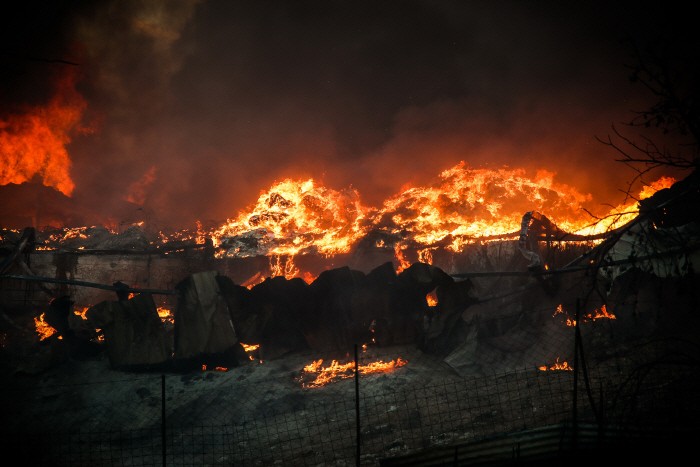 |
| A massive plume of smoke rises from a wildfire that broke out on the outskirts of Thessaloniki, Greece, on July 5 (local time). The Greek Fire Service announced that the blaze erupted outside Thessaloniki, the country's second-largest city, engulfing two factories and blanketing the entire urban area in toxic smoke. / Courtesy of Xinhua, Yonhap News |
Large-scale wildfires have broken out consecutively across southern Europe—including Portugal, Spain, France, and Greece—prompting the deployment of thousands of firefighters and emergency equipment. National authorities are marshaling all available resources for firefighting and resident evacuations to prevent further damage, the AP reported on July 6 (local time).
In the Vouzela region of central Portugal, a blaze that erupted on July 2 raged for four days, scorching 12,000 hectares of land. More than 1,200 firefighters, 400 response vehicles, and 15 water-bombing aircraft have been mobilized to the scene.
As the scale of the fire expanded, neighboring countries provided assistance under the coordination of the European Commission's Directorate-General for European Civil Protection and Humanitarian Aid Operations (ECHO). Spain dispatched 120 firefighters alongside 45 emergency vehicles, while a combined total of three firefighting aircraft were deployed from Italy and Spain.
Portuguese authorities stated that the main body of the fire had been contained as of the afternoon of July 5, with operations currently focused on extinguishing remaining hotspots.
In the Girona region of eastern Spain, a wildfire that broke out on July 3 has consumed approximately 2,200 hectares of land. Firefighting authorities reported facing difficulties achieving full containment due to the fire line stretching across 40 kilometers.
Meanwhile, in the mountainous area east of Perpignan within the Pyrénées-Orientales region of southern France, a fire has charred around 1,500 hectares. A force of 750 firefighters and 200 vehicles has been dispatched to combat the flames. While no fatalities have been reported, one firefighter and one resident are said to be in critical condition.
Notably, because this area sits in close proximity to the route of the Tour de France—the world's largest cycling tournament, which kicked off on July 4—relevant authorities are reportedly reviewing whether to proceed with the race as scheduled.
In Greece, a fire broke out on July 5 in a pine forest in the Mandra region west of the capital city of Athens, drawing a response of 210 firefighters and 29 water bombers. In the Oreokastro suburb of northern Thessaloniki, a wildfire that erupted on the evening of July 4 spread to a recycling plant, blanketing the surrounding area in toxic smoke. Authorities advised local residents to keep their windows closed and remain indoors, while issuing evacuation warnings for nearby sectors, including facilities for persons with disabilities.
Greece consistently suffers from wildfire damage due to its arid summer climate. To counter the threat of wildfires driven by climate change, the country introduced technical countermeasures this May, establishing a wildfire surveillance system powered by four low-Earth orbit satellites. Although Greece avoided the severe heatwave that recently slammed western Europe this summer, dozens of wildfires continue to be reported across the mainland and its islands.
Lee Jeong-eun
Most Read
-
1
Celltrion’s Omlyclo gains ground in major European..

-
2
Trump demands rates fall below 1% as Fed hikes for..

-
3
Trump makes $1 trillion bet ahead of midterm elect..

-
4
Iran resumes ballistic missile production, assembl..

-
5
Samsung Electronics, Mistral AI to jointly develop..

-
6
Trump warns countries not helping U.S. must pay re..

-
7
Apple launches first foldable, 1 million won prici..

PEOPLE






HEADLINE NEWS
- Trump to roll out ‘unprecedented welcome’ for Xi with B-2 bombers, F-22 fighters
- S. Korea, U.S., and Japan form united front on Taiwan and economic coercion..
- Trump administration moves to impose sweeping sanctions on International Cr..
- Xi to make state visit to U.S. Sept. 23-25, dispelling rumors over his heal..

-
Address : In-Young Bldg., 34, Uisadang-daero 1-gil, Yeongdeungpo-gu, Seoul
Copyright by ASIATODAY CO., LTD. All rights resereved