



China launches strategic missile toward Pacific
Jul 07, 2026, 10:23 am


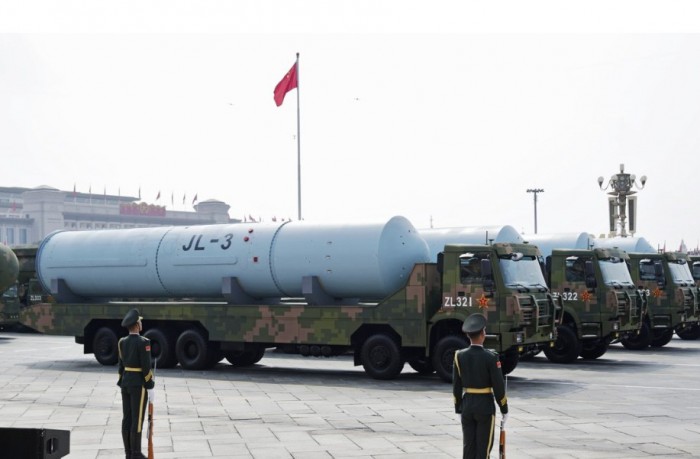 |
| China's JL-3 SLBM unveiled during a military parade on September 3 last year. / Courtesy of EPA, Yonhap News |
China test-fired a strategic missile toward the high seas of the Pacific Ocean on July 6. Commenting on the launch, a U.S. nuclear and missile expert analyzed that the projectile was highly likely the Julang (JL)-3, a submarine-launched ballistic missile (SLBM) capable of bringing the entire United States mainland within its striking range.
The People’s Liberation Army Navy (PLAN) announced via social media that a strategic nuclear submarine successfully launched a submarine-launched strategic missile carrying a dummy training warhead toward the Pacific Ocean at 12:01 p.m. (local time) on that day. The Chinese military explained that the missile accurately impacted the targeted waters, though it did not disclose specific details such as the model or the exact splashdown zone.
"This launch is part of our routine annual military training, and we provided advance notification to relevant nations in accordance with international law and practice," PLAN Spokesperson Wang Xuemeng stated. "It was not targeted at any specific country or objective."
China previously test-fired an intercontinental ballistic missile (ICBM) toward the high seas of the Pacific in September 2024. At the time, the launch marked China's first Pacific-bound ICBM test in 44 years since the Dongfeng (DF)-5 launch in 1980. Based on photographs released afterward, that missile was estimated to be the DF-31AG, which is capable of striking the U.S. mainland. The latest test comes approximately one year and 10 months after that launch, marking another strategic missile firing toward the Pacific.
The Japanese government expressed deep concern over China's latest test-firing. Prior to the launch, China had notified Japan of its plan, designating areas such as the waters south of Shiomisaki in Wakayama Prefecture as expected drop zones for space debris. However, Japanese media, including the Nihon Keizai Shimbun (Nikkei) and Kyodo News, reported that Japan had requested China to reconsider the move to avoid jeopardizing its national security.
According to the Japanese government, while parts of the designated drop zones fell within Japan's exclusive economic zone (EEZ), the actual splashdown point was confirmed to be outside the EEZ. No passage over Japanese territory or its EEZ airspace was detected, and no damage to aircraft or vessels was reported. Nevertheless, Japanese Chief Cabinet Secretary Minoru Kihara, serving as the government's top spokesperson, noted, "China's military trends lack transparency and present a matter of serious concern for Japan and the international community."
In response to the international backlash, the Chinese Ministry of Foreign Affairs stated, "The launch activity in question was a routine military exercise conducted in strict compliance with safety regulations and professional protocols. We hope that the countries concerned refrain from overinterpreting this event."
Conversely, experts in the United States are heavily weighing the possibility that the missile used in the test was the JL-3, China's latest SLBM. Jeffrey Lewis, director of the East Asia Nonproliferation Program at the Middlebury Institute of International Studies, told the New York Times, "It is highly probable that the Chinese military tested the JL-3."
As China's third-generation SLBM, the JL-3 boasts an operational range exceeding 10,000 km, allowing it to hold most of the globe, including the U.S. mainland, in its crosshairs. Because SLBMs are operated underwater from strategic nuclear submarines, making them highly elusive to detect, they possess far greater survivability than land-based ICBMs and are thus considered the backbone of nuclear deterrence. China previously showcased the JL-3 during a military parade in September last year.
Dr. Lewis assessed that this test serves as a signal that China's nuclear modernization has entered a new phase. "Historically, Beijing has exercised relative restraint in ICBM testing due to political considerations, but those underlying political dynamics now appear to be shifting," he analyzed, adding, "We are likely to see more frequent long-range, nuclear-capable missile tests going forward."
Nam Mi-kyung
Most Read
-
1
Celltrion’s Omlyclo gains ground in major European..

-
2
Trump demands rates fall below 1% as Fed hikes for..

-
3
Trump makes $1 trillion bet ahead of midterm elect..

-
4
Iran resumes ballistic missile production, assembl..

-
5
Samsung Electronics, Mistral AI to jointly develop..

-
6
Trump warns countries not helping U.S. must pay re..

-
7
Seoul faces triple squeeze over troop deployment t..

PEOPLE







-
Address : In-Young Bldg., 34, Uisadang-daero 1-gil, Yeongdeungpo-gu, Seoul
Copyright by ASIATODAY CO., LTD. All rights resereved