



U.S. strikes Iran after Hormuz tanker attacks, sending oil and gas prices higher
Jul 08, 2026, 10:28 am


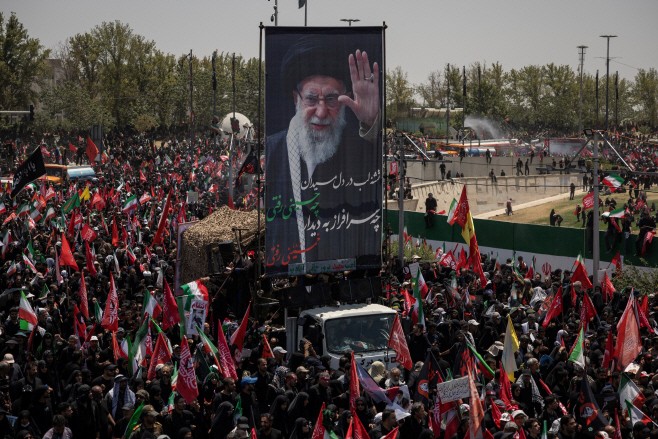 |
| A vehicle carrying a large portrait of Iranian Supreme Leader Ali Khamenei, who was killed in a joint US-Israeli airstrike on February 28, passes through a crowd of mourners during a funeral procession in Tehran on July 6 (local time). / Courtesy of Reuters, Yonhap News |
Iran’s Islamic Revolutionary Guard Corps (IRGC) carried out a series of attacks on three vessels, including a Qatari liquefied natural gas (LNG) carrier, in the Strait of Hormuz on July 7 (local time). This marks the largest maritime provocation since the signing of the US-Iran ceasefire memorandum of understanding (MOU) on June 18.
Following the attacks, the threat level for the Strait of Hormuz was upgraded to "severe." Global oil prices jumped more than 3% during intraday trading, while European natural gas futures surged by approximately 7%. Tensions are escalating rapidly as the US Central Command (CENTCOM) immediately launched retaliatory strikes against Iran.
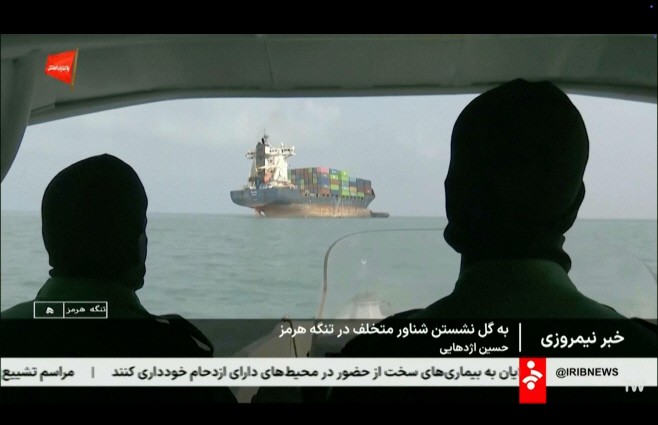 |
| This image, captured from an Iranian state TV broadcast, shows a vessel stranded in the Strait of Hormuz on July 1 (local time). / Courtesy of AP, Yonhap News |
IRGC attacks three vessels in Strait of Hormuz; Qatar demands accountability
Early this morning, the Al Rekayyat, a liquefied natural gas (LNG) carrier owned by Qatar's state shipping firm Nakilat, was struck in the Strait of Hormuz. The Wall Street Journal reported that a senior US official confirmed the Islamic Revolutionary Guard Corps (IRGC) fired missiles at two commercial vessels and deployed a drone against a third.
The crew of the Al Rekayyat abandoned the ship, which is now anchored southeast of Limah, Oman, Bloomberg reported, citing data from the Pakistan Hydrographic Office.
While Iran did not claim responsibility, Iranian state media reported that a Qatari tanker attempting to transit the Omani shipping lane had been targeted.
Bloomberg also reported that shipping data showed Qatari and Saudi vessels had been transiting the Strait with their Automatic Identification Systems (AIS) turned off to avoid detection. The Joint Maritime Information Center (JMIC), which coordinates communication between Western navies and commercial shipping, stated that the IRGC is continuing its radio contact demands and pressuring vessels to alter their courses.
The Washington Post reported that Qatari Foreign Ministry Spokesperson Majed al-Ansari strongly condemned the attack on X (formerly Twitter), calling it a "flagrant and serious violation" of international law and the freedom of navigation. He urged Iran to cease these actions immediately and stated that Qatar would hold Iran fully accountable for all damages and consequences resulting from the incident.
Despite the backlash, Iran argued at the UN International Maritime Organization that it retains the right to control parts of the Strait of Hormuz, according to Bloomberg.
US Central Command retaliates against Iranian military targets; threat level upgraded to 'Severe'
US Central Command (CENTCOM) launched retaliatory strikes in response to the attacks. "US forces have initiated powerful strikes against Iran to impose a heavy cost for targeting commercial vessels with civilian crews in international waterways," CENTCOM announced on X.
CENTCOM added, "These strikes are a direct response to Iran’s attack on three commercial vessels transiting the Strait of Hormuz. Iran's blatant acts of aggression are unwarranted, dangerous, and a clear violation of the ceasefire agreement."
While shipping traffic had been recovering—with more than 200 vessels transiting the strait during the week leading up to July 5—the maritime threat level for the area has been upgraded from "substantial" to "severe" following today's attacks.
Qatar may reconsider mediation role as IRGC's rogue actions emerge as a wildcard
Qatar joined the US-Iran mediation channel in May and successfully brokered the June ceasefire MOU. However, concerns are mounting that the attack on its own LNG carrier could fundamentally undermine Doha's role as a mediator.
"The attack on the LNG tanker will prompt Qatar to reconsider its mediation role," Andreas Krieg, an associate professor at King's College London and a director at MENA Analytica, told Bloomberg. "It has become clear that Iran does not respect the framework of the MOU."
Krieg pointed out that Iran is taking an "inconsistent" approach to mediation, analyzing that the IRGC Navy might be pursuing its own rogue interests, independent of other government ministries and factions within the IRGC that wish to continue negotiations.
Bloomberg noted that if Qatar withdraws from its mediation role, the pace of negotiations could slow drastically, adding that while Pakistan is also acting as a mediator, it lacks Qatar's extensive experience in handling Middle Eastern conflicts.
Gulf oil producers expand bypass routes, eroding Iran's leverage over Hormuz
The Wall Street Journal reported that the United Arab Emirates (UAE) successfully boosted its crude exports using bypass pipelines and shipping routes off the coast of Oman, increasing volumes from 1.9 million barrels per day (bpd) in March to 4.3 million bpd in early June—recovering to roughly 85% of pre-war levels.
According to Kpler data cited by the WSJ, oil transit through the Strait of Hormuz stood at around 8 million bpd in early July, which is only half of pre-war levels. Rising crude supplies from the United States, Kazakhstan, Brazil, and Venezuela are further eating into Iran's geopolitical leverage.
The WSJ also noted that Brent crude is trading around $73 a barrel, staying well below its early-war peak of $120.
The JMIC stated that despite the elevated threat level, US-supported shipping transits have continued without interruption. "Gulf oil producers have a powerful commercial incentive to prioritize transits that allow them to resume exports and expand production," Richard Bronze, co-founder of energy research firm Energy Aspects, told the WSJ. "Since the US wants to resupply the global oil market, this effort is actively supported and encouraged by Washington."
Sanam Vakil, director of the Middle East and North Africa program at Chatham House, told the WSJ: "This strategy is leading to diminishing returns and weakening Iran's authority. Iran is effectively sawing off the branch it is sitting on."
However, Max Meizlish, a research fellow at the Foundation for Defense of Democracies and a former US Treasury sanctions official, offered a different perspective to the WSJ. "The Strait of Hormuz may be easier for the Iranian regime to threaten than to monetize," Meizlish said. "Even if a formal transit toll system never fully materializes, the ability to inject uncertainty into one of the world's most critical maritime chokepoints still grants Tehran disproportionate leverage."
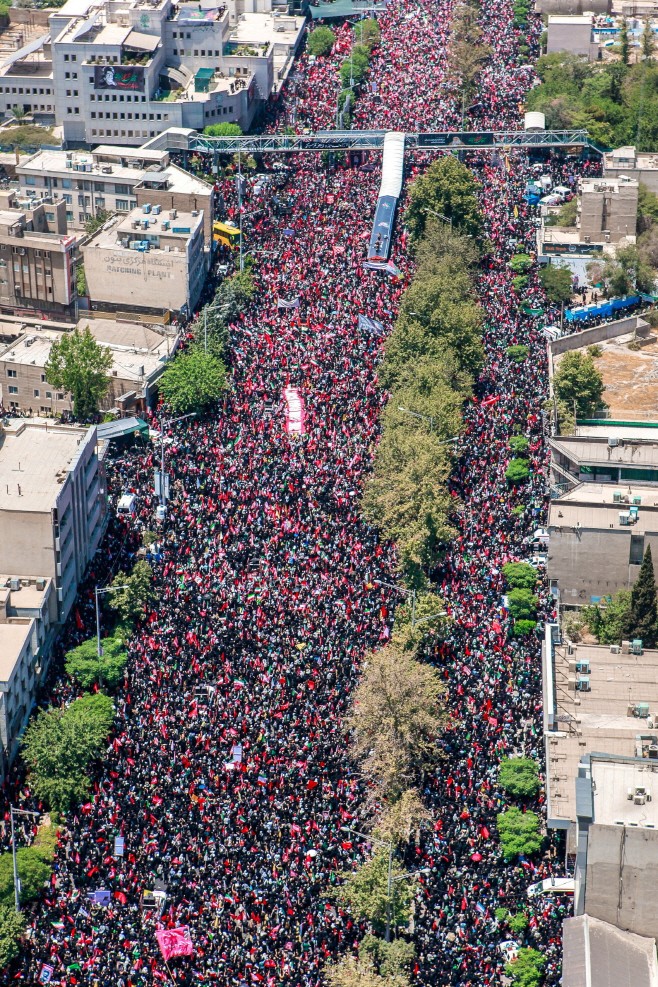 |
| Mourners gather in Tehran on July 6 (local time) to take part in the funeral procession for the late Iranian Supreme Leader Ali Khamenei, who was killed in a joint US-Israeli airstrike on February 28. / Courtesy of Reuters, Yonhap News |
Khamenei's funeral fuels hard-line sentiment; extension likely for 60-day US-Iran talks
The latest attacks appear closely linked to the mounting hard-line sentiment gripping the Iranian regime.
During the funeral proceedings for Supreme Leader Ali Khamenei—who ruled Iran for 37 years until he was killed in an Israeli airstrike on February 28, the opening day of the conflict—domestic hard-line rhetoric reached a fever pitch. The Wall Street Journal reported that Iranian President Masoud Pezeshkian encountered hostile crowds chanting "Death to the normalizers" and "Death to the traitors" after joining the funeral procession.
US-Iran negotiations have been temporarily suspended during the mourning period for Khamenei, which runs through July 9. Qatar stated that it intends to reschedule the next round of meetings as soon as the funeral concludes. However, because core disputes—such as the trajectory of Iran's nuclear program and guarantees for the freedom of navigation in the Strait of Hormuz—remain unresolved, observers are raising the possibility of extending the 60-day negotiation window originally established by the MOU.
"What we are likely to see is a continuation of tit-for-tat exchanges in the strait," Dina Esfandiary, an analyst at Bloomberg Economics, predicted. "While it may not trigger a return to full-scale war for now, it certainly does very little to help advance the negotiations."
Ha Man-joo
Most Read
-
1
Celltrion nears additional contract with major U.S..

-
2
Putin proposes trilateral U.S.-China-Russia summit..

-
3
U.S. weighs dropping MOAB, world's most powerful n..

-
4
"Aren't those foreigners on welfare?": M..

-
5
Attention centers on APEC for possible Trump-Xi-Pu..

-
6
Saudi Arabia, Iran hold first diplomatic talks to..

-
7
China tightens grip on boosting domestic demand an..

PEOPLE







-
Address : In-Young Bldg., 34, Uisadang-daero 1-gil, Yeongdeungpo-gu, Seoul
Copyright by ASIATODAY CO., LTD. All rights resereved