



AI warning system introduced for distressed SMEs to reshape financial restructuring
Jul 08, 2026, 09:49 am


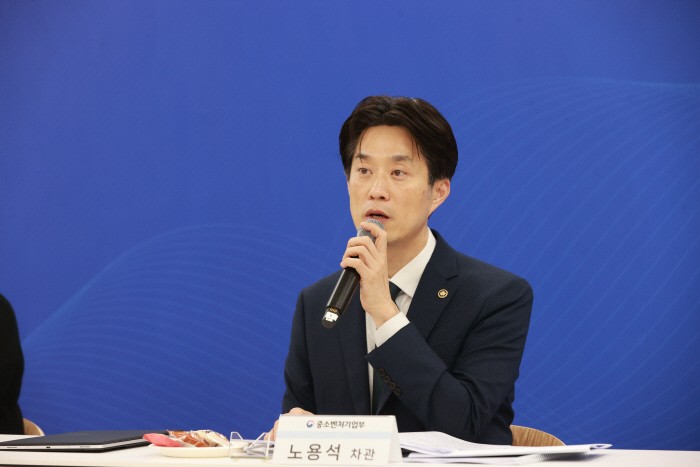 |
| Vice Minister of SMEs and Startups No Yong-seok, who is currently serving as acting minister |
A comprehensive, cross-ministerial blueprint has been devised to rescue and revitalize small and medium-sized enterprises (SMEs) struggling with stagnant growth and escalating financial distress at an early stage.
On July 8, the Ministry of SMEs and Startups, in coordination with relevant ministries, announced the "SME Revitalization Initiative." The sweeping measures cover the entire corporate rehabilitation lifecycle, spanning from early distress detection to debt restructuring and pivot strategies for new business ventures. The action comes in response to deteriorating business conditions, where a prolonged period of high interest rates and economic slowdown pushed the proportion of marginal firms—companies whose interest expenses have exceeded operating profits for three consecutive years—to a record high of 8.8% last year.
Under the new plan, the government will proactively filter out distressed enterprises and provide tailored support packages based on their risk profiles. Most notably, an "AI-driven Early Warning System" will be introduced, expanding the number of monitored companies from the previous 60,000 to all 250,000 registered SMEs. The artificial intelligence platform will analyze media coverage and broader industrial trends to calculate a four-tiered risk index, sending real-time alerts to vulnerable firms while automatically pairing them with specialized consulting, policy loans, and R&D support.
Concurrently, corporate restructuring frameworks and win-win financial programs for financially distressed firms will be tightly integrated. Screening criteria will be overhauled to offer preferential loan terms to distressed firms with strong turnaround potential. To encourage commercial banks to participate, the government will factor the proportion of SME debt restructurings into the banking sector's official "Win-Win Finance Index." For businesses seeking formal rehabilitation, the administration will actively deploy the "Pre-Ancillary Restructuring Support (Pre-ARS)" program, providing expert advisory services and steering debt negotiations.
The initiative also focuses on structural upgrades, giving funding priority to firms pivoting into promising new industries and regional core sectors. Moving forward, government support will follow a milestone-based system, meaning funds will be distributed incrementally based on the achievement of annual performance targets. Companies demonstrating exceptional results will be fast-tracked into the government's "Jump-Up Program" to accelerate scale-up growth. Alongside this, a "Collaborative Business Transformation Model" will be launched to encourage large conglomerates and mid-market companies to venture into new business sectors jointly with their SME suppliers.
Finally, legal and logistical frameworks will be updated to back these economic recovery goals. The official scope of what qualifies as a business transformation will be expanded to encompass diverse corporate restructuring methods, including spin-offs and mergers and acquisitions (M&A). To alleviate chronic labor shortages in high-tech fields, the maximum stay for specialized foreign workers (E-7 visas) employed at approved transforming enterprises will be extended from three to five years. The government plans to secure expanded budget allocations and advance related legislative amendments before the end of the year.
"We will concentrate our administrative capabilities and financial resources on ensuring that viable small and medium enterprises can overcome their current crises through business diversification and structural restructuring," said Vice Minister of SMEs and Startups No Yong-seok, who is currently serving as acting minister. He added, "Our goal is to build a robust economic ecosystem where continuous innovation and risk-taking remain viable for smaller firms."
Oh Se-eun
Most Read
-
1
Kia Sportage outperforms Mazda CX-5 in German auto..

-
2
Houthis launch successive attacks on Saudi airport..

-
3
Saudi Arabia, Iran hold first diplomatic talks to..

-
4
U.S. deploys carrier, 10,000 more troops to Middle..

-
5
Saudi airport in Riyadh struck again, leaving at l..

-
6
Japan tracks Ukraine fiber-optic drones, bolsters..

-
7
Putin's ally visits China on the 8th ahead of APEC..

PEOPLE






HEADLINE NEWS

-
Address : In-Young Bldg., 34, Uisadang-daero 1-gil, Yeongdeungpo-gu, Seoul
Copyright by ASIATODAY CO., LTD. All rights resereved