



Samsung-SK Hynix leverage ETNs sink below 20,000 won IPO price
Jul 08, 2026, 09:43 am


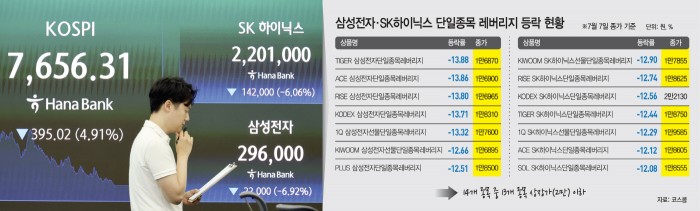 |
| The closing prices of the Kospi, SK Hynix, and Samsung Electronics are displayed on the electronic screen at the Hana Bank dealing room in Jung-gu, Seoul on July 7, following a nearly 5% plunge in the benchmark index. On this day, the Kospi plummeted 395.02 points (4.91%) from the previous session to close at 7,656.31, while the Kosdaq index shed 15.84 points (1.87%) to finish at 831.23. / Courtesy of Yonhap News |
As shares of Samsung Electronics and SK Hynix took a heavy beating, single-stock leverage financial products tracking the two tech giants tumbled to their lowest levels since listing. Out of 14 single-stock leverage products available on the market, 13 crashed well below their initial base price of 20,000 won. The steep decline was fueled by the inherent leverage mechanism, which amplified losses two-fold as the underlying stocks fell in a bearish market.
At the core of this price collapse lies fading market optimism surrounding Samsung Electronics. Despite reporting record-high corporate earnings that outpaced Nvidia, Samsung Electronics saw its stock price plunge by over 6%. Industry analysts note that a growing market consensus that semiconductor profitability has reached its peak played a decisive role, with worries over slowing future growth overshadowing the stellar earnings report. Observers forecast that this disconnect between earnings and stock performance could persist for some time unless the uncertainties hovering over the semiconductor industry are fully resolved.
The severe downturn shook the broader market, introducing extreme volatility to the benchmark Kospi index and triggering successive trading curbs throughout the day. It presented a structural vulnerability where the underperformance of mega-cap chip stocks ripples out to the broader bourse via derivative products—a classic case of the "tail wagging the dog." Acknowledging criticism that single-stock leverage products are exacerbating market volatility, the government indicated that it is carefully reviewing potential countermeasures.
According to data from the Korea Exchange and Koscom on July 7, Samsung Electronics and SK Hynix finished the trading session down 6.92% and 6.06%, respectively. Consequently, the 14 single-stock leverage products tied to these two assets plunged by double that amount, closing down in the 12% to 13% range.
In terms of percentage drops for Samsung Electronics tracking products, the TIGER Samsung Electronics Single-Stock Leverage ETN led the losses by plummeting 13.88% to close at 16,870 won, followed closely by the ACE Samsung Electronics Single-Stock Leverage ETN down 13.86% to 16,900 won, and the RISE Samsung Electronics Single-Stock Leverage ETN which shed 13.80% to finish at 16,965 won.
Among the products linked to SK Hynix, the KIWOOM SK Hynix Futures Single-Stock Leverage ETN saw the sharpest decline, dropping 12.90% to close at 17,855 won. The RISE SK Hynix Single-Stock Leverage ETN followed with a 12.74% drop to 18,625 won, while the KODEX SK Hynix Single-Stock Leverage ETN fell 12.56% to finish at 22,130 won.
Following the day's market rout, 13 out of the 14 products sank below their listing base price of 20,000 won, with the KODEX SK Hynix Single-Stock Leverage ETN being the sole exception. The KODEX Samsung Electronics Single-Stock Leverage ETN slid to an intraday low of 17,100 won, hitting its second-lowest level since touching an all-time low of 17,000 won on July 2.
The TIGER Samsung Electronics Single-Stock Leverage ETN also bottomed out at an intraday low of 15,705 won, remaining just above its previous low of 15,525 won recorded on July 2. Within the SK Hynix product lineup, the intraday lows for the KODEX SK Hynix Single-Stock Leverage ETN and the TIGER SK Hynix Single-Stock Leverage ETN hit 19,685 won and 16,645 won respectively, marking their third-lowest trading prices since inception.
Conversely, inverse leverage products—popularly known as "Gobbus"—which bet on a market decline, moved in the opposite direction. The SOL SK Hynix Futures Single-Stock Inverse 2X ETN surged 11.84% to close at 9,355 won, while the PLUS Samsung Electronics Futures Single-Stock Inverse 2X ETN jumped 12.68% to finish at 14,085 won.
The tandem plunge of the two largest market-cap stocks on the Kospi and their correlated leverage products exacerbated volatility across the entire exchange. In fact, trading on the Kospi swung so violently that a sidecar restriction on program selling was triggered during the session, followed by a full circuit breaker in the afternoon. However, the index managed to pare some losses as bargain hunters stepped in, closing down 4.91% at 7,656.31 after having plummeted over 8% at one point.
As single-stock leverage instruments sit at all-time lows, investor losses continue to mount due to the "negative compounding effect," which erodes principal capital whenever the underlying asset experiences heavy fluctuations. During a plenary session of the National Assembly's Strategy and Finance Committee on the same day, Deputy Prime Minister and Minister of Strategy and Finance Gu Yun-cheol addressed the issue, stating, "We are well aware of the concerns that leverage ETFs are introducing substantial volatility into the stock market," and added, "We are currently in consultations to find ways to stabilize and minimize these structural issues."
Park Isak
Most Read
-
1
Celltrion’s Omlyclo gains ground in major European..

-
2
Trump demands rates fall below 1% as Fed hikes for..

-
3
Hyundai Motor Group breaks ground on integrated st..

-
4
U.S. strikes 3 Iranian oil tankers, Iran vows reta..

-
5
Trump makes $1 trillion bet ahead of midterm elect..

-
6
Iran resumes ballistic missile production, assembl..

-
7
Samsung Electronics, Mistral AI to jointly develop..

PEOPLE







-
Address : In-Young Bldg., 34, Uisadang-daero 1-gil, Yeongdeungpo-gu, Seoul
Copyright by ASIATODAY CO., LTD. All rights resereved