



National Pension Service acts as stock market anchor, but fund management burdens grow
Jul 08, 2026, 09:29 am


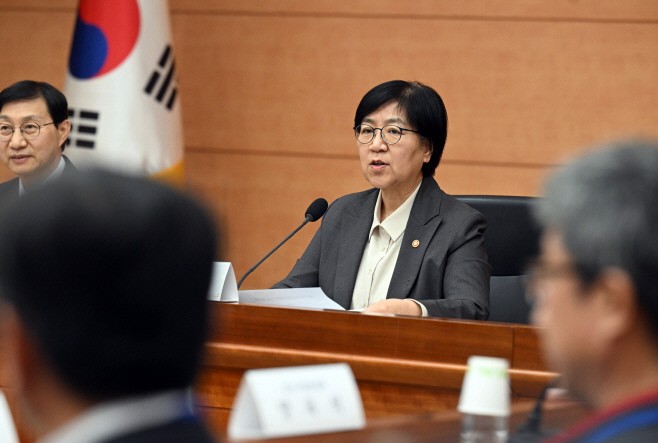 |
| Jung Eun-kyung, Minister of Health and Welfare, delivers remarks during the 3rd National Pension Fund Management Committee meeting of 2026, held at the Government Complex Sejong on the afternoon of the 14th. / Courtesy of Asia Today |
The National Pension Service (NPS) is facing a growing dilemma as it increasingly takes on the role of a safety valve for the domestic stock market. While the world-class pension fund must adhere strictly to asset allocation principles to ensure long-term profitability, its escalating influence over domestic equities is forcing it to heavily weigh market stability. Analysts note that the government's recent move to create a dedicated administrative unit to oversee fund management is closely tied to this evolving and weightier role.
According to government sources on July 7, the Ministry of Health and Welfare recently announced a legislative preview for a partial amendment to its enforcement rules. The proposal outlines the establishment of a Fund Management and Administration Division under the Social Welfare Policy Office to improve the overarching management structure of the national pension fund. Set up as a temporary unit operating until July 31, 2029, the new division will be staffed by four officials, including one grade-4 director.
As of late April this year, the NPS stands as one of the largest pension funds in the world, managing assets worth 1,670.7 trillion won. Last year, the fund posted an exceptional annual investment return of 18.82%, generating a profit of 231.6 trillion won. With the pool of capital expanding rapidly, the stakes surrounding its financial management have reached unprecedented heights.
The underlying challenge is that the sheer size of the fund amplifies its footprint across investment markets. In particular, during the recent surge in domestic equities, every single trade execution by the NPS emerged as a market-moving variable, transforming the fund from a standard institutional investor into a central force steering the entire bourse.
The most notable manifestation of this dynamic is the ongoing debate regarding the rebalancing of its domestic stock portfolio. As a long-term institutional investor, the NPS manages assets based on strict target weights assigned to each asset class. While its initial target weight for domestic equities earlier this year was set at 14.9%, the Fund Management Committee revised that target upward to 20.8% in May. When accounting for both Strategic Asset Allocation (SAA) and Tactical Asset Allocation (TAA), the permissible upper threshold was expanded to a maximum of 28.8%.
Nevertheless, as the domestic stock market extended its upward trajectory, market observers pointed out that the actual proportion of domestic equities held by the NPS likely exceeded the allowed limits. This triggered projections that the fund might have to unload an estimated 70 trillion won or more in massive sell-offs to rebalance its portfolio.
Adhering strictly to portfolio rules risks destabilizing the market due to the sheer volume of impending sell orders. Conversely, delaying liquidations for the sake of market stability threatens to undermine the fund's foundational asset allocation principles. If the market retreats, the fund's overall yield suffers; if the market continues to rally, the growing weight of domestic stocks creates an compounding asset concentration risk.
Addressing these challenges, Minister of Health and Welfare Jung Eun-kyeong, who chairs the Fund Management Committee, noted during the 6th committee session on July 2, "The National Pension Service has faithfully carried out its fiduciary duties to improve long-term, stable returns on our assets." She added, "Moving forward, we will continue to manage the public's retirement capital with a deep sense of responsibility and strive to deliver steady, long-term performance."
Lee Se-mi
Most Read
-
1
Celltrion nears additional contract with major U.S..

-
2
Putin proposes trilateral U.S.-China-Russia summit..

-
3
U.S. weighs dropping MOAB, world's most powerful n..

-
4
"Aren't those foreigners on welfare?": M..

-
5
Attention centers on APEC for possible Trump-Xi-Pu..

-
6
Saudi Arabia, Iran hold first diplomatic talks to..

-
7
China tightens grip on boosting domestic demand an..

PEOPLE







-
Address : In-Young Bldg., 34, Uisadang-daero 1-gil, Yeongdeungpo-gu, Seoul
Copyright by ASIATODAY CO., LTD. All rights resereved