



Labor and management narrow minimum wage gap to 990 won
Jul 08, 2026, 09:26 am


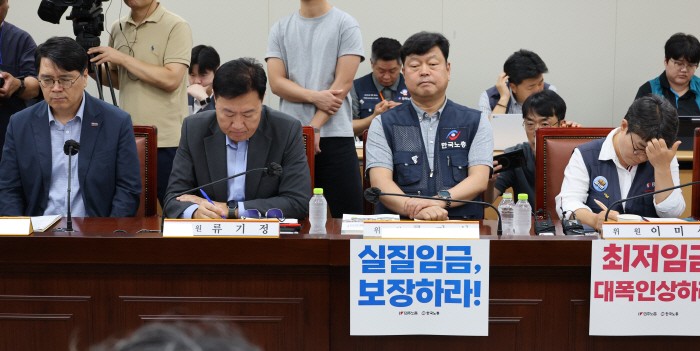 |
| Yang Ok-seok, head of labor policy at the Korea Federation of SMEs; Ryu Ki-jung, executive director of the Korea Enterprises Federation; Ryu Ki-sub, secretary-general of the Federation of Korean Trade Unions; and Lee Mi-sun, vice president of the Korean Confederation of Trade Unions, listen to public-interest members during the 12th plenary session of the Minimum Wage Commission at the Government Complex Sejong on July 7. / Courtesy of Yonhap News |
Labor and management narrowed the gap between their wage proposals to under 1,000 won during the ongoing deliberations for next year's minimum wage, yet failed to reach a consensus. Instead of immediately introducing a mediation range, public interest members chose to allow more time for voluntary negotiations, pushing the final decision to the next session.
The Minimum Wage Commission convened its 12th plenary session at the Government Complex Sejong on July 7 to continue reviews for the 2027 minimum wage. During the meeting, both sides expedited discussions by filing their fifth and sixth revised proposals in quick succession. In the sixth revision, labor requested an hourly rate of 11,450 won, while management offered 10,460 won. This brought the discrepancy down to 990 won, a 70-won reduction from the 1,060-won gap seen in the fifth revision.
The labor side lowered its demand by 50 won from its fifth proposal of 11,500 won. Compared to its initial demand of 12,000 won, the current figure represents a 550-won reduction and a 10.9% increase from the current minimum wage of 10,320 won. Meanwhile, management bumped its offer up by 20 won from its fifth proposal of 10,440 won. This stands 140 won higher than its initial demand for a freeze, translating to a 1.4% increase over the current rate.
Despite continuous efforts to find common ground through revised proposals, a significant rift remains. Labor continues to press for a double-digit growth rate, whereas management stands firm on a 1% range increase, citing the limited payment capacities of small businesses and self-employed micro-owners.
The clear divergence in perspectives was evident during the opening remarks. Ryu Ki-sub, secretary-general of the Federation of Korean Trade Unions, noted, "An export-driven recovery does not instantly trigger an expansion in domestic demand," adding, "The minimum wage adjustment is a critical matter that directly affects not only worker livelihoods but also the recovery pace of domestic consumer spending."
Lee Mi-sun, vice president of the Korean Confederation of Trade Unions, stated, "The minimum wage demanded by labor is not just a baseline to scrape by day to day, but a desperate cry to provide a breathing room that allows workers to plan for the upcoming month."
In contrast, employer members pointed to harsh business realities to argue for wage restraint. Ryu Ki-jung, executive director of the Korea Enterprises Federation, remarked, "Over the past decade, the minimum wage has climbed roughly 3.5 times faster than the consumer price index," warning that "another hike on top of this will inevitably force small businesses toward closures and payroll downsizings."
Yang Ok-seok, head of labor policy at the Korea Federation of SMEs, stated, "Although the statutory deadline has passed, we must not rush into a decision that small firms and shopkeepers cannot bear," emphasizing that "next year's minimum wage should be determined based on the payment capacity of the most vulnerable sectors."
Public interest members intend to wait for further progress between the two sides. Kwon Soon-won, chairperson of the Minimum Wage Commission, said, "The public interest members intend to wait until the absolute final moment to let both sides narrow their differences," urging, "We ask for your active cooperation so that a swift convergence can be achieved."
A mediation range is an administrative procedure where public interest members present an upper and lower limit for the wage hike when negotiations stall, aiming to guide a compromise or a vote within those boundaries. If bilateral talks collapse entirely, the public interest members will establish this range and put either the narrowed counterproposals or a public interest proposal to a final vote.
The commission has already pushed past its statutory deliberation deadline of June 29. The Minister of Employment and Labor is legally required to officially announce the next year's minimum wage by August 5. Considering subsequent administrative steps, such as handling formal objections, the commission must submit its finalized minimum wage proposal to the Ministry of Education by mid-July at the latest.
Kim Nam-hyung
Most Read
-
1
Celltrion nears additional contract with major U.S..

-
2
Putin proposes trilateral U.S.-China-Russia summit..

-
3
U.S. weighs dropping MOAB, world's most powerful n..

-
4
"Aren't those foreigners on welfare?": M..

-
5
Attention centers on APEC for possible Trump-Xi-Pu..

-
6
Saudi Arabia, Iran hold first diplomatic talks to..

-
7
China tightens grip on boosting domestic demand an..

PEOPLE






-
Address : In-Young Bldg., 34, Uisadang-daero 1-gil, Yeongdeungpo-gu, Seoul
Copyright by ASIATODAY CO., LTD. All rights resereved