



Gov't, DP go all out to court youth amid panic over losing their support
Jul 07, 2026, 09:12 am


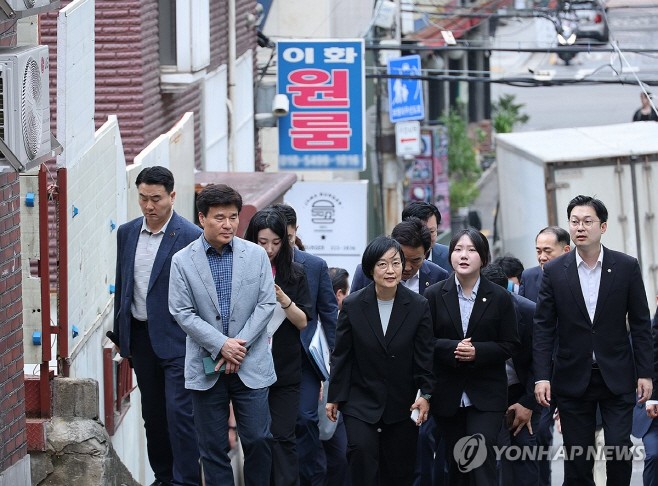 |
| Prime Minister Han Sung-sook, accompanied by Representative Kim Dong-ah of the Democratic Party of Korea and Seodaemun-gu Office Head Park Woon-ki, tours a studio apartment-heavy neighborhood in Sinchon, Seodaemun-gu, Seoul, on the afternoon of July 4. / Courtesy of Yonhap News |
The Lee Jae-myung administration and the Democratic Party of Korea are aggressively pushing youth-focused policies to the forefront. This coordinated effort is driven by an urgent need to win back young voters following a distinct departure of the 2030 demographic in the June 3 local elections, alongside a growing realization that relying solely on their traditional 40-to-60s base cannot guarantee future electoral victories.
According to political circles on July 6, this youth-centric approach materialized during a high-level government-party consultation on July 5 with a plan to establish a "Future Response Fund." Kang Hoon-sik, Presidential Chief of Staff, stated that the fund would focus on creating future growth engines, addressing K-shaped economic polarization, and providing housing, startup, and employment support for young adults. The presidential office has also ramped up engagement by formalizing monthly joint meetings for youth advisors across 19 ministries starting this month.
Within the party, lawmakers are increasingly vocal about youth issues. Representative Mo Kyeong-jong, chair of the national youth committee, commented on the retirement age extension by stating that the starting line for the youth cannot be erased for the sake of extension, leading the special committee to push back its feedback deadline to the September regular parliamentary session. Additionally, Prime Minister Han Sung-sook visited a studio apartment district in Sinchon, Seoul, on July 4—her first weekend since taking office—and stressed the necessity of expanding the youth housing supply, while leadership contenders ahead of the August 17 national convention are rolling out competing youth pledges.
This total mobilization stems from a stark decline in youth support. A Gallup Korea poll conducted from June 23 to 25 showed Democratic Party support at just 20% among respondents in their 20s and 30% for those in their 30s, falling well below the overall average of 41%. Even young women, traditionally viewed as a friendly demographic, recorded support rates of 31% and 36% for those in their 20s and 30s, respectively—significantly lower than the 61% recorded among women in their 40s.
Insiders emphasize that capturing the 2030 demographic requires actual policy shifts rather than temporary marketing, pointing out that party rhetoric often remains trapped in traditional intra-party debates despite putting youth at the center of public messaging. Against the backdrop of these anxieties, a wave of young candidates in their 20s and 30s are launching bids for the party's supreme council ahead of the national convention, emerging as a new variable in the race.
Shim Jun-bo
Most Read
-
1
Trump demands rates fall below 1% as Fed hikes for..

-
2
Celltrion seeks rheumatoid arthritis indication ex..

-
3
Chinese e-commerce giants AliExpress, Temu and She..

-
4
Trump warns countries not helping U.S. must pay re..

-
5
Turkish Airlines named main club partner of Liverp..

-
6
China expels No. 2 military official Zhang Youxia..

-
7
Houthi rebels release video claiming downing of Sa..

PEOPLE





-
Address : In-Young Bldg., 34, Uisadang-daero 1-gil, Yeongdeungpo-gu, Seoul
Copyright by ASIATODAY CO., LTD. All rights resereved