



Indian stock market emerges as new investment destination amid ai boom
Jul 06, 2026, 04:24 pm


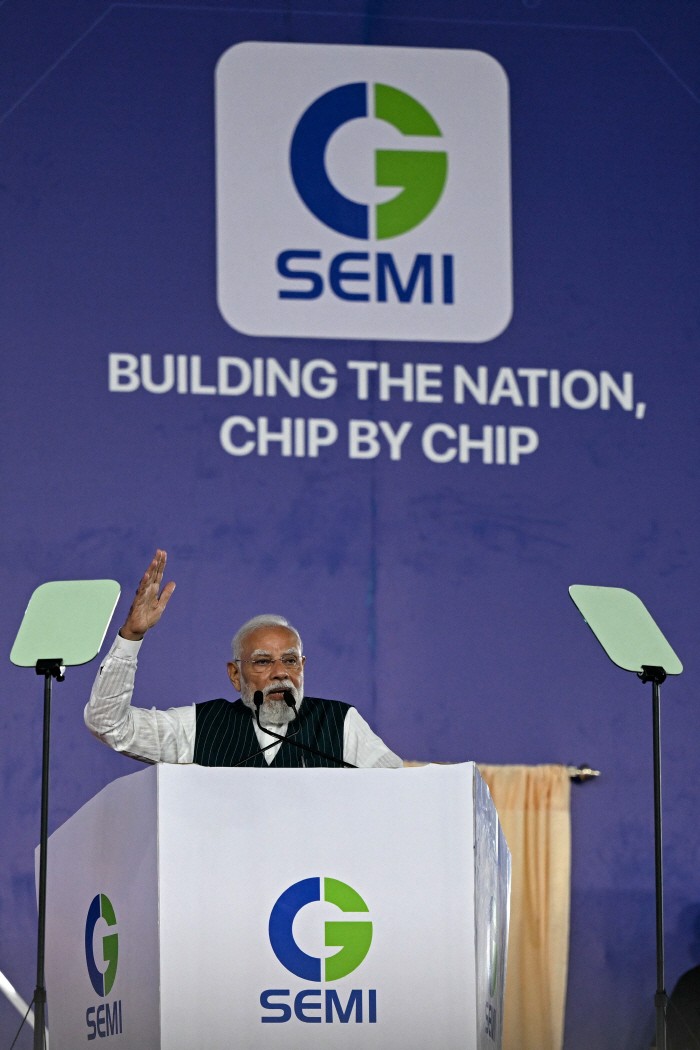 |
| Indian Prime Minister Narendra Modi speaks during the commercial production launch of 'CG Semi OSAT,' a newly built outsourced semiconductor assembly and test facility in Sanand, Gujarat, India, on July 4 (local time). / Courtesy of AFP-Yonhap |
The global artificial intelligence (AI) investment frenzy continues to surge, prompting investors to cast their eyes on the Indian stock market—a region that had previously drawn relatively less attention but is now emerging as a compelling new investment destination, Bloomberg reported on July 5 (local time).
A stabilizing Indian rupee, which had lost ground earlier this year, has effectively eased investor anxieties, while cooling tensions in the Middle East have driven down oil prices.
Last month, India's benchmark Nifty 50 index—comprising the top 50 companies by market capitalization listed on the National Stock Exchange of India (NSE)—outperformed the MSCI Emerging Markets Index by its widest margin since November last year.
The MSCI Emerging Markets Index serves as a global benchmark representing equities across developing economies, capturing large- and mid-cap representations across 24 emerging markets, including Brazil, China, India, South Korea, and Taiwan.
Sandeep Sabharwal, founder of the Mumbai-based investment research and advisory firm asksandeepsabharwal.com, observed, "The drop in commodity prices has swiftly reshaped India's macroeconomic outlook," adding that "depressed commodity costs, improved capital inflows, and a stable interest rate environment increase the likelihood that forward earnings revisions will tilt upward rather than downward."
Analysts at Morgan Stanley India, including Managing Director and Equity Strategist Ridham Desai, noted in a report last month that "India has now transformed into a significantly larger macro asset class." They highlighted that the nation has firmly established itself in recent years as a defensive growth market capable of weathering global shocks.
During the first half of the year, the Nifty 50 recorded a daily swing of 1% or more on 38 occasions—notably fewer than the 59 instances logged by both the MSCI Emerging Markets and Asia indexes. By contrast, South Korea’s KOSPI logged a staggering 79 instances, exhibiting heavy volatility across two-thirds of its trading days this year.
From an investor's standpoint, lower volatility translates into higher predictability and a more stable market, naturally boosting its appeal.
Expectations are also running high for the upcoming earnings season. Tata Consultancy Services (TCS) is scheduled to report its earnings on July 9, and investors are growing increasingly bullish following improvements in revenue and operating profit during the recent quarter.
Ben Powell, chief Middle East and APAC strategist at the BlackRock Investment Institute, remarked, "Earlier this year, India was held back by elevated energy prices, rich valuations, and a relative scarcity of AI enterprises." He concluded, "As these pressures subside, investors who had been strictly wedded to the AI investment craze are now looking elsewhere, including the Indian equity market. This shifts the focus back to India as a highly differentiated opportunity within emerging markets."
Park Jin-sook
Most Read
-
1
Celltrion’s Omlyclo gains ground in major European..

-
2
Trump demands rates fall below 1% as Fed hikes for..

-
3
Trump makes $1 trillion bet ahead of midterm elect..

-
4
Iran resumes ballistic missile production, assembl..

-
5
Samsung Electronics, Mistral AI to jointly develop..

-
6
Trump warns countries not helping U.S. must pay re..

-
7
Apple launches first foldable, 1 million won prici..

PEOPLE






HEADLINE NEWS
- Trump to roll out ‘unprecedented welcome’ for Xi with B-2 bombers, F-22 fighters
- S. Korea, U.S., and Japan form united front on Taiwan and economic coercion..
- Trump administration moves to impose sweeping sanctions on International Cr..
- Xi to make state visit to U.S. Sept. 23-25, dispelling rumors over his heal..

-
Address : In-Young Bldg., 34, Uisadang-daero 1-gil, Yeongdeungpo-gu, Seoul
Copyright by ASIATODAY CO., LTD. All rights resereved