



Record-breaking heatwave grips U.S., claiming at least 19 lives in New Jersey
Jul 06, 2026, 01:07 pm


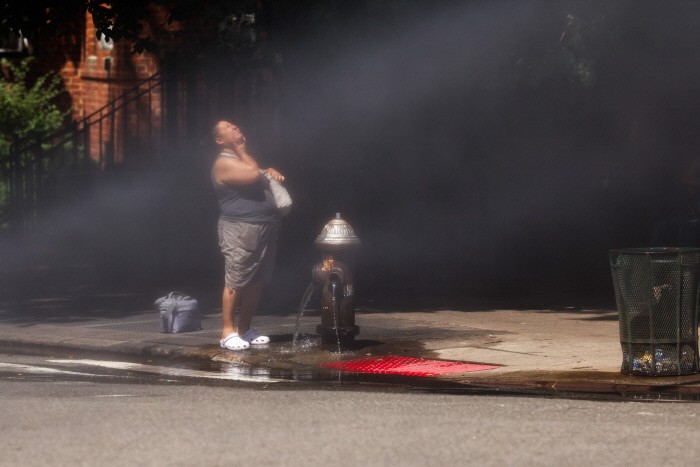 |
| A person cools off with water spraying from a fire hydrant in the Hamilton Heights neighborhood of Manhattan, New York, on July 2 (local time). / Courtesy of AFP-Yonhap |
The eastern United States is reeling from a record-breaking heat wave, with at least 19 deaths reported in New Jersey, the Associated Press reported on July 5 (local time).
Raynard Washington, director of the New Jersey Department of Health, told reporters on July 4, "Most of the heat-related fatalities were discovered in homes without air conditioning," adding that "some were also found outdoors, on the streets, and even inside parked vehicles."
New Jersey Governor Mikie Sherrill stated, "This is the hottest weather we've seen in 14 years," and noted that "this heat wave is hitting all age groups, not just the elderly or those with underlying health conditions."
Much of the eastern U.S., including New Jersey, is shattering all-time high temperature records.
Bryan Jackson, a meteorologist at the National Oceanic and Atmospheric Administration (NOAA) Weather Prediction Center, stated that the maximum temperature in Trenton, the capital of New Jersey, reached 38.3 degrees Celsius on July 2, breaking the previous record of 37.8 degrees set in 1901.
Newark, New Jersey's largest city, saw its peak temperature hit 40.5 degrees Celsius on the same day. Atlantic City, New Jersey, also broke its record at 39.4 degrees on July 2, with temperatures soaring further to 40.6 degrees on July 3 and 41.1 degrees on July 4.
In New York, LaGuardia Airport recorded 40 degrees Celsius on July 2, eclipsing the previous high of 38.3 degrees set in 1966.
Jackson explained that this heat wave is characterized by a "heat dome" phenomenon, which occurs when a combination of high temperatures, high humidity, and intense sunlight becomes trapped over an area.
"The heat wave persisted relentlessly for several days, and because the nights failed to cool down, the human body had no chance to recover," Jackson explained. "The accumulation of heat and humidity over multiple days placed excessive stress on the body, which ultimately proved fatal."
While the heat wave has since shifted eastward, it triggered severe storms packed with strong winds and heavy rainfall that knocked down utility poles.
According to PowerOutage.us, a website that tracks and aggregates power outages worldwide in real time, approximately 900,000 households across the U.S. Midwest, East, and South suffered power outages on July 5. More than 223,000 homes in Michigan and around 170,000 in Pennsylvania were left without electricity.
PPL Electric, a utility company in Pennsylvania, explained that a total of 121,417 households in the state were without power as of the morning of July 5.
Central Hudson, a utility provider in New York State, reported that more than 430 incidents of downed power lines had been received as of July 5, leaving roughly 50,000 households across New York affected by the storm.
Park Jin-sook
Most Read
-
1
Celltrion’s Omlyclo gains ground in major European..

-
2
Trump demands rates fall below 1% as Fed hikes for..

-
3
Trump makes $1 trillion bet ahead of midterm elect..

-
4
Iran resumes ballistic missile production, assembl..

-
5
Samsung Electronics, Mistral AI to jointly develop..

-
6
Trump warns countries not helping U.S. must pay re..

-
7
Apple launches first foldable, 1 million won prici..

PEOPLE






HEADLINE NEWS
- Trump to roll out ‘unprecedented welcome’ for Xi with B-2 bombers, F-22 fighters
- S. Korea, U.S., and Japan form united front on Taiwan and economic coercion..
- Trump administration moves to impose sweeping sanctions on International Cr..
- Xi to make state visit to U.S. Sept. 23-25, dispelling rumors over his heal..

-
Address : In-Young Bldg., 34, Uisadang-daero 1-gil, Yeongdeungpo-gu, Seoul
Copyright by ASIATODAY CO., LTD. All rights resereved