



China, Russia to launch joint military drills near Qingdao, Shandong soon
Jul 06, 2026, 10:28 am


China and Russia are expected to conduct joint military drills near Qingdao, Shandong Province, this month, before embarking on a joint maritime patrol in the Pacific Ocean. A flotilla of Russian warships taking part in the exercise has reportedly arrived at a naval port in Qingdao.
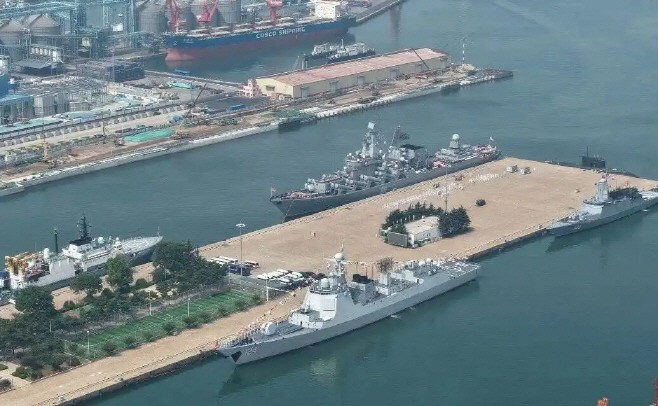 |
| A naval port in Qingdao, Shandong Province, where the joint military drills between China and Russia are set to take place. A flotilla of Russian warships is reportedly already at the port. / Courtesy of The Beijing News |
On July 5, China’s Ministry of National Defense announced through its official WeChat account that the Chinese and Russian navies will conduct the "Joint Sea-2026" joint military exercise this month in the waters and airspace near Qingdao. It explained that following the conclusion of the joint drills, select forces from both nations will move into the Pacific Ocean to carry out joint maritime patrols.
"This exercise and joint patrol are scheduled in accordance with the annual cooperation plan between the militaries of our two nations," the ministry stated. "They aim to jointly respond to security challenges and together safeguard regional peace and stability."
China and Russia have steadily strengthened their military cooperation over recent years, regularizing joint drills and patrols across both maritime and aerial domains. Through these combined exercises, the two sides have repeatedly tested their operational capabilities in various joint mission profiles, including anti-submarine warfare, air defense, and maritime search and rescue. The pattern of transitioning directly into a joint patrol after completing naval drills has also been consistently maintained.
Underscoring this dynamic, about a dozen military aircraft from both countries taking part in a China-Russia joint aerial exercise entered the Korea Air Defense Identification Zone (KADIZ) on June 27, prompting the South Korean Air Force to scramble fighter jets in response.
While Beijing and Moscow have maintained that these military activities are not directed at any third party, the international community views them differently. Global observers are closely monitoring the impact that the deepening Sino-Russian military cooperation will have on the security landscape of the Indo-Pacific region. This vigilance is especially heightened in the United States, which perceives both nations as its primary potential adversaries.
Hong Soon-do
Most Read
-
1
Celltrion’s Omlyclo gains ground in major European..

-
2
Trump demands rates fall below 1% as Fed hikes for..

-
3
Trump makes $1 trillion bet ahead of midterm elect..

-
4
Iran resumes ballistic missile production, assembl..

-
5
Samsung Electronics, Mistral AI to jointly develop..

-
6
Trump warns countries not helping U.S. must pay re..

-
7
Seoul faces triple squeeze over troop deployment t..

PEOPLE







-
Address : In-Young Bldg., 34, Uisadang-daero 1-gil, Yeongdeungpo-gu, Seoul
Copyright by ASIATODAY CO., LTD. All rights resereved