



Kazakhstan split over maintaining driver's licenses for the elderly
Jul 06, 2026, 10:20 am


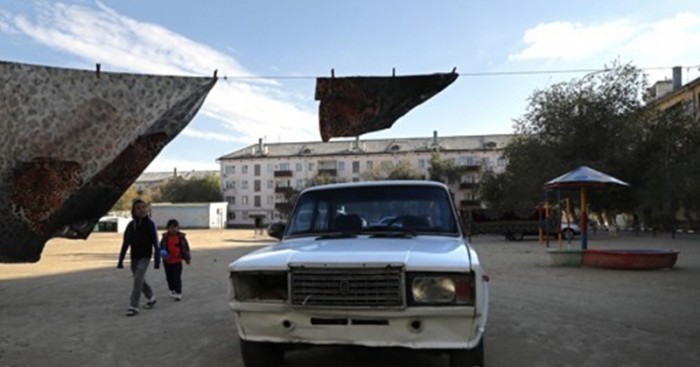 |
| An image showing children walking past a parked car in a residential complex in Baikonur, Kazakhstan. / Courtesy of EPA-Yonhap |
While the Kazakh government has recently tightened mandatory medical checkups for drivers aged 65 and older, local citizens continue to question the efficacy of these measures, with growing calls to tighten license renewal requirements. However, the government and medical experts maintain that the standard for driving eligibility should be based on health status rather than age.
According to Kazinform, a state-run news agency in Kazakhstan, on July 3, Dana Zhantemirova, a female resident in the northern city of Kokshetau, shared her experience of nearly being hit by a car driven by an elderly driver while crossing a crosswalk.
"A car suddenly dashed into the crosswalk, and we barely avoided an accident because we weren’t rushing and paused to look around," she said. "The driver was an elderly man with white hair."
She added, "Last year, I had another experience where an elderly driver refused to yield to me at a crosswalk. We need to apply much stricter license renewal standards for drivers aged 60 and over."
She also noted that she has acquaintances over the age of 70 who continue to drive despite having hearing problems and mobility issues with their legs, adding that "this issue is well worth a societal debate."
Under Kazakhstan’s Road Traffic Act, non-commercial drivers aged 65 and older must undergo a mandatory medical examination every two years, while large vehicle drivers, such as those operating trucks and buses, must do so annually. As long as no specific medical abnormalities are found, drivers can renew their licenses regardless of age.
According to the Ministry of Internal Affairs, President Kassym-Jomart Tokayev signed the "Act on Amendments and Additions to Certain Legislative Acts of Kazakhstan for Crime Prevention and Improvement in Specific Legislative Fields" on June 24.
Under this new law, if a driver aged 65 or older fails to undergo the medical examination within the designated period, authorities can temporarily suspend the validity of their driver's license. However, the Ministry of Internal Affairs explained that it is not considering measures that would require drivers to retake theoretical or practical driving tests upon reaching retirement age.
These policy discussions coincide with rapid demographic shifts, as the country faces an aging population. Last year, the average life expectancy in Kazakhstan reached a post-independence high of 75.97 years, with life expectancy for men rising to 72.19 years and for women to 79.80 years.
Experts urge caution regarding the introduction of age-based restrictions on driving privileges. Aleksey Alekseyev, an automotive expert, pointed out that uniform age limits are inappropriate because the rate of aging varies significantly from person to person.
"Driving skills and knowledge of traffic regulations do not simply disappear," he explained. "What actually needs to be verified is an individual's health status, including vision, hearing, reaction time, and cardiovascular conditions."
He also advised, "In Kazakhstan, major traffic accidents caused by sudden health deterioration in elderly drivers are not common. Managing medical examinations more systematically is far more effective than forcing drivers to retake license exams."
The medical community shares this perspective. Roza Ilikbaeva, a rehabilitation therapist at Kokshetau Central Hospital, said, "The criteria for restricting driving should be the presence of medical conditions, not age. It is vital to continuously monitor medical factors that can affect driving, such as poor night vision, cardiovascular diseases, and neurological disorders."
She also highlighted a recent case where an 83-year-old male driver successfully retained his license after passing all cognitive and memory assessments during his medical examination.
Kim Min-gyu
Most Read
-
1
Celltrion’s Omlyclo gains ground in major European..

-
2
Trump demands rates fall below 1% as Fed hikes for..

-
3
Trump makes $1 trillion bet ahead of midterm elect..

-
4
Iran resumes ballistic missile production, assembl..

-
5
Samsung Electronics, Mistral AI to jointly develop..

-
6
Trump warns countries not helping U.S. must pay re..

-
7
Apple launches first foldable, 1 million won prici..

PEOPLE






HEADLINE NEWS
- Trump to roll out ‘unprecedented welcome’ for Xi with B-2 bombers, F-22 fighters
- S. Korea, U.S., and Japan form united front on Taiwan and economic coercion..
- Trump administration moves to impose sweeping sanctions on International Cr..
- Xi to make state visit to U.S. Sept. 23-25, dispelling rumors over his heal..

-
Address : In-Young Bldg., 34, Uisadang-daero 1-gil, Yeongdeungpo-gu, Seoul
Copyright by ASIATODAY CO., LTD. All rights resereved