



Short-term borrowing spikes on margin-trading boom
Jul 06, 2026, 09:49 am


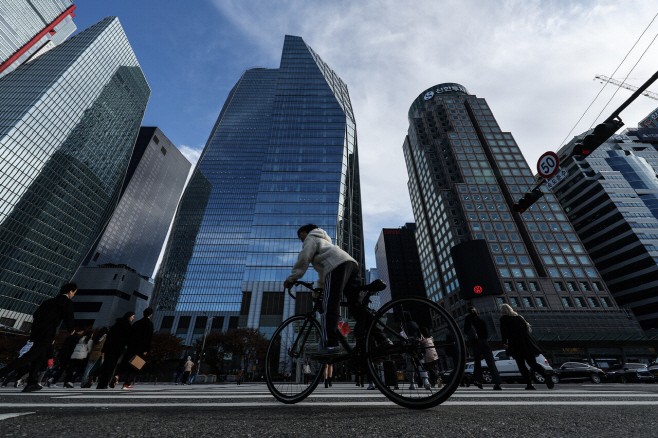 |
| An overview of the Yeouido financial district. / Courtesy of Yonhap News |
Domestic securities firms are experiencing a rapid acceleration in debt shortening, with the share of short-term market-based borrowing hovering near 60% of their total interest-bearing debt. Critics point out that this is the result of aggressively pulling in short-term funds to satisfy the surging demand for margin trading—locally dubbed "bittoo" (investing with borrowed money)—amid the recent stock market boom. Concerns over a liquidity crisis triggered by an "asset-liability maturity mismatch" are mounting, particularly as these short-term funds are also being funneled into investment banking (IB) and venture capital activities that require extended recovery windows.
According to the financial investment industry on July 5, short-term debt with a maturity of less than one year accounted for 59.0% of total borrowing among comprehensive financial investment providers, standing at 260.6 trillion won as of the second half of last year. In its Financial Stability Report published on June 24, the Bank of Korea noted that this ratio has been climbing even more steeply this year as major securities firms compete aggressively to secure liquidity.
The underlying driver is an unprecedented wave of margin trading. According to the Korea Financial Investment Association, the average daily balance of margin loans surpassed 30 trillion won for the first time in the first quarter of this year, hitting a historic high of 38.63 trillion won on June 24.
Under the Capital Markets Act, the total credit extension limit for comprehensive financial investment providers is capped at 200% of their equity capital. As securities firms found it impossible to meet this explosive demand for margin loans solely with their own funds, they launched aggressive funding drives by flooding the short-term money market with massive volumes of commercial paper (CP) and electronic short-term bonds.
Data from the Korea Securities Depository shows that electronic short-term bond issuances by domestic comprehensive financial investment providers reached 457 trillion won in the first half of this year, a sharp 3.4-fold increase compared to the same period last year. Notably, second-quarter issuances nearly doubled from the first quarter (155 trillion won) to reach 302 trillion won, illustrating a sharp acceleration in the accumulation of short-term liabilities.
The core problem lies in the fact that the short-term capital easily raised by these brokerages is also being directed toward mid-to-long term, illiquid assets with long payback periods, such as IB projects and venture investments. According to Korea Investors Service, the ratio of short-term borrowing to equity capital for domestic comprehensive financial investment providers skyrocketed from 37% in 2015 to 135% last year. In particular, KB Securities and Korea Investment & Securities, both of which actively utilize promissory notes, saw this ratio exceed 200%. This points to an entrenched maturity mismatch structure where funds raised with maturities under one year are directly allocated into long-term investments.
"If investments in mid-to-long term, illiquid assets expand via IB or venture capital while brokerages remain highly dependent on short-term market borrowing, the asset-liability maturity mismatch will deepen, heightening liquidity risks," the Bank of Korea cautioned in its Financial Stability Report. The central bank added, "Given that the securities sector has relatively high systemic interconnectedness with other financial segments, any liquidity shock could easily spill over into the broader financial system."
Han Hye-sung
Most Read
-
1
U.S. Treasury Secretary Bessent publicly warns ove..

-
2
Celltrion’s Omlyclo gains ground in major European..

-
3
U.S. strikes Iran after a month, hits IRGC rocket..

-
4
Hyundai Motor Group breaks ground on integrated st..

-
5
Russia faces warning signs over prolonged war econ..

-
6
Anti-Western solidarity strengthens amid Trump's e..

-
7
U.S. strikes 3 Iranian oil tankers, Iran vows reta..

PEOPLE





HEADLINE NEWS

-
Address : In-Young Bldg., 34, Uisadang-daero 1-gil, Yeongdeungpo-gu, Seoul
Copyright by ASIATODAY CO., LTD. All rights resereved