



Over 56% of SMEs feel weighed down by volatile global politics
Jul 06, 2026, 09:34 am


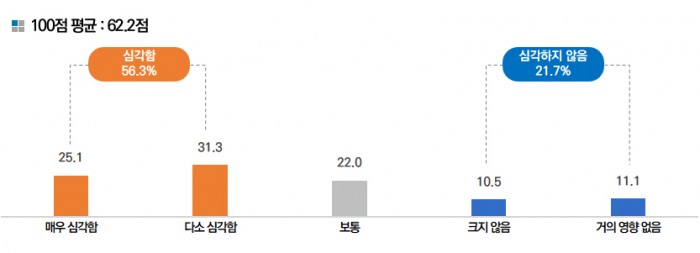 |
| Level of business burden driven by Middle East conflicts and shifting global geopolitics. |
According to a survey, 56.3% of Main-Biz companies (innovative small and medium enterprises) reported that shifting global geopolitics are placing a heavy burden on their business management, with the level of burden averaging 62.2 out of 100 points. While a mere 8.4% of respondents saw an increase in both revenue and operating profit, 56.0% reported a decrease in both.
The Management Innovation Association for Small and Medium Enterprises (Main-Biz Association) released the findings of its "Survey on the Business Environment of SMEs Amid Shifting Global Geopolitics" on July 6. The survey was conducted on 323 Main-Biz firms nationwide to assess how external environmental factors—such as the prolonged conflict in the Middle East, fluctuations in international raw material prices, energy costs, and exchange rates—are impacting corporate management.
The results showed that manufacturing firms (67.1%) and exporting companies (67.4%) were relatively more prone to feeling a substantial business burden. Within the manufacturing sector, the burden was particularly pronounced in the petroleum/chemical, electrical/electronics, and food/textile industries compared to other fields.
The most notable finding of the survey is that the core driver of the perceived crisis lies in rising costs rather than supply chain disruptions. Companies cited "surging purchasing prices for raw materials and commodities (64.1%)" as the most impactful factor, followed by rising energy costs, exchange rate fluctuations, and swelling logistics fees.
In terms of actual cost burdens, 42.8% of the surveyed companies stated that operating expenses—including raw material/commodity procurement and energy costs—accounted for over 50% of their total revenue, with 21.4% indicating that these expenses consumed more than 70% of revenue. When asked about their countermeasures against changing international relations, most firms relied on passive measures such as "monitoring the situation" and "cost-cutting," while only 5.3% responded that they had formulated active strategic plans.
Regarding supply chain disruptions, "no separate response (28.8%)" accounted for the largest share, and responses to rising cost pressures remained focused on short-term expense management. The most widely requested government support was "stabilizing raw material and commodity supply and easing price burdens (39.6%)," followed by financial assistance (24.8%) and logistics/transportation support (11.5%).
Meanwhile, only 37.5% of the companies evaluated the government's response as appropriate, and the level of policy satisfaction averaged a relatively low 52.1 out of 100 points.
"Shifting global geopolitics have surpassed temporary external shocks to become a constant, structural risk that threatens the cost structure and profitability of SMEs," an official from the Main-Biz Association stated. "The government must move away from policies centered heavily on short-term financial subsidies and expand initiatives aimed at improving corporate resilience, such as distributing crisis management manuals and offering consulting services for diversifying client bases and procurement channels."
Oh Se-eun
Most Read
-
1
U.S. Treasury Secretary Bessent publicly warns ove..

-
2
Celltrion’s Omlyclo gains ground in major European..

-
3
U.S. strikes Iran after a month, hits IRGC rocket..

-
4
Hyundai Motor Group breaks ground on integrated st..

-
5
Russia faces warning signs over prolonged war econ..

-
6
Anti-Western solidarity strengthens amid Trump's e..

-
7
U.S. strikes 3 Iranian oil tankers, Iran vows reta..

PEOPLE






HEADLINE NEWS

-
Address : In-Young Bldg., 34, Uisadang-daero 1-gil, Yeongdeungpo-gu, Seoul
Copyright by ASIATODAY CO., LTD. All rights resereved