



Public, private sectors deliver cooling relief to 'jjokbang' residents
Jul 06, 2026, 09:23 am


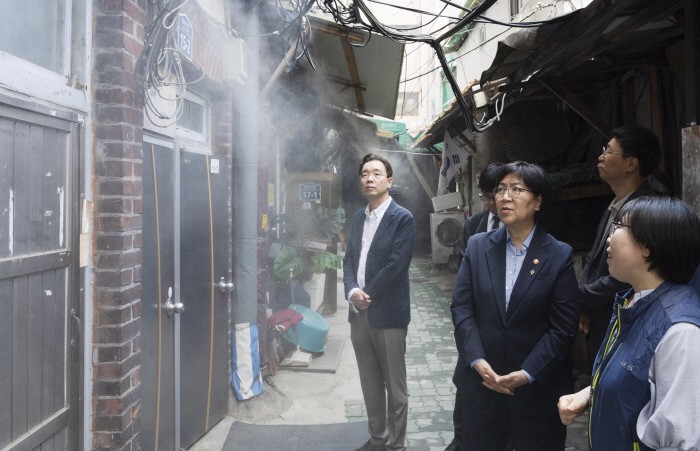 |
| Minister of Health and Welfare Jung Eun-kyeong checks the operation of a cooling mist system while visiting a jjokbang district in Jongno-gu, Seoul, on June 10 to review protective measures for vulnerable groups during the summer. / Courtesy of Yonhap |
Amidst the onset of a scorching heatwave, the government and the private sector are stepping in to provide cooling units and electricity bill subsidies to support residents of jjokbang districts (substandard tightly packed miniature rooms). Due to the architectural nature of these districts, where midday heat becomes trapped without proper ventilation, residents are highly vulnerable to extreme temperatures. Government statistics show that a significant portion of jjokbang residents are elderly individuals or people with disabilities.
According to the Ministry of Health and Welfare on July 5, the government, in collaboration with the Community Chest of Korea, received a designated donation of 250 million won from IBK Industrial Bank of Korea and distributed it to 10 jjokbang counseling centers nationwide. This initiative, titled "Relieving the Sweltering Heat," was launched to address the harsh realities faced by these neighborhoods. Following individual needs assessments, 40 air conditioners will be installed in units where the building structure permits. For households where air conditioning cannot be installed due to structural limitations or power overload risks, a total of 1,610 new electric fans and other cooling appliances will be provided.
The "2024 Survey on the Homeless and Vulnerable Populations" released by the Ministry last year revealed that 4,717 residents are registered across the 10 counseling centers nationwide. While this population has been on a downward trend compared to 2016 (6,192 residents) and 2021 (5,448 residents), the remaining demographic is rapidly aging and predominantly composed of single-person households. Out of 4,641 total households, 4,590 (98.9%) live alone, while multi-person households account for just 1.1% (51 households). Health conditions are also a major concern, with 608 individuals (12.9%) registered as disabled, meaning more than one in ten residents falls into this category. The actual number could be higher, given that the status of 1,036 residents remains unaccounted for.
The structural design of jjokbang buildings further compounds the risk of heat-related illnesses. By room type, standard miniature rooms make up 43.7%, followed by low-end commercial lodgings like inns and motels at 28.6%, and goshiwon (tiny study rooms) at 24.4%. Most of these are high-density structures where indoor temperatures soar easily during the summer.
Compounding the issue, the economic capacity of residents to cope with the heat remains extremely limited. The survey showed that 63.3% of jjokbang residents receive basic livelihood benefits, and 72.2% receive housing benefits—a marked increase from the 2016 and 2021 studies. The Korea Institute for Health and Social Affairs noted in the report, "While recipients constitute the absolute majority, a 60% to 70% enrollment rate can hardly be considered high when factoring in the abysmal living conditions and financial hardships these residents endure."
In light of these conditions, the government has decided to provide separate electricity bill subsidies from July to September to residents across five jjokbang areas in Busan, Incheon, Daegu, and Daejeon—four regions where local governments do not offer separate utility assistance. Residents will receive between 46,000 won and up to 120,000 won per person over the three-month period.
"We are deeply grateful to IBK Industrial Bank of Korea and the Community Chest of Korea for exercising positive social influence through this meaningful donation," stated Minister of Health and Welfare Jung Eun-kyeong. "We expect this support to help jjokbang residents, who are highly vulnerable to extreme heat, spend their summer in a more comfortable and cool environment. The government will thoroughly execute summer protection measures for vulnerable groups to ensure they are robustly shielded from the upcoming heatwave."
Lee Jeong-yeon
Most Read
-
1
Celltrion nears additional contract with major U.S..

-
2
Putin proposes trilateral U.S.-China-Russia summit..

-
3
U.S. weighs dropping MOAB, world's most powerful n..

-
4
"Aren't those foreigners on welfare?": M..

-
5
Attention centers on APEC for possible Trump-Xi-Pu..

-
6
Saudi Arabia, Iran hold first diplomatic talks to..

-
7
China tightens grip on boosting domestic demand an..

PEOPLE





-
Address : In-Young Bldg., 34, Uisadang-daero 1-gil, Yeongdeungpo-gu, Seoul
Copyright by ASIATODAY CO., LTD. All rights resereved