



KAIST develops Alzheimer's prodrug enabled by dementia-causing agents
Jul 03, 2026, 09:53 am


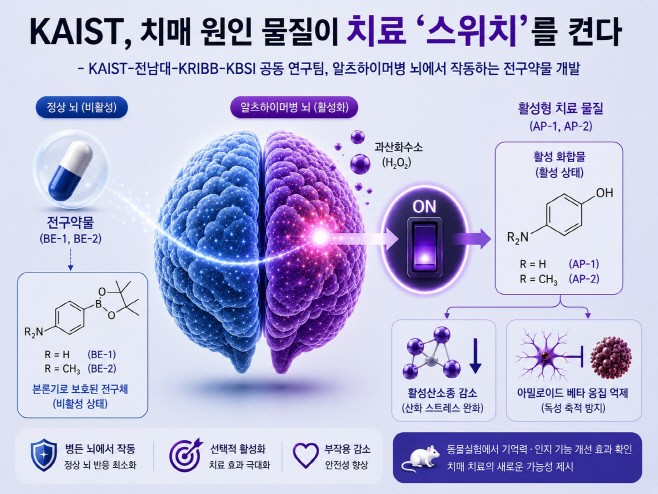 |
| AI-generated research image. / Courtesy of KAIST |
A domestic research team has developed a prodrug that turns hydrogen peroxide—a key driver of dementia—into a treatment signal, ensuring activation exclusively within a diseased brain.
KAIST announced on July 2 that a research team led by Professor Mi Hee Lim of the Department of Chemistry has developed a prodrug that activates solely within a brain affected by Alzheimer's disease, and successfully verified its therapeutic effects through animal testing. The study was conducted jointly with research teams led by Professor Min-Geun Kim of Chonnam National University, Dr. Chul-Ho Lee and Dr. Kyung-Sim Kim of the Korea Research Institute of Bioscience and Biotechnology, and Dr. Young-Ho Lee of the Korea Basic Science Institute.
A prodrug is a medication that remains inactive initially but transforms into an active therapeutic agent under specific environments within the body. In this study, the drug was engineered to trigger only upon encountering hydrogen peroxide, which surges in the brains of Alzheimer's patients, serving as a smart therapeutic that operates selectively in diseased brain tissue.
In the brains of Alzheimer's patients, cell-damaging hydrogen peroxide is produced in quantities far exceeding normal levels. While it had previously been viewed strictly as a toxic byproduct to be eliminated, the research team devised a way to repurpose it as a switch to activate the drug.
The developed prodrugs (BE-1 and BE-2) show little to no reaction in a healthy brain, but transform into active therapeutic substances (AP-1 and AP-2) when they encounter hydrogen peroxide in a brain undergoing neurodegeneration. This process reduces reactive oxygen species, including hydrogen peroxide, while simultaneously preventing amyloid-beta proteins—known to accumulate in the brain and damage neurons—from binding together to form highly toxic aggregates.
Using advanced analytical techniques, the team confirmed that the activated drug alters the structure of amyloid-beta proteins, inhibiting them from growing into large clusters. Testing on Alzheimer's mouse models demonstrated that the drug crossed the blood-brain barrier (BBB) and successfully converted into the therapeutic agent inside the brain.
The significance of this research lies in its design: unlike existing Alzheimer's treatments that target only a single specific protein, this approach utilizes the diseased brain environment itself to ensure the drug operates only where needed. KAIST noted that this offers a new therapeutic strategy that maximizes efficacy while minimizing side effects, and holds promise for treating other degenerative brain diseases like Parkinson's.
"This study is highly meaningful in that it repurposes hydrogen peroxide, which had long been viewed merely as a target for elimination, into a signal that activates a drug," Professor Lim said. "This technology, which selectively activates medication only within diseased tissues, is expected to serve as a new platform for treating complex illnesses like Alzheimer's disease more safely and effectively."
Seo Byung-ju
Most Read
-
1
Kia Sportage outperforms Mazda CX-5 in German auto..

-
2
Houthis launch successive attacks on Saudi airport..

-
3
Saudi Arabia, Iran hold first diplomatic talks to..

-
4
U.S. deploys carrier, 10,000 more troops to Middle..

-
5
Saudi airport in Riyadh struck again, leaving at l..

-
6
Japan tracks Ukraine fiber-optic drones, bolsters..

-
7
Putin's ally visits China on the 8th ahead of APEC..

PEOPLE






HEADLINE NEWS

-
Address : In-Young Bldg., 34, Uisadang-daero 1-gil, Yeongdeungpo-gu, Seoul
Copyright by ASIATODAY CO., LTD. All rights resereved