



Rainy season traffic accidents peak in July
Jun 26, 2026, 09:57 am


 |
| This image was generated by AI. |
With the rainy season approaching, drivers are urged to exercise heightened caution against traffic accidents on wet roads. Over the past five years, rain-related traffic accidents peaked in July, the month with the heaviest rainfall, with the highest number of crashes occurring during evening commute hours.
The Ministry of the Interior and Safety called on the public on the 25th to take extra care to prevent traffic accidents on wet roads as the country enters the rainy summer season.
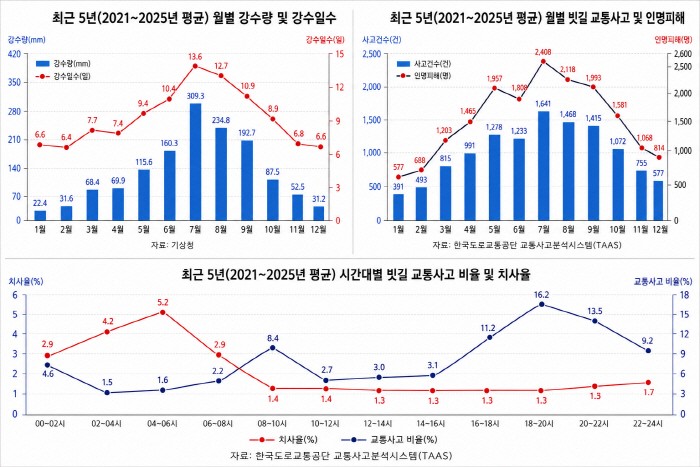
According to the ministry's analysis of data from the Korea Meteorological Administration and the Traffic Accident Analysis System of the KoROAD, July recorded the highest average rainfall at 309.3 mm and the most rainy days at 13.6 days over the past five years. Consequently, rain-related traffic accidents also peaked in July, averaging 1,641 cases per month, which resulted in a chart-topping 2,408 casualties.
The leading cause of wet-road traffic accidents was the failure to comply with safe driving duties, such as distracted driving, accounting for more than half at 53.4%. This was followed by signal violations at 13.5% and failure to maintain a safe following distance at 11%. Since roads become slick and braking distances increase when it rains, drivers must reduce their speed below normal limits and maintain a sufficient distance from the vehicle ahead.
By time of day, accidents began to rise gradually starting at 8:00 a.m. during the morning commute and reached their highest concentration between 6:00 p.m. and 8:00 p.m. during the evening rush hour. This specific window accounted for 16.2% of all rain-related accidents. However, the fatality rate—the number of deaths per 100 traffic accidents—peaked between 4:00 a.m. and 6:00 a.m. at 5.2%.
The ministry emphasized that motorists must strictly observe traffic regulations and lower their speed below the speed limit when driving in the rain. Drivers should slow down by more than 20% of the speed limit when roads are wet, and by up to 50% during heavy downpours when visibility drops below 100 meters.
Speeds must also be reduced below normal when passing through intersections. When turning right at a red light, drivers are legally required to come to a complete stop and check for pedestrians before proceeding. Extra alertness is required during the night and pre-dawn hours, as rainwater and light reflections can obscure road boundaries, puddles, and unexpected road hazards.
"Rainy days carry a high risk of traffic accidents due to slick road surfaces and frequent unexpected situations," said Ha Jong-mok, Director General for Disaster Prevention Policy at the Ministry of the Interior and Safety. He added, "When driving in the rain, please reduce your speed below normal limits and adhere to traffic laws more strictly for your own safety."
Kim Nam-hyung
Most Read
-
1
Trump demands rates fall below 1% as Fed hikes for..

-
2
Celltrion seeks rheumatoid arthritis indication ex..

-
3
Chinese e-commerce giants AliExpress, Temu and She..

-
4
Trump warns countries not helping U.S. must pay re..

-
5
Turkish Airlines named main club partner of Liverp..

-
6
China expels No. 2 military official Zhang Youxia..

-
7
Houthi rebels release video claiming downing of Sa..

PEOPLE







-
Address : In-Young Bldg., 34, Uisadang-daero 1-gil, Yeongdeungpo-gu, Seoul
Copyright by ASIATODAY CO., LTD. All rights resereved