



Strike looms at Hyundai Motor over job security, bonuses
Jun 26, 2026, 09:32 am


 |
Strikes loom at Hyundai Motor as management and the union failed to reach common ground in this year's wage and collective bargaining negotiations, pushing the dispute into a potential walkout phase.
While the union has secured a legal strike mandate, this year's negotiations are unfolding in a far more complex manner than in previous years. Beyond standard wage hikes, core issues surrounding the transition to future vehicles have moved to the forefront—most notably job security and retirement extensions driven by the introduction of artificial intelligence (AI) and humanoid robotics.
On the 25th, the National Labor Relations Commission decided to suspend mediation between Hyundai Motor's management and the union. Consequently, the Hyundai Motor union has officially secured a legal strike mandate. Previously, on the 24th, the union passed the strike action bill with an approval rate of 86.65% of total registered members (92.03% of actual voters) in a membership vote. With the union now holding a strike mandate, this year's collective bargaining has reached a critical watershed.
Industry observers expect the company to present its first proposal shortly to begin full-scale tug-of-war negotiations. Last year, Hyundai Motor's management and union struck a deal only after undergoing three partial strikes.
The union plans to launch its Central Strike Committee on the 30th to determine the specific schedule and intensity of the potential walkout. If a strike materializes, it will mark the second consecutive year of industrial action following last year's disruptions.
However, since the union has historically utilized strike mandates as a tactical negotiation card, analysts suggest there is a high probability they will leverage this newly gained dispute right as a bargaining tool to continue talks.
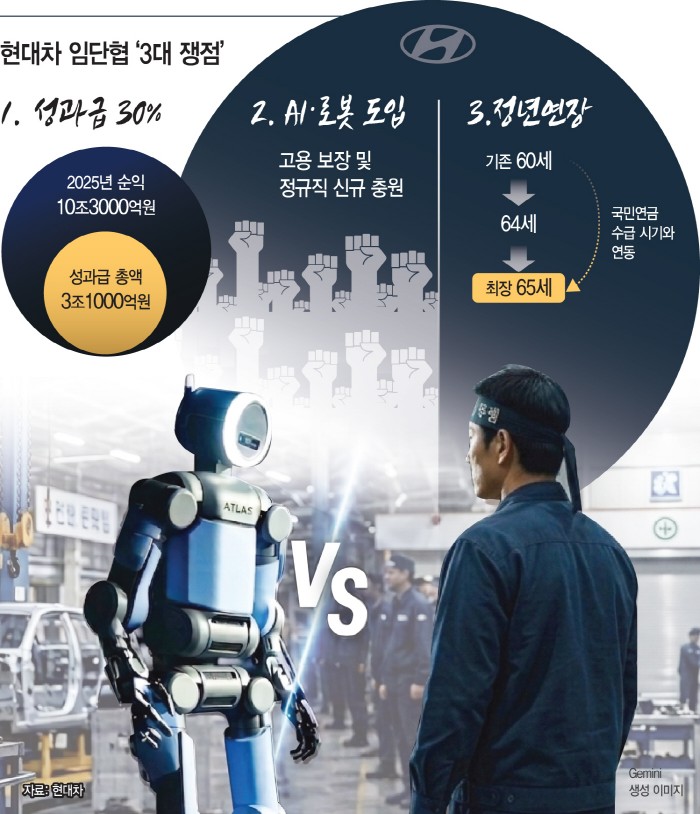
The wild cards in this year's negotiations are AI, humanoid robots, and performance bonuses. As Hyundai Motor Group accelerates its establishment of smart factories and the introduction of humanoid robotics, the issue of job security in the era of future mobility has surfaced as a core agenda item for the first time. In particular, the group is aggressively pushing forward with humanoid commercialization centered around its U.S. robotics subsidiary, Boston Dynamics, which is expected to sharply increase automation levels on factory floors.
The union expresses deep concern that expanding the application of AI and robotics to production lines could lead to a reduction in manufacturing labor hours and a subsequent drop in wages. Accordingly, they are demanding the implementation of a full monthly salary system to supplement the current hourly wage framework. Furthermore, measures to guarantee job security and protect working conditions amid AI deployment were included in the union's proposal package for the first time this year. Along with these, the union is demanding a base monthly pay increase of 149,600 won (excluding consecutive service steps), a bonus payout equivalent to 30% of the previous year's net profit, an increase in standard bonuses from 750% to 800%, a reduction in working hours without intensifying labor density, a retirement age extension up to 65 to align with the national pension eligibility age, and new workforce recruitment.
The union's expectations for performance bonuses have heightened significantly, emphasizing the 30% net profit share. Based on Hyundai Motor's annual net profit last year of 10.36 trillion won, a simple calculation puts the requested bonus pool at a staggering 3.09 trillion won.
Conversely, management maintains that a massive wage hike and bonus expansion pose an excessive burden under compounding business uncertainties, including looming U.S. automobile tariff pressures, slowing global demand, and expanding future vehicle research and development (R&D) investments. Regarding the retirement age extension, the company stands by its position that a broader social consensus and regulatory adjustments must precede any corporate changes.
The two sides have held a total of 11 rounds of negotiations since their initial meeting on May 6 but failed to narrow differences on core issues. When the company failed to present a detailed initial proposal, the union declared a breakdown in negotiations on the 12th and initiated dispute procedures.
Should a strike become reality, production disruptions remain inevitable. Hyundai Motor's Ulsan plant is the world's largest single automotive facility, manufacturing approximately 6,000 vehicles per day. Industry analysts estimate that just a single hour of a partial strike results in a production loss of roughly 10 billion won, and if escalated to a full-scale general strike, daily losses could clear 100 billion won.
Prolonged production halts would cause a chain reaction, affecting not only vehicle delivery schedules but also the supply timelines of hundreds of domestic subcontractors. Given the compounding pressures of a potential 25% U.S. automotive tariff and intensifying global competition, observers project that the fallout from a strike this year would be substantially heavier than past cycles.
While Hyundai Motor is mitigating tariff exposures by expanding local production in the United States and boosting hybrid vehicle sales, a protracted production disruption would boundingly impair global supply timelines and overall profitability.
"This year's collective bargaining is not a simple wage negotiation; the core conflict centers on how to guarantee employment during the structural shift to future mobility," an industry insider noted. "If the strike drags on, it will not only trigger production shortfalls but also burden future vehicle investments and global supply chain operations, making it critical for both management and labor to find common ground swiftly."
Nam Hyun-soo
Most Read
-
1
Kia Sportage outperforms Mazda CX-5 in German auto..

-
2
Houthis launch successive attacks on Saudi airport..

-
3
Saudi Arabia, Iran hold first diplomatic talks to..

-
4
U.S. deploys carrier, 10,000 more troops to Middle..

-
5
Saudi airport in Riyadh struck again, leaving at l..

-
6
Putin's ally visits China on the 8th ahead of APEC..

-
7
Chinese military support and training center opens..

PEOPLE





HEADLINE NEWS

-
Address : In-Young Bldg., 34, Uisadang-daero 1-gil, Yeongdeungpo-gu, Seoul
Copyright by ASIATODAY CO., LTD. All rights resereved