



Heatwaves engulf France, stoking 'climate inflation' across industries
Jun 26, 2026, 10:06 am


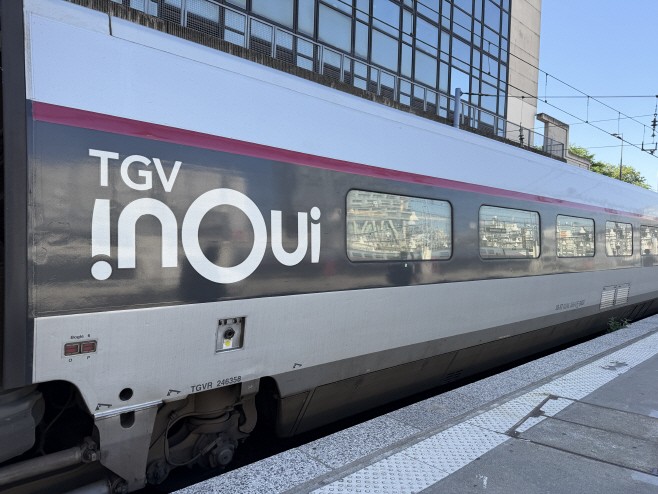 |
| A high-speed train (TGV) stopped at Montparnasse Station in Paris, France on the 21st (local time) when full-scale heatwaves began to grip the country. / Lim Yu-jung, Paris Correspondent |
The heatwaves striking all of France are expanding beyond a mere natural disaster, stoking concerns over "climate inflation" as they trigger price hikes across various industries.
On the 24th (local time), Ouest-France pointed out that this latest heatwave in France is extending past a simple meteorological phenomenon to exert upward price pressures on daily life, citing examples such as skyrocketing prices for air conditioners and electric fans, projections of rising food prices, and increasing transportation and logistics infrastructure costs.
France has been experiencing consecutive days of extreme heat for four days now since the heatwaves began on the 21st, leaving the entire nation suffering from high temperatures once again just a month after a heatwave advisory was issued late last month.
Experts analyze that climate inflation, a phenomenon where climate change directly stimulates price hikes, is intensifying. Climate inflation refers to instances where meteorological variables, including droughts, floods, and heatwaves, exert a direct impact on rising inflation.
This is drawing significant attention as a new inflationary threat that is difficult to rein in through interest rate policies or conventional measures.
The sector hit hardest by the heatwaves is the cooling equipment market. While demand for electric fans and air conditioners has exploded, supply has failed to keep pace, driving prices sharply upward.
According to the consumer organization UFC-Que Choisir, the average price of an air conditioner rose to 558 euros (approximately 978,200 won) as of the 22nd, up from 493 euros (approximately 864,000 won) on the 16th of last month, before the year's first heatwave began.
Climate inflation is also impacting the food sector. In the past, a severe drought triggered by heatwaves in Spain caused olive oil prices to skyrocket from 2,100 euros (approximately 3.68 million won) per ton in 2019 to 8,000 euros (approximately 14.02 million won) in 2023.
The supply shortage persisted for a year and a half, prompting the governments of Spain and Greece—countries where olive oil is an essential ingredient—to implement direct price controls.
The Potsdam Institute for Climate Impact Research projected that rising temperatures will drive food prices up by 3.2% annually until 2035.
Extreme heat is also affecting transportation infrastructure, such as railway tracks, thereby driving up maintenance and repair costs. Experts warned that more frequent malfunctions and delivery delays will ultimately translate into price hikes for daily necessities.
Meanwhile, Météo-France forecast that cold air entering from the Atlantic starting this afternoon would somewhat alleviate the heat in some western regions. However, the eastern provinces are expected to see the heatwave persist through this weekend.
Lim Yu-jung
Most Read
-
1
Trump shares map on social media labeling Strait o..

-
2
Kia Sportage outperforms Mazda CX-5 in German auto..

-
3
Houthis launch successive attacks on Saudi airport..

-
4
U.S. deploys carrier, 10,000 more troops to Middle..

-
5
Trump rejects Iran's offer to open Strait of Hormu..

-
6
N. Korea conducts first swarm attack drill with dr..

-
7
U.S.-China summit falls short on substance as Trum..

PEOPLE






HEADLINE NEWS
- Seoul dismisses Ukraine's claim of 'S. Korean support for Russia' as "inaccurate and inappropriate"
- S. Korea, Japan race to develop nuclear-powered submarines
- Henri Kagan, Kenso Soai win Nobel Prize in Chemistry for uncovering how mol..
- Vance says Alaska LNG cooperation will move forward with Seoul's current or..

-
Address : In-Young Bldg., 34, Uisadang-daero 1-gil, Yeongdeungpo-gu, Seoul
Copyright by ASIATODAY CO., LTD. All rights resereved