



S. Korea-US currency swap and BOK 'big step' will help stabilize exchange rate, experts say
Jun 26, 2026, 09:14 am


 |
Analysis indicates that the surging won-dollar exchange rate into the mid-1,500 won range is driven more heavily by external factors, such as foreign capital outflows and a globally strong dollar, rather than domestic economic fundamentals. While experts evaluate the current exchange rate level as a temporary overshooting, they projected that the high exchange rate in the 1,500 won range could persist for the time being as external uncertainties drag on. However, they forecast that policy responses, such as a South Korea-U.S. currency swap or a "big step" (half-percentage-point interest rate hike) by the Bank of Korea (BOK), could help stabilize the exchange rate.
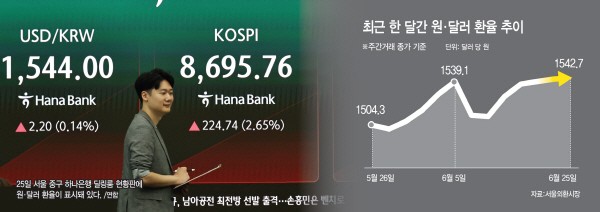
On the 25th, the won-dollar exchange rate in the Seoul foreign exchange market closed daytime trading (as of 3:30 p.m.) at 1,542.7 won, up 0.9 won from the previous day (1,541.8 won), marking the second consecutive day finishing in the 1,540 won range. This represents the highest level since March 9, 2009 (1,549.0 won), during the global financial crisis.
The won-dollar exchange rate closed daytime trading at 1,539.1 won on the 5th before skyrocketing to as high as 1,561.5 won during overnight trading. Afterward, it fell to 1,511.1 won on the 15th as foreign exchange authorities signaled their commitment to market stability and foreign net selling somewhat eased. However, as the U.S. Federal Open Market Committee (FOMC) hinted at potential interest rate hikes on the 18th due to inflation concerns, the dollar strengthened once again, putting upward pressure back on the won-dollar exchange rate.
The exodus of foreign investors from the domestic stock market is cited as a key reason behind the sustained rally of the won-dollar exchange rate. When foreign investors sell domestic equities, demand to exchange won for dollars increases, leading to a depreciation of the won. In fact, according to the BOK's "First Half 2026 Financial Stability Report," net foreign equity capital outflows compiled from the beginning of this year through the 9th reached $94.81 billion. In May alone, $31.83 billion left the market, marking an all-time monthly high.
Nevertheless, Kim Sang-bong, an economics professor at Hansung University, noted, "The exchange rate in the mid-1,500 won range has a strong characteristic of a temporary overshooting triggered by massive net selling by foreign investors," adding, "The current exchange rate has aspects that are difficult to explain solely through economic fundamentals." He further stated, "Looking at the medium to long term (two to three years), the exchange rate will converge toward the 1,480 to 1,490 won level."
Monetary policy uncertainty from the U.S. Federal Reserve is also fueling the weakness of the won. While freezing its benchmark interest rate, the Fed left the door open for additional tightening depending on inflation conditions, stoking market concerns that the initially anticipated timing for rate cuts could be delayed. This led to a stronger dollar, and indeed, the dollar index, which tracks the value of the greenback against a basket of six major currencies, rose from 99.54 on the 16th to 101.61 as of this morning. The strong dollar is weighing on major currencies across the board. The won is also considered a representative currency that faces depreciation pressure when global risk aversion intensifies.
Jang Jeong-su, Assistant Governor of the BOK, explained, "The recent high level of the exchange rate is a combined result of ongoing uncertainties in the Middle East and a stronger dollar following hawkish monetary policy outlooks from the Fed after the June FOMC meeting." Kim Yu-mi, a researcher at Kiwoom Securities, also stated, "Since the Fed heightened its vigilance against inflation at the June FOMC, upward pressure on the dollar is expected to remain dominant until related concerns ease."
However, some point out that this high exchange rate trend is excessive relative to South Korea's actual economic conditions. According to the BOK, the cumulative current account surplus from January to April this year was compiled at $102.67 billion. On top of that, May exports surged 53.2% year-on-year to $87.75 billion, breaking the record for an all-time monthly high. Generally, an increase in exports and an expanding current account surplus boost the dollar supply flowing into the country, acting as a factor that strengthens the won.
Considering external conditions, experts projected that the won-dollar exchange rate will maintain its 1,500 won range for the time being.
Ju Won, deputy director at the Hyundai Research Institute, forecast, "As external uncertainties such as the path of U.S. interest rates continue, the won-dollar exchange rate is likely to remain at a elevated level in the 1,500 won range for the time being." He added, "However, if foreign exchange market stabilization measures like a currency swap with the U.S. are established, or if the BOK takes a 'big step' by significantly raising the benchmark interest rate within the year, it could cushion the weakening trend of the won and help stabilize the exchange rate."
Researcher Kim also noted, "The won-dollar exchange rate will fluctuate within the 1,500 won range for the time being," adding, "However, once inflation stabilization signals are confirmed and the Fed's tightening concerns ease going forward, it is projected to show a gradual downward trend."
Lee Ji-hoon
Most Read
-
1
Celltrion nears additional contract with major U.S..

-
2
Putin proposes trilateral U.S.-China-Russia summit..

-
3
U.S. weighs dropping MOAB, world's most powerful n..

-
4
"Aren't those foreigners on welfare?": M..

-
5
Attention centers on APEC for possible Trump-Xi-Pu..

-
6
Saudi Arabia, Iran hold first diplomatic talks to..

-
7
China tightens grip on boosting domestic demand an..

PEOPLE







-
Address : In-Young Bldg., 34, Uisadang-daero 1-gil, Yeongdeungpo-gu, Seoul
Copyright by ASIATODAY CO., LTD. All rights resereved