



Ruling, opposition parties clash over property tax adjustments
Jun 22, 2026, 10:35 am


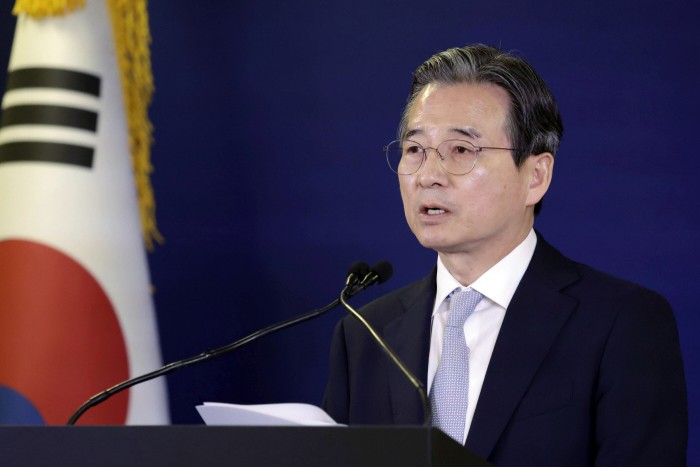 |
| Ruling and opposition parties reacted with sharp contrast after Cheong Wa Dae Policy Chief Kim Yong-beom hinted at potential property tax adjustments. The photo shows Policy Chief Kim delivering a briefing. / Photo by Yonhap News |
On June 21, the Democratic Party of Korea and the People Power Party clashed over Cheong Wa Dae Policy Chief Kim Yong-beom's social media remarks hinting at potential property tax adjustments. The People Power Party criticized the administration's failure to supply housing and blasted the aide's reliance on "social media politics," while the Democratic Party defended the move as a legitimate policy response to prevent economic growth from fueling unearned real estate income.
The core of the dispute centers on Kim's vision for a "rational adjustment" of property holding and capital gains taxes. Choi Bo-yun, chief spokesperson for the People Power Party, criticized the remarks in a written briefing, stating, "Now that the elections are over, the administration is showing its true colors by pushing for tax hikes." Addressing Kim's forecast that "bonuses and export revenues in the second half of the year will drive capital into preferred real estate markets," Choi added, "When a policy architect is driving buying sentiment instead of managing it, he acts less like an official and more like a real estate instructor. They fail to build houses, lock up supply, label price surges as unearned income, and ultimately resort to raising holding and capital gains taxes."
Conversely, Park Ji-hye, spokesperson for the Democratic Party, countered that if the national wealth accumulated through the semiconductor and AI booms flows into real estate speculation, the burden will fall entirely on non-homeowning working-class families and young people. "The goal is to acknowledge the government's economic achievements while fixing the breakdown that prevents those gains from reaching ordinary citizens and small business owners," Park said. "Policy solutions meant to ensure that the fruits of growth revitalize the broader public livelihood must not be used as political weapons."
The two parties also sparred over volatility in the rental market and capital market performance. Cho Yong-sul, a spokesperson for the People Power Party, leveled criticism at the current administration. "The integrated monthly rent price index for Seoul apartments rose by 2.8%, outpacing the purchase price index increase of 2.71%, while monthly rent listings in the outskirts of Seoul plunged by more than 50%," Cho said. "This is an era of skyrocketing rents under the Lee Jae-myung administration. We must not repeat the failures of the Moon Jae-in administration, where poorly prepared tax hikes were ultimately passed down to tenants in the form of higher rent."
In response, Kim Han-na, another spokesperson for the Democratic Party, defended the administration by highlighting gains in the domestic stock market. "Under the Yoon Suk-yeol administration, the KOSPI index stagnated around the 2,500 level," Kim noted. "The Lee Jae-myung administration has fundamentally reformed the capital market through structural improvements, including revisions to the Commercial Act, strengthened shareholder protections, and the eradication of unfair trading practices."
Kim's personal use of social media emerged as an additional point of contention. Choi Eun-seok, senior deputy floor leader of the People Power Party, pointed out, "Policy Chief Kim has churned out 37 posts since February 8, effectively immersing himself in Facebook politics once every three days." Choi further criticized the setup, noting, "Kim is running a closed account with 18,000 followers and zero followings without disclosing his portal address."
Shim Jun-bo
Most Read
-
1
Trump demands rates fall below 1% as Fed hikes for..

-
2
Celltrion seeks rheumatoid arthritis indication ex..

-
3
Chinese e-commerce giants AliExpress, Temu and She..

-
4
Trump warns countries not helping U.S. must pay re..

-
5
Turkish Airlines named main club partner of Liverp..

-
6
China expels No. 2 military official Zhang Youxia..

-
7
Houthi rebels release video claiming downing of Sa..

PEOPLE







-
Address : In-Young Bldg., 34, Uisadang-daero 1-gil, Yeongdeungpo-gu, Seoul
Copyright by ASIATODAY CO., LTD. All rights resereved