



100 days of Yellow Envelope Act: Labor sector gripped by growing chaos
Jun 22, 2026, 10:23 am


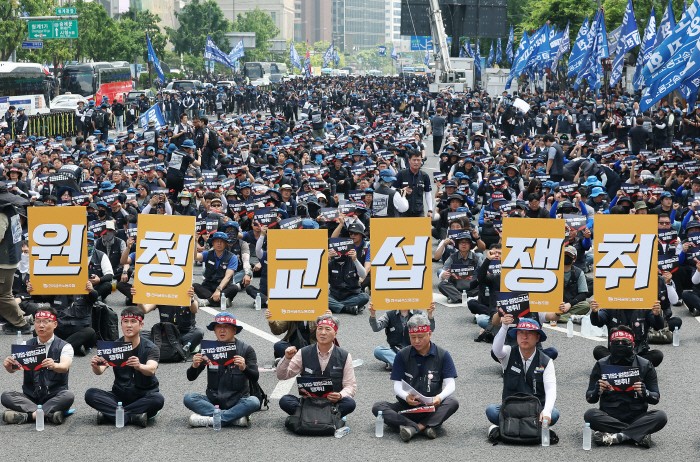 |
| Members of the Korean Metal Workers' Union hold placards and chant slogans during the "10,000 Cadres Resolution Rally" held near Gwanghwamun Square in Jongno-gu, Seoul, on June 10. / Photo by Yonhap News |
It is common in industrial sites for a prime contractor to control workplace access or mandate the use of protective gear to ensure the safety of subcontracted workers. Coordinating production schedules and managing workflows through integrated computer systems to meet deadlines and quality standards are also standard practices in typical subcontracting transactions. However, following the implementation of the revised Trade Union Act, commonly known as the Yellow Envelope Act, concern is growing that such management actions by prime contractors could be used as grounds to establish their status as an "employer" in relations with subcontracted unions.
According to labor and management circles on June 21, just three months after the Yellow Envelope Act took effect, confusion is intensifying across industrial sites regarding the criteria for determining a prime contractor's employer status and the scope of bargainable agendas. While the amendment aims to guarantee the bargaining rights of subcontracted and indirectly employed workers, critics on the ground point out that the boundaries of what constitutes "substantial control" by a prime contractor remain highly ambiguous.
According to the Ministry of Employment and Labor, as of June 5, subcontracted unions across 1,937 subcontractors have demanded bargaining from 431 prime contractors. Among these, 37 sites have voluntarily entered the unified bargaining channel process, while 123 are undergoing procedures with labor relations commissions. The remaining 271 sites have seen no further procedural progress since the initial bargaining requests.
The biggest bone of contention is the scope of a prime contractor's employer status. The revised Trade Union Act defines an employer to include anyone in a position to exert substantial and concrete control or decision-making power over working conditions. Crucially, because prime contractors bear safety obligations under the Serious Accidents Punishment Act and the Occupational Safety and Health Act, they have no choice but to instruct subcontracted workers to adhere to safety standards, control facility access, and wear personal protective equipment. The problem is that if these safety management measures are utilized as grounds for establishing employer status under the Trade Union Act, faithful compliance with one law could create legal risks under another.
"There are many situations where a prime contractor must issue immediate, real-time instructions regarding safety standards, access control, or protective gear," pointed out Kim Deok-ho, a professor at Sungkyunkwan University. "A contradiction arises where such actions are used as evidence to determine employer status under the Trade Union Act. This could inadvertently create a counter-incentive, leading companies to become passive about safety management."
The business community shares the same concerns. Hwang Yong-yeon, an executive director at the Korea Enterprises Federation (KEF), stated, "We are seeing rulings from labor relations commissions that recognize the employer status of prime contractors, focusing heavily on occupational safety issues. If fulfilling statutory safety obligations is evaluated as a criterion for employer status, a contradiction arises where faithful compliance with the law translates into another legal risk."
The potential expansion of bargaining agendas presents an additional burden. While the current dispute primarily centers on whether a prime contractor qualifies as an employer, future conflicts are expected to escalate over which specific agendas the prime contractor is required to negotiate. Concerns are mounting that not only production planning, deadlines, and task assignments, but also executive decisions—such as the introduction of AI automation, performance-based pay restructuring, and corporate downsizing—could become subjects of collective bargaining and industrial action on the grounds that they impact working conditions.
"Today, nearly every managerial decision is directly or indirectly linked to working conditions," Professor Kim said. "If issues like AI automation, performance-pay restructuring, and corporate downsizing arise, an all-out war surrounding managerial prerogatives could intensify." He added, "The clock of technology and management ticks rapidly, and if every single decision must be brought to the bargaining table, it could severely slow down corporate responsiveness."
Kim Nam-hyung
Most Read
-
1
Trump demands rates fall below 1% as Fed hikes for..

-
2
Celltrion seeks rheumatoid arthritis indication ex..

-
3
Chinese e-commerce giants AliExpress, Temu and She..

-
4
Trump warns countries not helping U.S. must pay re..

-
5
Turkish Airlines named main club partner of Liverp..

-
6
China expels No. 2 military official Zhang Youxia..

-
7
Houthi rebels release video claiming downing of Sa..

PEOPLE







-
Address : In-Young Bldg., 34, Uisadang-daero 1-gil, Yeongdeungpo-gu, Seoul
Copyright by ASIATODAY CO., LTD. All rights resereved