



Encephalitis virus detected in Daegu prompts nationwide alert
Jun 18, 2026, 11:40 am


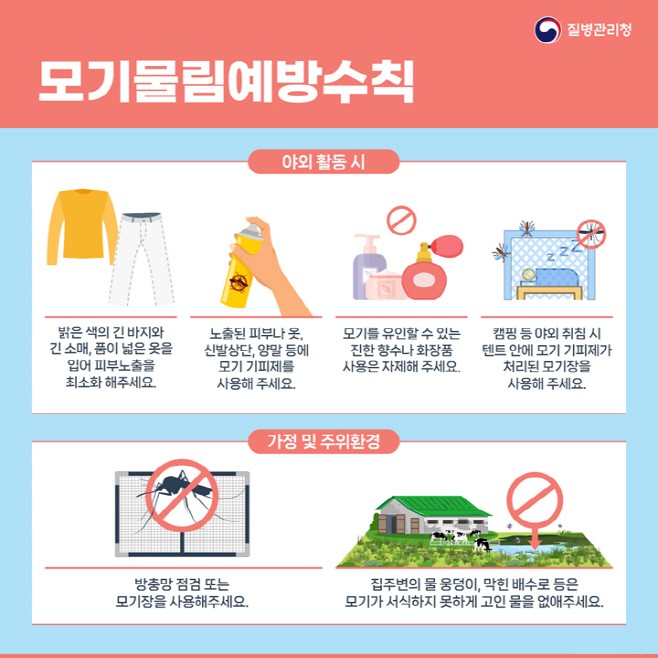 |
| Guidelines for preventing mosquito bites. / Poster courtesy of the Korea Disease Control and Prevention Agency (KDCA) |
Health authorities issued a nationwide Japanese encephalitis alert after the virus's genetic material was detected in Daegu.
According to the Korea Disease Control and Prevention Agency (KDCA) on June 17, a Japanese encephalitis alert is triggered when: the daily average number of Culex tritaeniorhynchus (the primary vector mosquito) collected twice a week reaches 500 or more and accounts for more than 50 percent of the total mosquito population; the Japanese encephalitis pathogen is isolated or its genetic material is detected from collected mosquitoes; or a confirmed case of Japanese encephalitis occurs.
To prevent infections, the KDCA has been monitoring vector mosquitoes since 1975, and this year’s surveillance project runs from March to October across 14 sites nationwide. Recently, in cooperation with local government institutes of public health and environment, the agency strengthened its pathogen surveillance by expanding its monitoring targets to include Culex pipiens alongside the primary Culex tritaeniorhynchus vector.
The newly detected virus was confirmed in Culex pipiens, a species that primarily inhabits small pools of stagnant water rich in organic matter in urban areas, such as septic tanks and artificial containers.
The initial symptoms of Japanese encephalitis are mild, including fever, headache, and vomiting. In rare cases, however, the infection can progress to encephalitis, leading to high fever, seizures, confusion, convulsions, and paralysis, with 20 to 30 percent of these severe cases resulting in death. For those who experience encephalitis, 30 to 50 percent suffer from various neurological complications even after recovery, depending on the site of brain damage.
South Korea records an annual average of about 17 Japanese encephalitis cases, with the first patient usually reported between August and September and cases continuing through November. Looking at the characteristics of the 79 patients reported over the past five years, men accounted for 60.8 percent, and 65.9 percent of all patients were aged 60 or older.
Noting that an effective vaccine is available, the KDCA advised that children eligible for the national immunization program (those born in or after 2013) should receive their shots in accordance with the standard vaccination schedule.
"With the virus detected and the nationwide alert issued, people must strictly follow guidelines to prevent mosquito bites, and eligible children must receive their mandatory vaccinations," Lim Seung-kwan, Director of the KDCA, said. "Local governments should strengthen comprehensive pest control efforts—prioritizing larvicide treatment in urban stagnant water where vector mosquitoes breed, and combining it with adult mosquito control around their resting spots—to thoroughly manage the situation and minimize patient occurrences."
Seo Byung-ju
Most Read
-
1
Trump demands rates fall below 1% as Fed hikes for..

-
2
Celltrion seeks rheumatoid arthritis indication ex..

-
3
Chinese e-commerce giants AliExpress, Temu and She..

-
4
Trump warns countries not helping U.S. must pay re..

-
5
Turkish Airlines named main club partner of Liverp..

-
6
China expels No. 2 military official Zhang Youxia..

-
7
Houthi rebels release video claiming downing of Sa..

PEOPLE






-
Address : In-Young Bldg., 34, Uisadang-daero 1-gil, Yeongdeungpo-gu, Seoul
Copyright by ASIATODAY CO., LTD. All rights resereved