



Drugmakers expand convenience race with weekly growth hormone injections
Jun 18, 2026, 09:46 am


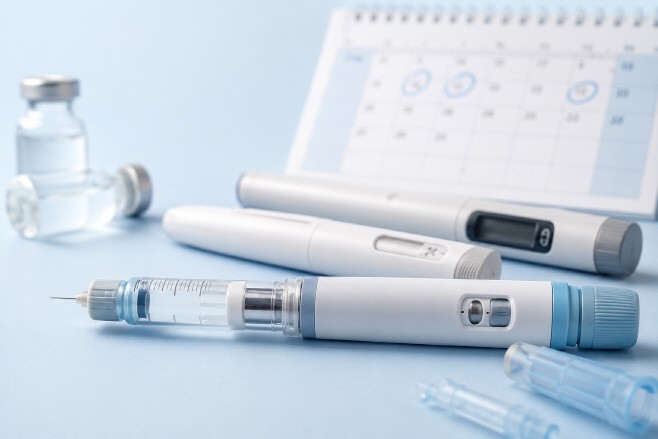 |
This image was generated by AI.
The axis of competition in the domestic growth hormone market is shifting from therapeutic efficacy to convenience of administration. As reducing the burden on patients and caregivers has emerged as a core competitiveness due to the nature of long-term treatment continuing over several years, domestic and foreign pharmaceutical companies are also accelerating efforts to extend administration cycles and advance injection devices.
According to the industry on June 17, long-acting formulations administered once a week have recently been attempting to enter the domestic growth hormone market. Novo Nordisk's 'Sogroya' was launched with insurance coverage last May, initiating a full-scale market push. Sogroya is a growth hormone formulation used for the treatment of pediatric and adult growth hormone deficiency, and is a product that is self-administered once a week.
Currently, the domestic market is led by LG Chem's 'Eutropin' and Dong-A ST's 'Growtropin.' Eutropin requires administration 3 to 6 times a week, and Growtropin requires 5 to 7 times. Since these products must be self-administered at home on schedule, the burden on patients and caregivers is not small. In particular, because treatment often lasts for several years, medication compliance is cited as a crucial factor determining the success or failure of the therapy.
Accordingly, attempts to extend the administration cycle have continued from before. LG Chem had already launched 'Eutropin Plus,' the first once-weekly administration growth hormone formulation in Korea, in 2009, and in 2023, Pfizer's 'Ngenla' was launched to target the market once again. However, these products, which received high attention at the time of launch, have all trodden the path of withdrawal from the market. This was because they failed to expand market share in a market where children are the main user base due to greater pain during administration compared to existing products.
Sogroya, unlike previous long-acting formulations, features a reduced injection volume and improved convenience of administration. Consequently, attention is focused on whether it can become the first once-weekly formulation to successfully establish itself in the market. However, whether it can prove its competitiveness to surpass domestic products, which are relatively inexpensive in the non-reimbursed market, remains to be seen.
While once-weekly formulations aim for market establishment, domestic companies are enhancing their competitiveness in medication compliance by improving devices. LG Chem recently launched 'Eutropin Ecophen 48,' a product featuring replaceable injection liquid cartridges. Unlike integrated cartridge products, it allows users to reuse the device multiple times simply by replacing the cartridge. It introduced a spring-based semi-automatic injection method so that even children with weak strength can self-inject, and increased convenience by applying a residual-matched dose setting function.
Dong-A ST also launched 'Growtropin-II Pen,' a digital pen-type growth hormone. The advantage of Growtropin-II Pen is that it applies an electronic driving method to enable precise dose adjustment in units of 0.2 IU. The set dose and remaining dose can also be checked through the OLED display window. At the start and end of administration, voice guidance along with vibration alerts operate, allowing users to intuitively perceive whether the administration is in progress.
An industry official said, "Due to the characteristics of the treatment, once a prescription begins in the growth hormone market, product changes are not frequent," adding, "For a new product to establish itself in the market, it will need a process of securing trust by accumulating long-term prescription experience in addition to improving convenience."
Bae Da-hyun |
Most Read
-
1
Kia Sportage outperforms Mazda CX-5 in German auto..

-
2
Houthis launch successive attacks on Saudi airport..

-
3
Saudi Arabia, Iran hold first diplomatic talks to..

-
4
U.S. deploys carrier, 10,000 more troops to Middle..

-
5
Saudi airport in Riyadh struck again, leaving at l..

-
6
Putin's ally visits China on the 8th ahead of APEC..

-
7
Chinese military support and training center opens..

PEOPLE





HEADLINE NEWS

-
Address : In-Young Bldg., 34, Uisadang-daero 1-gil, Yeongdeungpo-gu, Seoul
Copyright by ASIATODAY CO., LTD. All rights resereved