



[Exclusive] Dong-A Pharmaceutical launches dedicated open innovation unit for OTC and health supplements
Jun 17, 2026, 11:05 am


 |
Dong-A Pharmaceutical has established a dedicated unit tasked with sourcing external technologies and ingredients, embarking on building an open innovation framework across consumer healthcare sectors, including over-the-counter (OTC) drugs and health functional foods. The strategy signals a shift away from its historically self-reliant, in-house R&D model to scale up external partnerships, thereby securing differentiated ingredients and technologies while expanding the scope of collaboration from health supplements to OTC drugs and quasi-drugs.
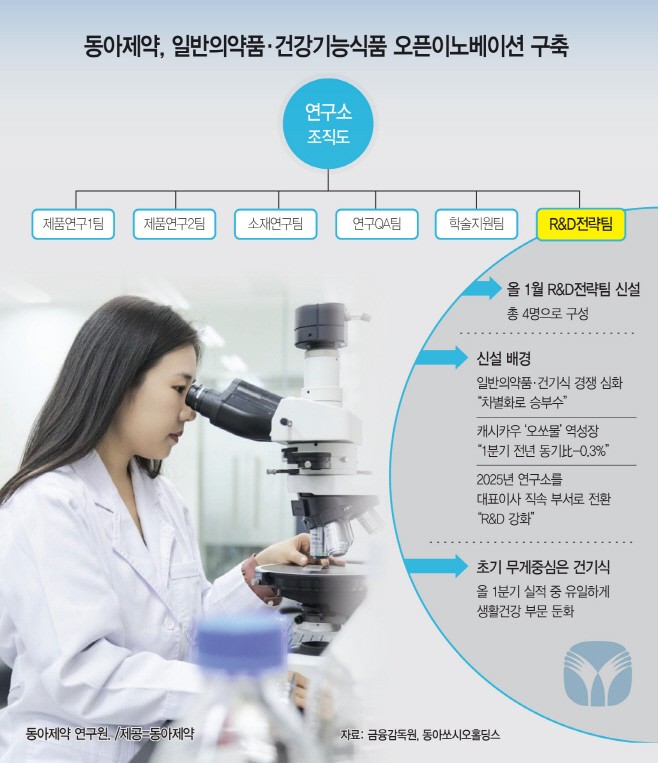
According to industry sources, Dong-A Pharmaceutical established the "R&D Strategy Team" within its research institute in January this year and began building a framework for sourcing external technologies and ingredients. The company finalized its recruitment process by late April to form a four-member team, which is currently focusing on laying the groundwork for open innovation partnerships.
The R&D Strategy Team is responsible for scouting and evaluating external technologies and ingredients, as well as driving joint research and technology licensing. Its core mandates include formulating research strategies through internal and external environmental analysis, discovering new projects, and managing the open innovation framework. The team is currently led by the head of the Product Research Team in a concurrent role, while the entire research institute is overseen by Executive Director Yoon Chun-hee.
"The R&D Strategy Team was established to bolster competitiveness and expand the portfolio across consumer healthcare, which encompasses our core businesses such as quasi-drugs, OTC drugs, and health functional foods," a Dong-A Pharmaceutical official said. "We are focusing on securing a mid-to-long-term research portfolio for future growth and building collaborative frameworks for joint research and technology sourcing."
The creation of this new unit is viewed as an extension of the R&D organizational restructuring that Dong-A Pharmaceutical has been pursuing since last year. In April last year, the company placed its research institute directly under the CEO—moving it from under the Development Strategy Office—to streamline its decision-making structure. The Academic Support Team was also transferred to the research institute, and a separate Research QA Team was formed in June of the same year. Currently, the research institute operates under a six-team system, including the R&D Strategy Team, Product Research Teams 1 and 2, the Material Research Team, the Academic Support Team, and the Research QA Team.
Intensifying competition in the health functional food and OTC markets is driving Dong-A Pharmaceutical’s push for a dedicated open innovation unit. The company determined that accelerating decision-making and expanding external networks are essential to rapidly discover and introduce unique technologies and ingredients. According to the Ministry of Food and Drug Safety, the number of registered distributors specializing in health functional foods stood at around 5,630 as of 2023, a 73% surge compared to 2019. Industry insiders note that amid this influx of market players, only products with highly differentiated ingredients and proven functionality can maintain a competitive edge.
Industry analysts also interpret the organizational move as a countermeasure against saturation in the health supplement market and decelerating growth of the company's flagship brands. Through a partnership with Germany's Orthomol, Dong-A Pharmaceutical launched "Orthomol Immun" in Korea in 2020, capturing leadership in the premium vitamin market. While Orthomol maintained the top market share in the domestic multi-vitamin sector for three consecutive years, its sales last year dipped 8.3% year-on-year to 119.4 billion won. Its first-quarter sales this year also edged down 0.3% year-on-year to 30.1 billion won, indicating stalled growth.
This trend is reflected in Dong-A Pharmaceutical’s first-quarter performance by business segment this year. Backed by new product rollouts and brand extensions, the Bacchus and OTC divisions grew 11% and 17.3%, respectively. Conversely, the Health & Technology Care (HTC) division, which manages health supplements, was the sole business segment to post a decline, shrinking 2.1%. Consequently, industry experts anticipate that Dong-A Pharmaceutical will initially anchor its open innovation efforts on the health supplement sector to accelerate the discovery of new brands and distinctive products.
"It is highly unusual in the domestic industry to operate a dedicated open innovation unit focused primarily on over-the-counter drugs and health supplements rather than prescription pharmaceuticals," an industry insider commented. "Proactively securing external technologies and ingredients will position the company to strengthen its market dominance and secure an unrivaled competitive edge."
Kang Hae-won
Most Read
-
1
Kia Sportage outperforms Mazda CX-5 in German auto..

-
2
Houthis launch successive attacks on Saudi airport..

-
3
Saudi Arabia, Iran hold first diplomatic talks to..

-
4
U.S. deploys carrier, 10,000 more troops to Middle..

-
5
Saudi airport in Riyadh struck again, leaving at l..

-
6
Putin's ally visits China on the 8th ahead of APEC..

-
7
Chinese military support and training center opens..

PEOPLE






HEADLINE NEWS

-
Address : In-Young Bldg., 34, Uisadang-daero 1-gil, Yeongdeungpo-gu, Seoul
Copyright by ASIATODAY CO., LTD. All rights resereved