



AI-generated artwork hangs in art museums
Jun 16, 2026, 02:09 pm


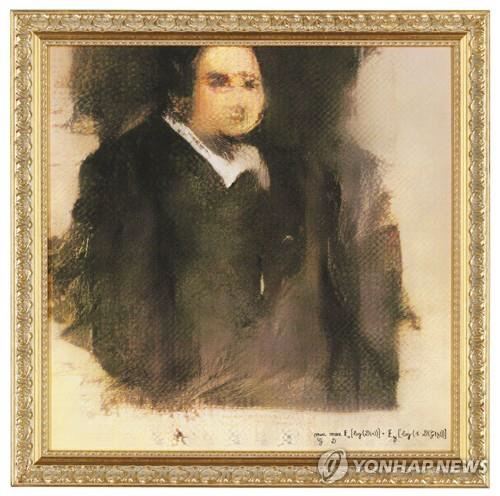 |
| "Edmond de Belamy," an AI-generated portrait auctioned at Christie's New York in 2018. / Photo courtesy of AP, Yonhap News Agency |
An unprecedented scene unfolded at a Christie's auction in New York in October 2018. "Edmond de Belamy," a portrait generated entirely by Artificial Intelligence (AI), was knocked down for a staggering $432,500 (approximately 500 million KRW). Fetching over 40 times its initial estimate, the piece was recognized as the first AI-generated artwork ever sold by a major global auction house.
While considered an experimental phenomenon at the time, AI art is now entering a brand-new phase. On June 20 (local time), Dataland, the world's first museum dedicated entirely to AI art, will officially open its doors in Los Angeles. Founded by media artist Refik Anadol and his colleague Efsun Erkilic, the museum is designed as a space exclusively for exhibiting generative AI creations and digital art. Its inaugural exhibition, "Machine Dreams: Rainforest," will showcase a virtual rainforest realized by an AI system that has processed vast amounts of natural datasets regarding climate and vegetation.
AI art has already emerged as a central talking point in the global art market. At this year's Art Basel Hong Kong, numerous pieces utilizing AI and media art were introduced, expanding relevant academic and critical discourse. Leading galleries and institutions are also consecutively presenting AI-driven works, exploring the boundaries of this novel artistic medium. Independent curator Lee Jin-young noted, "While it is difficult to see AI becoming the market mainstream within a short period, the reception in Hong Kong this year was significantly positive," adding that "the art market is ultimately moving in a direction that absorbs new technologies."
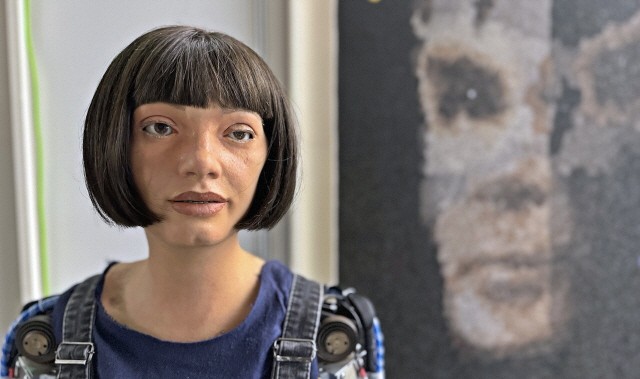 |
| Humanoid robot artist Ai-Da stands alongside her portrait painting titled "A.I. God." / Photo courtesy of EPA, Yonhap News Agency |
Examples demonstrating the market viability of AI art have also emerged. "A.I. God," a portrait of mathematician Alan Turing created by the humanoid robot artist Ai-Da, was knocked down for approximately $1.32 million (about 1.8 billion KRW) at a Sotheby's auction in the United Kingdom in 2024. This figure exceeded seven times its initial estimate. Since then, Ai-Da has continuously participated in major auctions and art fairs, frequently cited as a representative case of AI art.
The utilization of AI is also expanding rapidly within the domestic sector. However, professionals evaluate that the domestic market has not yet reached a stage where AI artworks themselves are actively traded, unlike overseas markets. Son Yi-cheon, senior auctioneer at K Auction, remarked, "It is difficult to say that a substantial demand for AI art has been established in the domestic auction market yet," adding that "at present, the emphasis is placed on topicality rather than marketability."
The attitude of artists is also more complex than anticipated. Contrary to some concerns, a significant number of artists are already actively leveraging AI in their creative processes. AI is establishing itself as a new tool across diverse domains, including image research, data collection, ideation, and video production.
Seo Jin-soo, director of the Art Market Research Institute, suggests that AI should be viewed as an industry-wide shift rather than an issue confined strictly to artistic creation. He noted, "Just as IT altered the art market, education, and distribution structures in the past, AI will likewise impact the art world as a whole," emphasizing that "what matters is not the technology itself, but how it is utilized."
In fact, AI is growing its presence within actual exhibition spaces. Early this year, the Museum of Applied Arts in Frankfurt, Germany, held a special exhibition titled "AI-Worlding," which explored the worldviews and social impacts generated by generative AI. Domestically, an exhibition by the French creative collective Obvious was held last year at Sun Gallery in Insa-dong, Seoul, drawing considerable attention. Obvious produced surrealistic landscapes and portraits by combining brainwave data measured via MRI with AI.
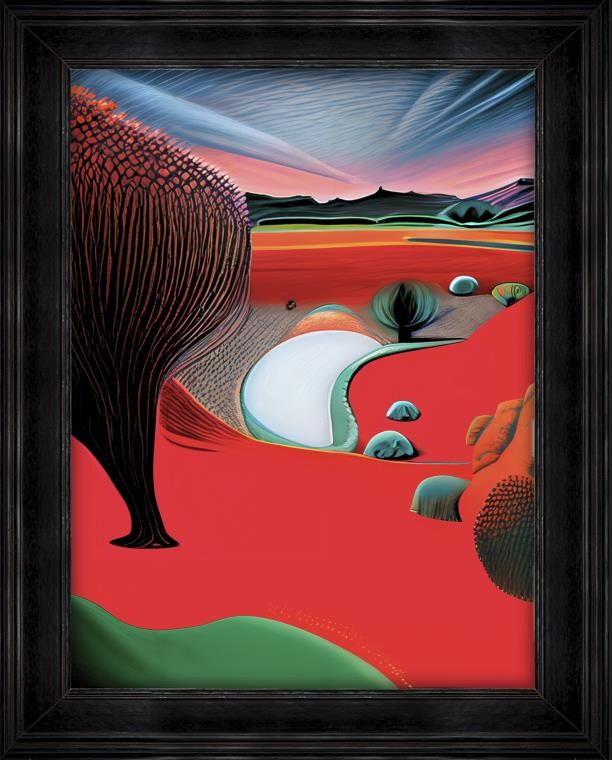 |
| "Iron Vines" by the French AI art collective Obvious. / Photo courtesy of Sun Gallery |
Refik Anadol also held his first solo exhibition in Asia during the 2024 inaugural show at Futura Seoul in Jongno-gu, Seoul, presenting immersive pieces driven by data and AI. The exhibition drew significant attention at the time, introducing domestic audiences to the potential of art utilizing data and AI.
However, controversies persist. The most critical issue revolves around copyright. Continuous concerns are raised that generative AI might violate the rights of original creators, given that it produces outcomes by learning from existing images and artworks. In fact, when Christie's proceeded with an auction of generative AI-related works early this year, international artists launched a petition in opposition, raising copyright issues regarding the training datasets.
Curator Lee Jin-young pointed out, "It is essential to clearly disclose the sources of the data utilized by AI and to ensure appropriate processes of transformation," adding that "unless relevant regulations and standards are established, copyright disputes are bound to continue."
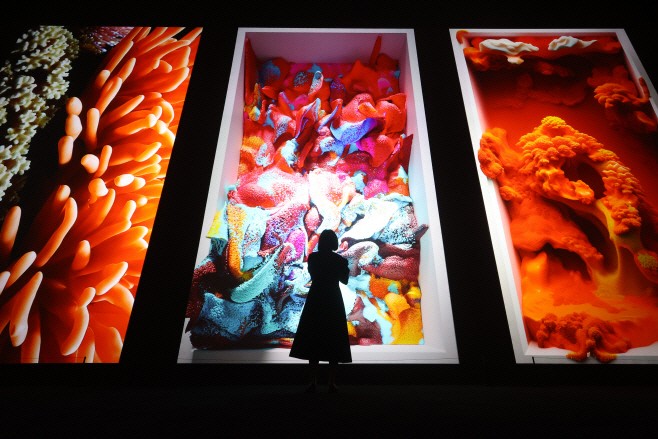 |
| The interior view of Refik Anadol's first solo exhibition in Asia, held at Futura Seoul in Jongno-gu, Seoul, in 2024. / Photo courtesy of Yonhap News Agency |
Jeon Hye-won
Most Read
-
1
Celltrion nears additional contract with major U.S..

-
2
Putin proposes trilateral U.S.-China-Russia summit..

-
3
"Aren't those foreigners on welfare?": M..

-
4
U.S. weighs dropping MOAB, world's most powerful n..

-
5
Houthis launch successive attacks on Saudi airport..

-
6
Saudi Arabia, Iran hold first diplomatic talks to..

-
7
Saudi airport in Riyadh struck again, leaving at l..

PEOPLE





HEADLINE NEWS
- [Exclusive] U.S. military steel frame work at Gwangju Airport casts cloud over planned semiconductor industrial complex
- Momentum grows for mid-next month U.S.-China-Russia summit with mounting is..
- Elon Musk formalizes review of SpaceX-Tesla merger
- [Exclusive] 10 SNUs pledged, but three regional universities take half the..

-
Address : In-Young Bldg., 34, Uisadang-daero 1-gil, Yeongdeungpo-gu, Seoul
Copyright by ASIATODAY CO., LTD. All rights resereved