



Oil prices hit 3-month low as US-Iran sign ceasefire MOU
Jun 16, 2026, 09:15 am


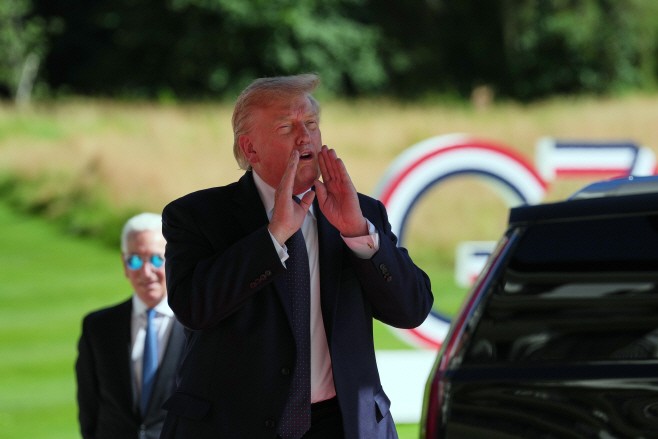 |
| U.S. President Donald Trump arrives in Évian-les-Bains, France, on June 15 (local time), where the Group of Seven (G7) summit is scheduled to take place. / Photo by AP-Yonhap |
The White House announced on June 15 (local time) that U.S. President Donald Trump, Vice President J.D. Vance, and Iranian Parliament Speaker Mohammad Bagher Ghalibaf electronically signed a memorandum of understanding (MOU) to end the war on June 14.
In conjunction with the official signing ceremony scheduled for June 19 in Geneva, Switzerland, the United States and Iran plan to reopen the Strait of Hormuz and lift the U.S. naval blockade. Following these steps, the two nations will enter a 60-day negotiation window to address Iran’s nuclear program and the easing of U.S. sanctions against Iran.
While international oil prices tumbled to a three-month low following the news, several flashpoints remain for the upcoming talks, including Strait of Hormuz transit fees, frozen assets, and the ongoing conflict on the Lebanese front.
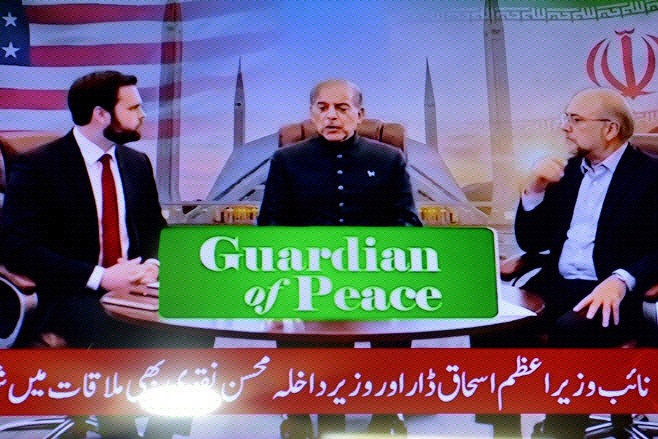 |
A television screenshot captured on April 11 (local time) shows U.S. Vice President J.D. Vance (left) and Iranian Parliament Speaker Mohammad Bagher Ghalibaf (right) holding peace talks at a hotel in Islamabad, Pakistan, mediated by Pakistani Prime Minister Shehbaz Sharif. / Photo by EPA-Yonhap Trump and Vance digitally sign US-Iran ceasefire MOU; Trump assures "Iran will not have nuclear weapons" |
U.S. President Donald Trump, speaking during a bilateral meeting with French President Emmanuel Macron at the G7 Summit in Évian-les-Bains, France, stated, "The agreement has already been signed, and the strait has already partially opened."
Vice President J.D. Vance also confirmed the development during an interview with ABC's Good Morning America, saying, "We already signed the agreement digitally yesterday." A senior U.S. official verified that President Trump and Vice President Vance digitally signed the MOU on June 14, with Speaker Ghalibaf signing on behalf of Iran.
President Trump emphasized that the most crucial aspect of this peace agreement is ensuring Iran will never possess nuclear weapons. He highlighted that Iran has fully agreed to this condition under stringent oversight authority.
Addressing concerns over why Iranian Supreme Leader Ayatollah Seyyed Mojtaba Khamenei did not sign the document, a senior U.S. official argued this is not unusual, pointing out that the Supreme Leader similarly did not sign the 2015 Joint Comprehensive Plan of Action (JCPOA) under the Barack Obama administration.
According to Vice President Vance and the Wall Street Journal, the official signing ceremony in Geneva on June 19 will be attended by Vice President Vance, Middle East Envoy Steve Witkoff, and President Trump's son-in-law Jared Kushner from the U.S. side, while Speaker Ghalibaf and Foreign Minister Abbas Araghchi will represent Iran.
Meanwhile, there was some conflicting information regarding the timing of the agreement's public release. A senior U.S. official mentioned it would be made public within 24 to 48 hours, whereas President Trump suggested the disclosure might take place after the signing ceremony on June 19.
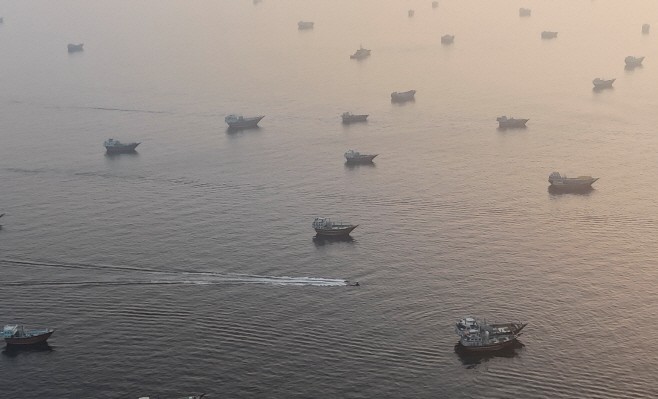 |
| Ships float in the Strait of Hormuz on June 15 (local time), as viewed from Musandam, Oman. / Photo by Reuters-Yonhap |
US-Iran MOU stipulates '60-day toll-free opening' of Hormuz; post-grace period transit fees remain unresolved
U.S. officials stated that the MOU explicitly stipulates the Strait of Hormuz will be reopened for 60 days without any transit fees. However, they acknowledged that subsequent discussions with Iran are required to determine the framework after this grace period.
While President Trump asserted that the strait would remain open and toll-free, Iran's semi-official Fars News Agency quoted a source reporting that Iran's right to collect fees after the 60-day window has been recognized.
Regarding the normalization of traffic through the strait, a senior U.S. official projected that while full normalization within two weeks is unlikely, there will be a substantial increase in vessel transits.
US denies pre-release of frozen assets; Lebanon withdrawal excluded
Meanwhile, the United States made it clear that it cannot release frozen Iranian assets simultaneously with the signing of the MOU. Vice President Vance stated that no money has been paid and this stance will not change, adding that sanctions relief would only become possible if Iran takes steps to handle its enriched uranium or permits a verification framework.
A senior U.S. official also noted that if Iran makes a few small gestures to demonstrate its commitment to fulfilling its promises, the U.S. will respond with minor reciprocal gestures early on. Conversely, Iranian Deputy Foreign Minister Kazem Gharibabadi stated that the 60 days of negotiations following the MOU signing depend on the implementation of lifting the U.S. naval blockade, terminating military operations, and unfreezing assets.
Iranian media mentioned a plan to release $12 billion in frozen assets immediately upon the MOU signing, with an additional $12 billion during the negotiation period, while Reuters reported that total frozen assets are estimated at around $100 billion.
Furthermore, a senior U.S. official confirmed that Israel's withdrawal from Lebanon is not included in the terms of the MOU. Israeli Prime Minister Benjamin Netanyahu defined the agreement as "Trump's decision" and declared that Israel will maintain its freedom of action to respond to threats.
Israeli Defense Minister Israel Katz stated that the Israel Defense Forces will continue their presence in southern Lebanon, Syria, and the Gaza Strip, compounding the uncertainties surrounding the implementation of the MOU.
Brent crude plummets 4.9%; New York dow hits all-time high
Following the news of the ceasefire MOU, international oil prices tumbled to their lowest levels since March 10. On the London ICE Futures Exchange, Brent crude for August delivery slid 4.9% from the previous trading day to settle at $83.2 per barrel.
On the New York Mercantile Exchange, West Texas Intermediate (WTI) for July delivery fell 4.8% to $80.75 per barrel. The Financial Times reported that the average retail gasoline price in the United States dropped to $3.99 per gallon, down more than 52 cents over the past month.
In the New York stock market, the Dow Jones Industrial Average rose 468.77 points, or 0.92%, to rewrite its all-time high. The S&P 500 Index surged 122.83 points, or 1.65%, and the tech-heavy Nasdaq Composite Index jumped 795.10 points, or 3.07%.
Ha Man-joo
Most Read
-
1
Trump shares map on social media labeling Strait o..

-
2
Kia Sportage outperforms Mazda CX-5 in German auto..

-
3
Houthis launch successive attacks on Saudi airport..

-
4
U.S. deploys carrier, 10,000 more troops to Middle..

-
5
Trump rejects Iran's offer to open Strait of Hormu..

-
6
N. Korea conducts first swarm attack drill with dr..

-
7
U.S.-China summit falls short on substance as Trum..

PEOPLE






HEADLINE NEWS
- Seoul dismisses Ukraine's claim of 'S. Korean support for Russia' as "inaccurate and inappropriate"
- S. Korea, Japan race to develop nuclear-powered submarines
- Henri Kagan, Kenso Soai win Nobel Prize in Chemistry for uncovering how mol..
- Vance says Alaska LNG cooperation will move forward with Seoul's current or..

-
Address : In-Young Bldg., 34, Uisadang-daero 1-gil, Yeongdeungpo-gu, Seoul
Copyright by ASIATODAY CO., LTD. All rights resereved