



Surging exchange rates and inflation rattle market rates, weighing on borrowers
Jun 12, 2026, 10:50 am


 |
| /Yonhap. |
With the high exchange rate phase of well over 1,500 won persisting long-term, borrowers are facing deepening anxiety. This comes as the rising won-dollar exchange rate fuels domestic inflation, heightening inflationary concerns, while the Bank of Korea has effectively taken a second-half base interest rate hike for granted, prompting a steep rise in market interest rates stimulated by this outlook.
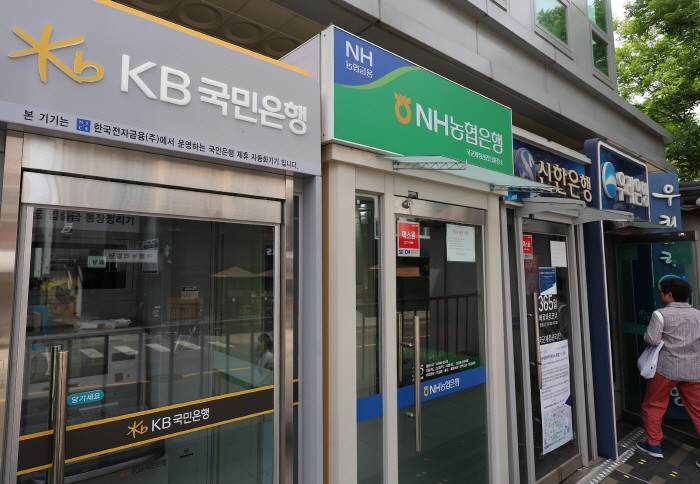
Major banks are also swiftly reflecting the rise in market interest rates into their lending rates. The upper bound of mortgage rates has surpassed 7.5%, and credit loan rates have surged to the mid-6% range, further compounding the interest burden on borrowers.
According to the financial sector on the 11th, the interest rates for flagship credit loan products (12-month bank bonds) at the five major banks (KB Kookmin, Shinhan, Hana, Woori, and NH Nonghyup) ranged from 4.59% to 6.20%. Compared to the 4.49% to 6.06% recorded on the 4th, the lower bound rose by 0.1 percentage point and the upper bound jumped by 0.14 percentage points. When contrasted with May 8th, when rates stood at 4.18% to 5.70%, the upper bound of the rate climbed by 0.50 percentage points in just one month. Over the same period, rates for 6-month credit loan products also rose from 3.86% to 5.37% to a range of 4.07% to 5.67%.
The upward trajectory of mortgage rates was equally steep. As of this date, the rates for the five major banks' flagship mortgage products applying a 5-year fixed rate recorded 4.49% to 7.51%, crossing the 7.5% threshold. This marks a 0.5 percentage point jump in just one month since the upper bound first hit the 7% mark on May 8th at 4.40% to 7.00%.
The sharp increase in lending rates is driven by the rise in market rates, such as bank bonds, which banks utilize as benchmark rates when pricing loans. According to the Korea Financial Investment Association’s bond information center, the yield on 12-month bank bonds (unsecured, AAA), used as the reference rate for credit loans, stood at 3.612% as of the 10th. This represents a 0.432 percentage point increase from the 3.180% recorded on the 8th of last month. Over the same period, 6-month bank bonds rose by nearly 0.3 percentage points from 2.835% to 3.118%, while 5-year bonds, used as the reference rate for mortgages, advanced by 0.347 percentage points from 4.019% to 4.366%.
The rise in market rates is heavily influenced by the exchange rate. With the war in the Middle East acting as a long-term uncertainty and foreign investors continuing their net selling streak in the domestic stock market, the won-dollar exchange rate has remained in the 1,500 won range for 18 consecutive trading days. A rising exchange rate pushes up import prices, which then feeds into domestic consumer prices, exerting inflationary pressure. In May, the consumer price inflation rate rose 3.1% year-on-year, crossing the 3% threshold for the first time in 26 months since March 2024.
Consequently, the Bank of Korea has effectively locked in a base rate hike for the second half of the year to counter inflation. Accordingly, the market expects that if upward inflationary pressures intensify, the BOK will either increase the magnitude of the rate hike or implement additional hikes more swiftly. Concerns are mounting that this scenario would not only push up lending rates for new loan products at commercial banks but also further weigh on the interest burden of existing borrowers.
"While short-term fluctuations in interest rates are common, a sustained upward trend like the current one is rare," a commercial bank official explained. "Following the Bank of Korea's signal for a rate hike, related indicators such as the rising exchange rate have aligned, driving market interest rates upward."
Chae Jong-il
Most Read
-
1
Celltrion’s Omlyclo gains ground in major European..

-
2
Trump demands rates fall below 1% as Fed hikes for..

-
3
Trump makes $1 trillion bet ahead of midterm elect..

-
4
Iran resumes ballistic missile production, assembl..

-
5
Samsung Electronics, Mistral AI to jointly develop..

-
6
Trump warns countries not helping U.S. must pay re..

-
7
Apple launches first foldable, 1 million won prici..

PEOPLE






HEADLINE NEWS
- Trump to roll out ‘unprecedented welcome’ for Xi with B-2 bombers, F-22 fighters
- S. Korea, U.S., and Japan form united front on Taiwan and economic coercion..
- Trump administration moves to impose sweeping sanctions on International Cr..
- Xi to make state visit to U.S. Sept. 23-25, dispelling rumors over his heal..

-
Address : In-Young Bldg., 34, Uisadang-daero 1-gil, Yeongdeungpo-gu, Seoul
Copyright by ASIATODAY CO., LTD. All rights resereved