



Vanishing social mobility: Widening asset, income gap hits youth
Jun 12, 2026, 10:10 am


 |
| / Getty Images Bank. |
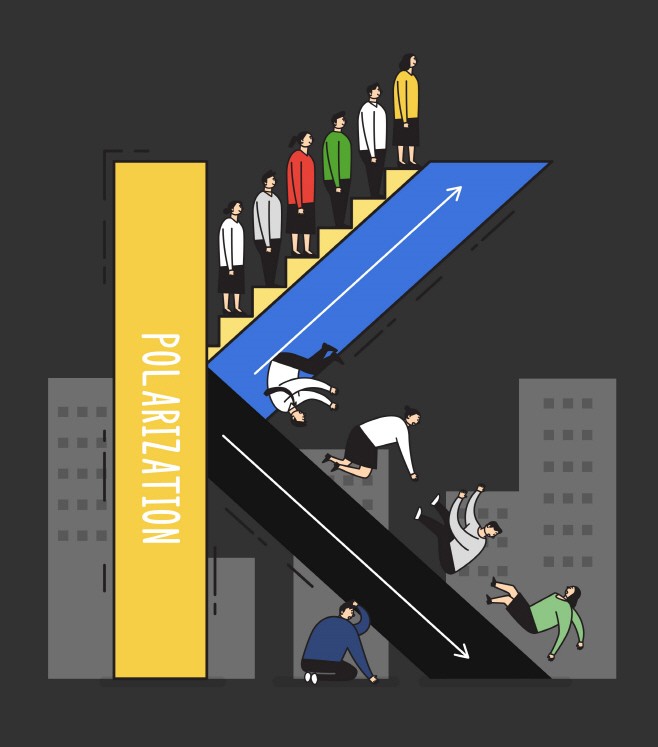
The Bank of Korea (BOK) warned that the South Korean economy is facing a "composite polarization" where gaps in both assets and income are widening simultaneously. According to the analysis, while surging real estate prices have widened the asset gap, the proliferation of artificial intelligence (AI) and divergent growth among industries are widening the income gap once again, eroding the economic standing of the youth and non-homeowners.
Researchers from the BOK Research Department delivered this diagnosis on the 11th in a BOK Issue Note titled "The Reality and Economic Impact of Household Polarization." According to the report, South Korea's net asset Gini coefficient had dropped to 0.584 in 2017, but subsequently reversed course to reach 0.625 last year. A Gini coefficient closer to 0 indicates equality, while a value closer to 1 signifies inequality.
Surging real estate prices were identified as the primary catalyst behind the widening asset gap. The report analyzed that real estate price appreciation is the core mechanism explaining the trajectory of the asset gap. In particular, it pointed out that as real estate assets become heavily concentrated among older demographics, generational asset polarization is becoming structurally entrenched.
Conditions for asset accumulation among the youth were found to be deteriorating. The report diagnosed that an increasing number of young individuals earn high incomes but fail to enter the upper asset bracket due to their lack of real estate ownership. Even when generating upper-middle-class income or higher, the mobility to transition into the top asset bracket is declining, signaling that the ladder for asset accumulation is weakening.
The income gap is also showing signs of re-widening. The income Gini coefficient based on disposable income had dropped from 0.353 in 2016 to 0.323 in 2023, but ticked up slightly to 0.325 in 2024. The report suggested that the income gap, which had previously improved due to redistribution policies, could widen again due to K-shaped growth across different industries.
Specifically, divergent growth between the IT and non-IT sectors was cited as a driving factor behind income polarization. While wages in the IT sector surged heavily, centered around performance bonuses, wage growth remained limited in other industries, thereby widening the inter-industry wage gap.
The proliferation of AI was also presented as a factor that could exacerbate the income gap in the future. The research team predicted that AI technology, coupled with advancements in robotics, has the potential to replace jobs held by low-income brackets and young workers in the early stages of their careers. A BOK Research Department AI survey also revealed that individuals in lower-income brackets perceive a higher likelihood of their own tasks being replaced by AI.
The fallout of this composite polarization was most pronounced among the youth. The proportion of individuals in their 20s and 30s among households ranked in the bottom 20% for both net assets and income surged significantly from 7.9% in 2020 to 15.2% in 2025. This indicates a strengthening trend where non-homeowning youth are being pushed down into the lower echelons of the economy.
The report pointed out that composite polarization could dampen overall economic productivity and consumption vitality. An analysis utilizing data from 120 countries revealed that when the share of assets held by the top 10% rises by 1 percentage point, total factor productivity drops by 0.16% two years later. South Korea's top 10% net asset share rose by 3.1 percentage points from 43.0% in 2022 to 46.1% in 2025, and the research team explained that a widening asset gap could act as a constraint on economic growth and productivity gains.
Social costs could also escalate. The asset and income polarization could lower expectations for social mobility, while weakening the incentive to work and undermining social trust. Furthermore, the housing cost burden on the youth is highly likely to act as a factor constraining marriage and childbirth.
The research team suggested that existing redistribution policies centered on income preservation have limitations in addressing composite polarization. They explained that household assets concentrated in real estate should be guided toward productive sectors, and opportunities for productive asset accumulation must be expanded to enhance capital efficiency.
They also argued for securing a stable tax base aligned with structural economic changes driven by technological advancement, and checking institutional frameworks to prevent the path of asset accumulation through labor income from deteriorating. In addition, they emphasized the need to strengthen the ecosystem for new growth industries to establish a foundation where the fruits of growth can diffuse across the wider economy.
Han Sang-wook
Most Read
-
1
Celltrion’s Omlyclo gains ground in major European..

-
2
Trump demands rates fall below 1% as Fed hikes for..

-
3
Trump makes $1 trillion bet ahead of midterm elect..

-
4
Iran resumes ballistic missile production, assembl..

-
5
Samsung Electronics, Mistral AI to jointly develop..

-
6
Trump warns countries not helping U.S. must pay re..

-
7
Apple launches first foldable, 1 million won prici..

PEOPLE






HEADLINE NEWS
- Trump to roll out ‘unprecedented welcome’ for Xi with B-2 bombers, F-22 fighters
- S. Korea, U.S., and Japan form united front on Taiwan and economic coercion..
- Trump administration moves to impose sweeping sanctions on International Cr..
- Xi to make state visit to U.S. Sept. 23-25, dispelling rumors over his heal..

-
Address : In-Young Bldg., 34, Uisadang-daero 1-gil, Yeongdeungpo-gu, Seoul
Copyright by ASIATODAY CO., LTD. All rights resereved